



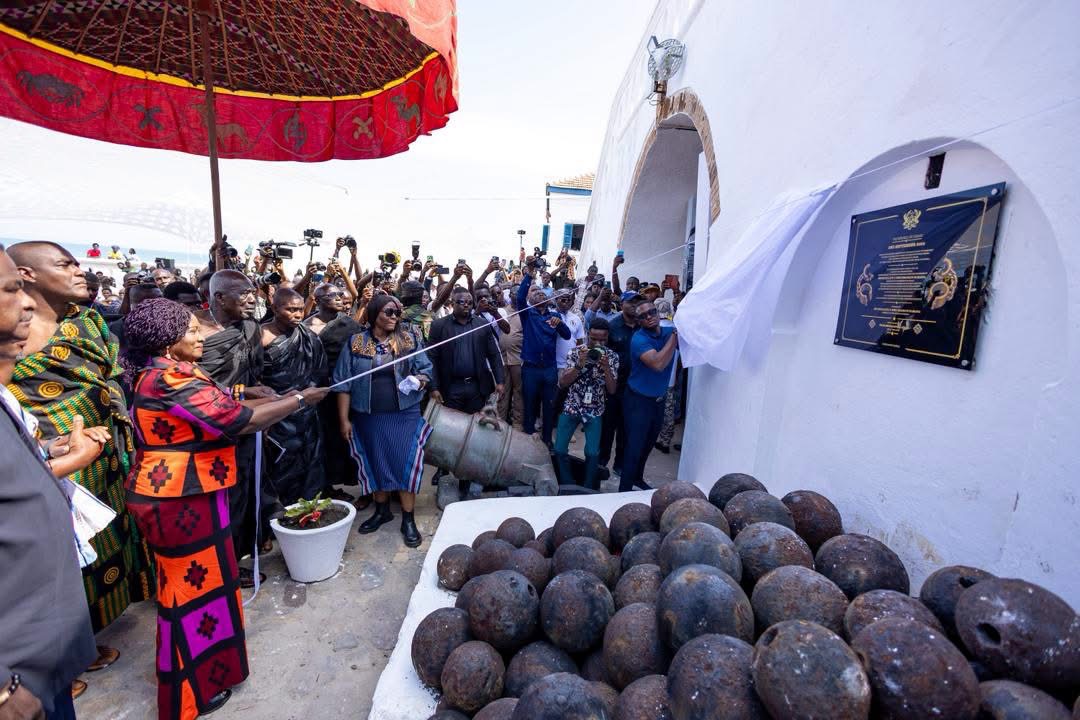
Vice President calls for honest preservation of history and renewed commitment to reparative justice as Cape Coast remembers victims of transatlantic slave trade
Cape Coast, Thursday, September 3, 2026 — Vice President Professor Naana Jane Opoku-Agyemang has joined the people of Oguaa, traditional leaders, and dignitaries for a solemn Slavery Memorial Service at the historic Cape Coast Castle, one of Ghana’s most significant sites associated with the transatlantic slave trade .
The memorial, held under the theme “From Memory to Momentum,” forms part of activities marking the 2026 Oguaa Fetu Afahye Festival and honoured the millions of Africans who suffered, resisted, and perished during the transatlantic slave trade .
A Historic Backdrop
The service took place within the walls of Cape Coast Castle, a structure that once held thousands of enslaved Africans in its dungeons before they were forced onto ships bound for the Americas. Cannonballs still rest nearby as silent reminders of the fort’s brutal past .
The Vice President was joined by Osabarima Kwesi Atta II, the Oguaamanhen (Paramount Chief of the Oguaa Traditional Area), along with other traditional authorities including His Royal Majesty Jira Yagbonwura Bii-Kunuto Jewu Soale I, Overlord of Gonja, and His Royal Majesty King Tackie Teiko Tsuru II, the Ga Mantse . The presence of traditional leaders from across the country underscored that the slave trade affected communities far beyond the coast, with slave routes reaching inland to places like Assin Manso, where captives took their last bath before the final march to the sea .
Call for Honest Preservation
Addressing the gathering, Professor Opoku-Agyemang emphasized Ghana’s duty to protect its historic forts, castles, and sites linked to the transatlantic slave trade .
“Cape Coast Castle and other forts, castles and sites must be fully preserved and honestly interpreted,” she stated. “Remembering the suffering is important, but we must also recognize the resistance and resilience shown by African communities” .
The Vice President stressed that preserving these sites is critical to ensuring that future generations understand the scale of the injustice and the experiences of Africans who suffered, resisted, and survived . She noted that the responsibility extends beyond simply maintaining the structures to accurately preserving and communicating the history attached to these locations .
“Our responsibility is equally important here at home,” she emphasized, calling attention to lesser-known locations such as Assin Manso, Sankana, and Golu, where evidence of resistance to enslavement survives in written records, architecture, oral accounts, and the landscape. She recounted encountering caves where communities sought protection from slave raiders and defensive walls constructed to keep them out .
“Our ancestors resisted enslavement in different ways. They were never simply passive victims of history,” the Vice President said, noting that Africans fought to preserve their freedom, escaped, and organized resistance against capture .
A Global Context
The memorial comes against the backdrop of the United Nations’ historic recognition of the transatlantic trafficking of enslaved Africans as the gravest crime against humanity—an international effort in which Ghana played a leading role .
Commemorative Plaque and Path Forward
During the service, the Vice President assisted in unveiling a commemorative plaque on the castle grounds, marking both the painful history and the country’s commitment to telling it truthfully for future generations . She linked the preservation of these sites to the broader reparatory justice agenda, emphasizing that historical understanding remains essential to strengthening ties between Africa and the diaspora .
“The history of the slave trade must not portray Africans solely as passive victims,” she said, calling for sustained international discussions on reparative justice. While acknowledging that centuries of injustice cannot be reversed, she noted that recognition of historical wrongs could create a shared understanding and provide a foundation for meaningful conversations on accountability, justice, and the way forward .
A Festival of Remembrance and Celebration
The Fetu Afahye Festival itself is one of the oldest and most important festivals on the Ghanaian calendar, commemorating the purification of the Oguaa community from a plague . Including a slavery memorial in the programme demonstrates how the community continues to hold space for difficult aspects of its past while celebrating the living culture of the present .
The grand durbar of the festival is set for Saturday, with the city already transformed into a vibrant display of colour, sound, and culture as thousands of revellers, traders, and artisans fill the streets . However, Thursday’s memorial service set a reflective tone for the week, serving as a powerful reminder of the history that continues to shape identities, relationships, and political questions today .
“Remembering the past must go beyond acknowledging suffering to also recognising resistance, resilience and the continuing consequences of the transatlantic slave trade,” the Vice President concluded. “We owe the past remembrance, and we owe future generations an honest account of the suffering, resistance and consequences associated with one of the darkest chapters in human history” .


