



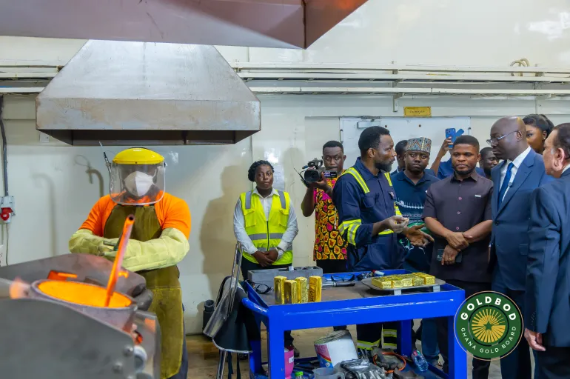
Ghana has taken a decisive step in its quest to transform its gold industry, with the Ghana Gold Board (GoldBod) enforcing a sweeping directive that requires certain gold exporters to refine their products locally before shipping them abroad. The policy, effective September 1, 2026, targets Self-Financing Aggregators (SFAs) who purchase gold doré under arrangements with approved offtakers, barring them from exporting unrefined gold.
A Historic Shift in Policy
The directive, issued by GoldBod’s Compliance Directorate on August 24, marks a fundamental change in how Ghana manages its most valuable natural resource. For decades, the country has exported semi-refined gold doré—a mixture of gold and other metals cast into bars after initial extraction—to overseas refineries, losing significant value in the process.
“Ghana is one of the top gold-producing countries in the world, so we need to truly maximise national benefits. Value addition is key,” said Prince Kwame Minkah, GoldBod’s media relations officer.
The policy stems from the Ghana Gold Board Act, 2025 (Act 1140), which established GoldBod as the sole authority overseeing the buying, selling, assaying, refining, and exporting of gold in Ghana, replacing the previous regulatory framework managed by the Precious Minerals Marketing Company. The Act also bars foreign traders from directly participating in the domestic small-scale gold market, reserving licensed activities for Ghanaian citizens and wholly-owned Ghanaian companies.
The Vision Behind the Policy
President John Dramani Mahama has set an ambitious target: by 2030, no mineral should leave Ghana in its raw form. Speaking at Zambia’s Parliament in February 2026, Mahama explained that the GoldBod reforms are central to Ghana’s “economic reset” agenda and a broader push for African sovereignty over natural resources.
“For the first time since independence, we have a government determined to make sure Ghana benefits from our biggest resource, gold,” said Clement Edem Asare Morjah, chief executive of United Gold International Limited, a licensed SFA.
The refining mandate is part of a wider strategy that includes requiring large-scale mining companies to sell 30% of their output domestically (up from 20%), effective July 2026, under a new sliding-scale royalty framework of 5% to 12%.
Ghana’s Gold Sector: A Booming Economic Engine
The timing of the policy is significant, coming on the heels of record-breaking gold performance. Ghana produced nearly six million ounces (about 187 tonnes) of gold in 2025, solidifying its position as Africa’s largest gold producer—well ahead of Mali (48 tonnes) and Burkina Faso (94 tonnes).
Gold exports earned the country approximately 4.2 billion) and crude oil ($3.7 billion)—and accounted for a remarkable 63.1% of total merchandise exports. The sector’s growth was driven primarily by a 63.8% surge in small-scale mining production to 3.1 million ounces, facilitated by GoldBod’s tighter regulation which channeled over 100 tonnes of small-scale gold into formal exports.
Domestic Refining Capacity and Challenges
Ghana currently has four licensed gold refineries: Gold Coast Refinery, Sahara Royal Gold Refinery, IPM KAL Ghana, and Royal Ghana Gold. However, GoldBod has so far announced supply agreements with only two of them:
· Gold Coast Refinery: Opened in 2016, with a capacity of up to two tonnes per week. GoldBod’s five-year agreement initially required one tonne of doré per week, though a March amendment reduced this to a one-tonne ceiling.
· Royal Ghana Gold Refinery: Commissioned in August 2024, with daily capacity of 400 kilograms. The plant required additional equipment before full operations could commence.
The Gold Coast Refinery’s refining fee stands at 0.3% of fine gold value—approximately $13.8 per ounce based on August 2026 prices—while major Swiss and South African refiners rarely disclose their fees, making direct comparisons difficult.
A significant challenge remains: no Ghanaian refinery currently holds accreditation on the London Bullion Market Association’s Good Delivery List, meaning some international banks may require additional testing or remelting before accepting Ghana-refined gold. Gold Coast is working with South Africa’s Rand Refinery to obtain this recognition.
Industry Reactions and Implementation
The directive requires SFAs to amend existing offtake agreements by August 31, with export applications only processed after GoldBod confirms local refining, settlement of applicable charges, and compliance with all regulatory requirements.
For industry insiders, the benefits extend beyond individual companies. “Once refined, gold becomes bullion that can meet recognised standards, making its quality and value more predictable,” Morjah explained. He added: “When you’re doing business, you don’t only think about your individual benefit as a company. You must think about the body corporate as a nation.”
GoldBod CEO Sammy Gyamfi emphasized the economic imperative behind the policy: “Purity is not a technical detail, it’s economic substance. When purity is not preserved, the final refined product can lose significant portions of its value. We cannot continue to export our gold at a loss”.
Enforcement and Future Plans
Non-compliance with the new directive could result in severe consequences, including refusal or suspension of export approvals, suspension or revocation of licences, administrative penalties, and other enforcement measures permitted under Act 1140.
GoldBod is also pursuing ambitious plans beyond refining, including developing a “gold village” modeled on Dubai’s Gold Souk, and establishing what Minkah described as “the largest refinery on the African continent”. The government’s broader strategy includes domesticating the processing of manganese and bauxite as well, ending the export of raw ores.
As Ghana’s gold industry enters this new era, the government is betting that value addition will create jobs, reduce outflows for foreign processing, and ultimately secure a brighter economic future. “Give it time,” Morjah said. “Everybody will understand the benefit”.


