



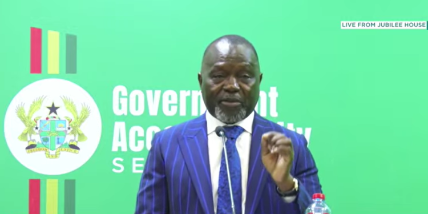
In a bid to end the protracted legal battles that have historically delayed the resolution of presidential elections, the government has accepted a constitutional reform that would compel the Supreme Court to determine election petitions within 30 days of filing, Attorney-General Dr. Dominic Ayine announced on Thursday.
Speaking at the Government Accountability Series, Dr. Ayine revealed that the proposed amendments also set a strict 14-day window for petitioners to file their challenges after the Electoral Commission (EC) declares results. The timelines, he said, are designed to inject certainty and finality into Ghana’s democratic transitions, reducing the political uncertainty that often accompanies disputed polls.
“On presidential election petitions, the government has accepted that a petition must be filed within 14 days of the declaration of results and determined by the Supreme Court within 30 days,” Dr. Ayine stated. “In other words, the Constitution will be amended to specifically provide for these timelines when it comes to the electoral petitions to be filed.”
A Response to Past Delays
The reform directly addresses criticisms that have mounted over successive election cycles. In the 2020 presidential election petition, for instance, the Supreme Court took nearly three months to deliver its final judgment—a period that left the nation in political limbo and strained public confidence. Similar delays have been observed in other jurisdictions, but Ghana’s proposed 30-day mandate would place it among the fastest in the world for appellate electoral rulings.
Currently, the Constitution provides no explicit deadline for the Supreme Court to rule on election petitions, leaving the timeline at the discretion of the justices. The new provision would constitutionalise a binding timetable, forcing the court to expedite hearings and limit interlocutory motions that have often stretched proceedings.
Mandatory Data Disclosure by EC
Beyond timelines, Dr. Ayine disclosed that the amendments would impose a constitutional obligation on the Electoral Commission to supply all relevant election data—including polling station results, voter registers, and biometric logs—to the court and all parties involved. This move is intended to ensure transparency and prevent disputes over access to evidence, which has been a recurring flashpoint in past cases.
“We take this position because the timely resolution of election disputes inures well to the stability of our democratic transitions and to the general political stability of our country and society,” the Attorney-General emphasised.
Part of Broader Constitutional Overhaul
The proposed changes are among a raft of recommendations from the Constitutional Review Committee (CRC), chaired by Professor H. Kwasi Prempeh, which was tasked with auditing the 1992 Constitution and proposing modernising reforms. The committee’s report, submitted earlier this year, also recommended taxing presidential salaries (as accepted by the government), limiting presidential pardons, and strengthening the independence of the judiciary.
The government’s acceptance of the petition timeline signals a strong political will to streamline electoral justice, though implementation will require a two-thirds parliamentary vote to amend the Constitution. If passed, the reforms would take effect for the next general election—likely 2028—though advocates have urged expedited passage to allow for procedural testing.
Implications for Political Stability
Political analysts have welcomed the move, noting that Ghana’s reputation as a beacon of democracy in West Africa has been occasionally tarnished by election-related litigation that drags on for months. By imposing a hard deadline, the reform could discourage frivolous petitions, as litigants would have less time to build weak cases, while also ensuring that aggrieved parties receive a swift judgment.
However, some legal practitioners have raised concerns about the practicality of a 30-day limit for complex cases involving thousands of polling stations. They argue that the court may need sufficient time to examine evidence thoroughly. Dr. Ayine did not address these concerns directly but assured that the details of implementation—including the court’s procedural rules—would be fine-tuned in the enabling legislation.
Next Steps
The government is expected to lay a Constitutional Amendment Bill before Parliament in the coming weeks. Meanwhile, the CRC’s broader recommendations—including those on presidential immunity, local government reforms, and judicial appointments—will continue to be debated as Ghana seeks to cement its democratic gains. For now, the proposed 30-day clock represents one of the boldest electoral reforms in the nation’s history, promising to turn the Supreme Court into a swift arbiter of the people’s will.


