



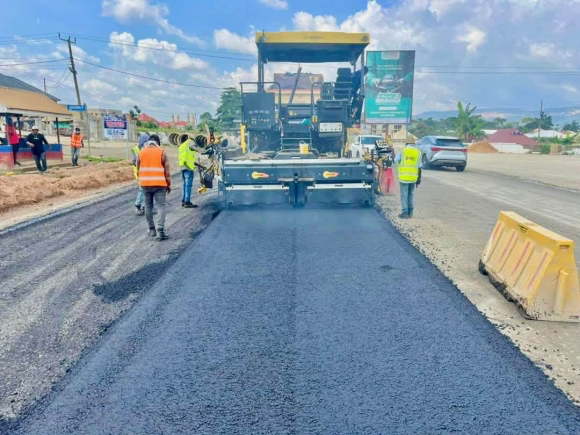
The Minister of Roads and Highways, Governs Kwame Agbodza, has announced plans to extend the one-year defect liability period in road contracts, arguing that the current framework allows contractors and consultants to escape accountability for poor workmanship on projects costing the state billions of cedis.
According to the Minister, the current practice of declaring contractors’ and consultants’ defect liability period over after just one year—after the government has paid billions of cedis on a road—must change. “If you build a road that should last 30 years, why is the liability of a contractor only ending after one year; it should go a bit more than that,” he said.
Engagements Underway with Finance, Works and Housing Ministries
Speaking during an inspection of ongoing construction works on the Accra-Kumasi N6 highway on Tuesday, September 29, Mr Agbodza said he was discussing with the Ministers of Finance and Works and Housing to change the one-year defect liability to make road contractors more accountable for the quality of roads they execute.
“After a road construction anything can go wrong but the idea that anytime we pay billions of cedis on a road and after one year we say that the defect liability period is gone and so if anything goes wrong it is not the fault of the contractor and the consultant must change,” he said.
Protecting Public Investment
The Minister said extending the liability period would help protect public investments in road infrastructure and encourage contractors to deliver durable and high-quality works. He said the move formed part of efforts by his ministry to enforce quality standards and ensure that contractors complied with the specifications of their respective projects.
“We are trying to make sure that they are going by the specifications. And we’ve had quite a few occasions where we are getting mistakes,” he said. In his view, a longer liability period would provide an additional incentive for contractors to pay greater attention to the quality and durability of their work.
A Long-Documented Problem
The push to extend the defect liability period follows years of documented failures in Ghana’s road construction sector. A 2024 study published in the International Journal of Building Pathology and Adaptation found that defects start showing in both buildings and roads within 12 months after being handed over for the client’s use. The study concluded that the 6–12 month defect liability periods existing in Ghana are inadequate and do not provide sufficient security to clients.
The research, conducted by Collins Ameyaw, Sarfo Mensah, Blondel Akun Abaitey and Anita Asamoah-Duodu, found low concordance among construction professionals that the existing defect liability periods were sufficient. The authors recommended that construction project clients include the tenderer’s proposed defect liability period as part of tender evaluation criteria to signal the quality of work to be delivered.
A History of Policy Reversals
This is not the first time a Roads Minister has attempted to reform the defect liability regime. In 2020, then-Minister Kwasi Amoako-Atta announced that road contractors would be made to maintain new roads they constructed for five years instead of the current one year. “The 12-months liability period for us, has existed all these while, gave a lot of people to slip through,” he said at the time.
Mr Amoako-Atta argued that roads, however poorly constructed, are likely to withstand shocks within 12 months, after which the government would be saddled with maintenance costs indefinitely. “You construct roads as a road contractor, you keep it for five years, so if you do poor work, it will be on your head for five years,” he warned.
That policy was to be implemented alongside the Output and Performance-Based Contract (OPBRC) model, under which the contractor designs, constructs and maintains roads over a minimum of five years. However, the one-year defect liability period has remained the standard practice, and it is unclear whether the 2020 directive was fully implemented across all road contracts.
High-Profile Project Failures
The need for reform has been underscored by several high-profile project failures. In July 2026, the National Democratic Congress in the Upper East Region called on the Ghana Highway Authority to direct contractors working on the Sumbrungu-Namong Road to rectify extensive defects that developed less than two years after completion. The approximately 11-kilometre road, undertaken under four contract lots with a combined value of GH¢50.83 million, began deteriorating rapidly after being handed over.
“The rapid failure of portions of this road raises serious and legitimate questions about the quality of workmanship, the materials used and adherence to approved engineering specifications during construction. This is unacceptable,” the NDC statement said.
The party called for the suspension of any interim payment certificates, completion certificates or other contractual payments until all identified defects had been satisfactorily rectified and independently certified.
In a separate case, the Roads Ministry initiated steps in May 2026 to recover approximately US158 million, but the contractor reportedly failed to execute the project as agreed.
The Minister described the development as “unfortunate” and revealed that the government was working closely with the Attorney-General’s Department to pursue legal action aimed at retrieving the funds.
In another case, the Minister ordered the termination of the Bogoso–Prestea road contract after the contractor, Black Oak, abandoned the site, claiming they had not received the road’s design. The contractor had received approximately GH¢66 million as mobilisation funds but failed to deliver work to the expected standard.
Consultants Also Under Scrutiny
The Minister’s proposal extends to consultants as well as contractors. Mr Agbodza has previously urged third-party consultants working on behalf of the Ministry not to connive with contractors to compromise quality standards. He said the government had decided that from the beginning of 2026, all road contracts awarded must ensure that agreements for consultancy and contractors were separate.
“We are trying to make sure that they are going by the specifications. And we’ve had quite a few occasions where we are getting mistakes,” he said, indicating that supervision gaps have contributed to substandard work.
Confidence in Local Expertise
Despite the challenges, the Minister expressed confidence in the capacity of Ghanaian engineers and contractors to design and execute road projects to international standards.
“I believe the Ghanaian engineer is actually a very good engineer. I don’t think there’s anything that we can’t design and build here,” he said. He pointed out that the government was relying on local expertise to deliver quality road infrastructure that would withstand the test of time and reduce the need for frequent repairs.
The objective, he said, was to ensure that completed road projects remained in good condition for longer periods, thereby enabling the government to direct limited resources towards expanding road infrastructure to other communities. “We are also trusting that we can do this and do a very high quality road that will last so that when we find more money, we can extend the road to other people,” he said.
Wider Accountability Drive
The defect liability reform is part of a broader push by the Minister to strengthen accountability in the road sector. He has warned that contractors can no longer rely on weak supervision or falsified reports to cover up poor performance, noting that citizens are now using mobile phones to document construction activities and relay them to government officials, including the President and the Ministry.
“No contractor working on any road in the country or Savannah will be tolerated for doing shoddy work,” he warned during a citizens’ engagement in the Savannah Region in May 2026.
The Minister has also criticised Regional Ministers and District Chief Executives for failing to report contractors who abandon projects. “I do not understand why you would sit quietly when contractors are not working instead of bringing the matter to my attention. Why should anyone be afraid of offending a contractor?” he asked during an inspection tour of the Oti Region.
What Happens Next
Mr Agbodza said the Ministry would continue to monitor construction works closely to ensure that contractors deliver value for money and that public funds invested in road infrastructure produce lasting benefits for motorists and communities. The government, he said, was determined to improve the quality of road infrastructure by strengthening supervision, enforcing specifications and promoting greater accountability among contractors.
The engagement with the Ministers of Finance and Works and Housing will determine the specific legislative or contractual changes required to extend the defect liability period. With the Accra-Kumasi Bypass targeted for completion by the end of 2027 and the wider Big Push programme progressing across all regions, the reform could have significant implications for how road contracts are structured and enforced in Ghana.


