



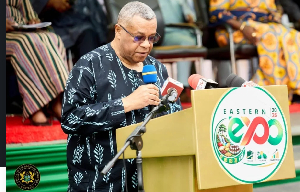
The Eastern Region is positioned to become one of the major anchors of Ghana’s second wave of industrialisation under the government’s 24-Hour Economy programme, according to Goosie Augustus Obuadum Tanoh, Presidential Adviser on the 24-Hour Economy and Accelerated Export Development.
Speaking on behalf of President John Dramani Mahama at the opening of the Eastern Expo 2026 in Koforidua, Tanoh said the policy is designed to shift Ghana from exporting raw materials to processing and manufacturing finished products for the domestic market and the African Continental Free Trade Area (AfCFTA). The Eastern Region, he said, would benefit significantly from investments in industrial parks, transportation infrastructure, agriculture, manufacturing and tourism.
Ending a Century-Old Pattern
Tanoh said the 24H+ Programme was intended to end the longstanding situation where Ghana exports raw materials and imports finished products, citing cocoa and timber as examples. “For a hundred years, we sold cocoa and bought back chocolate. We sold timber and bought back furniture. The 24H+ Programme is ending that pattern,” he said.
He said the government’s target was to reduce unemployment to below five per cent by 2035 while increasing manufacturing’s contribution to the national economy from about 10 per cent towards 20 per cent.
The Presidential Adviser has previously highlighted the scale of the challenge, noting that Ghana spent GH¢39 billion in 2024 importing food items such as rice, frozen chicken, sugar, cereals and animal offal—products the country has the capacity to produce locally. He also expressed concern that over 80 per cent of Ghana’s exports still consisted of three primary commodities, a pattern similar to that of the early 20th century when the country’s main exports were gold, timber and raw cocoa beans.
Volta Economic Corridor: 75 Districts, Ten in Eastern Region
Tanoh identified the Volta Economic Corridor as a major component of the programme, covering 75 districts, including ten in the Eastern Region. He said the corridor would link production centres in areas including the Kwahu Afram Plains, Asuogyaman, Manya, Kwahu East and South, Fanteakwa and Yilo Krobo to markets through improved transport infrastructure.
The programme will also leverage the new railway connection to Mpakadan and the Volta Lake Transport System to move agricultural and industrial goods. Tanoh said transporting goods by water was expected to reduce freight costs by as much as 60 per cent, allowing products such as fish from Asuogyaman and yam from the Afram Plains to reach Accra at more affordable costs.
He further said the Accra-Kumasi Expressway would strengthen the region’s position as a trade and production corridor, with interchanges planned at Adeiso, Asamankese, Akyem Oda and Ofoase. The 198.7-kilometre dual-carriageway is expected to turn the Eastern Region into a logistics hub, reducing the cost of doing business for manufacturers along the corridor.
Three Industrial Parks for Afram Plains
The Presidential Adviser disclosed that three industrial parks were being developed in the Kwahu Afram Plains under the 24H+ Programme. GB Foods, producers of Gino and Pomo tomato products, would anchor the food and beverage park, creating a market for locally produced tomatoes. According to him, the initiative could help address post-harvest losses while increasing agricultural productivity, noting that pilot farms operated by GB Foods had already increased tomato yields from about seven tonnes per hectare to 20 tonnes per hectare.
He added that two agroecological parks would be anchored by Pitiku and Africa Golden Foods, while Koforidua had been identified as a centre for regional garment manufacturing.
The Ghana Investment Promotion Centre has reported that the Eastern Region recorded 44 wholly Ghanaian-owned projects worth over US$1.9 billion across agriculture, manufacturing, services, tourism, construction and trade between 1994 and December 2025, alongside 164 foreign projects in similar sectors. The GIPC also highlighted pipeline projects including a National Poultry and Feed Corridor designed to break Ghana’s reliance on imported frozen chicken, a Kwahu Cassava Agro-Industrial Park targeting industrial starch and ethanol markets, and a pharmaceutical manufacturing cluster near Akabusi.
What the 24-Hour Economy Really Means
Tanoh explained that the 24-hour economy was not simply about factories operating at night but about removing the constraints that prevent businesses from expanding production. He said businesses would need reliable and affordable electricity, efficient supply chains, access to raw materials, safe transportation for night workers, working capital and trained workers. He added that access to large markets in Ghana, AfCFTA and beyond would be critical to enabling factories to move from one shift to second and third shifts.
The 24-Hour Economy Authority Bill was passed by Parliament on February 6, 2026, and signed into law by President Mahama on February 19, 2026. The government allocated GH¢110 million in the 2026 Budget to kickstart the programme, with resources expected to enable businesses to operate beyond traditional hours and attract private investment through partnerships with the Development Bank of Ghana and the Ghana Infrastructure Investment Fund.
The programme has mobilised approximately US11.5 billion project pipeline. Under Section 18 of the 24-Hour Economy Authority Act, 2026 (Act 1164), most projects are funded by private investors rather than public funds.
Tourism as an Export
Tanoh said tourism would also form part of the Eastern Region’s 24H+ economic activities, describing the sector as an export that generates income for local businesses. The Eastern Expo 2026, which runs from September 26 to October 3 at Jackson Park in Koforidua, is being held under the theme “Unlocking Opportunities for Sustainable Trade, Tourism and Investment” and is merged with Ghana’s World Tourism Day celebration.
The Eastern Regional Minister, Rita Akosua Adjei Awatey, has called for stronger public-private partnerships to unlock the region’s untapped agribusiness, tourism and trade potential. She explained that processing crops such as cocoa, oil palm, citrus, cassava and vegetables into finished products would help meet global standards and increase export potential.
Cautions Against Expecting Overnight Transformation
Tanoh has previously cautioned against expecting the 24-hour economy programme to transform the country’s industrial sector overnight. He said the initiative would not deliver overnight industrialisation and emphasised that the private sector would be central to its success. The 24-Hour Economy Secretariat has also clarified that the programme has not utilised part of the GH¢650 billion approved by Parliament over the past two years, and that its financing structure relies primarily on private investors, companies and cooperatives.
With the Eastern Region’s agricultural base—producing cocoa, maize, rice, oil palm, cassava, plantains, yam and various fruits and vegetables—and its strategic location between Accra and Kumasi, the region is positioned to play a central role in the government’s industrialisation agenda. The Eastern Expo 2026, which President Mahama is expected to attend, will serve as the first major showcase of the region’s potential as a production and export hub under the 24H+ Programme.


