



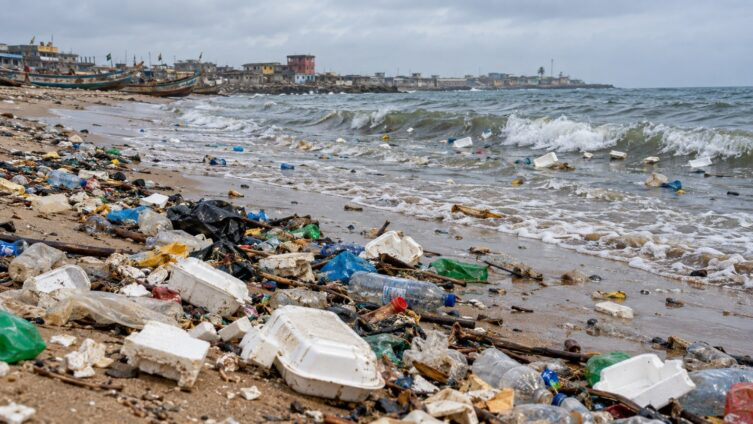
The waves crashing against Jamestown Beach carry more than just seawater and sediment. They deposit a visible reminder of Ghana’s mounting environmental crisis: thousands of fragments of white polystyrene foam, plastic bottles, sachets, and disposable containers tangled in the dark sand, stretching along the shoreline near the historic Gbetse Mantse Palace.
This scene, observed during a recent environmental communication workshop organized by the Environmental Protection Authority (EPA), Ignite Media, and KNUSTFORD University College, illustrates why Ghana has taken the decisive step to ban expanded polystyrene (EPS) products—commonly known as Styrofoam—beginning January 1, 2027.
A Nation Drowning in Plastic
Ghana’s environmental challenges form an interconnected crisis. Illegal mining, known locally as galamsey, continues to pollute rivers and destroy farmlands. Poorly planned settlements on waterways have increased flooding vulnerability. Meanwhile, inadequate waste collection has left plastic waste scattered across streets, beaches, markets, gutters, and water bodies.
The numbers paint a troubling picture:
· 840,000 tonnes of plastic waste generated annually in Ghana (UNDP Ghana, 2025)
· Only 9.5 per cent collected for recycling
· Just 33.4 per cent of households had their solid waste collected (2021 Population and Housing Census)
· 77.5 per cent of households without collection services resort to burning waste
· In urban areas, that figure rises to 88 per cent
These statistics reveal a fundamental gap in Ghana’s waste management infrastructure that the Styrofoam ban alone cannot address, but which it seeks to mitigate by reducing the volume of problematic materials entering the waste stream.
The Science Behind the Pollution
The workshop, part of the National Climate and Environmental Communication Initiative, brought together journalists, researchers, and communicators to bridge the information gap surrounding Ghana’s environmental challenges. Experts including Dr. Diana Afi Sebbie, Dr. Annie Owusua, Dr. Sarfo Yiadom, Dr. Godfred K. Teye, and Mr. Nathaniel Laryea addressed various aspects of environmental communication and plastic pollution.
What emerged from the sessions was a scientific framework for understanding why Styrofoam poses such a persistent environmental threat.
The Physics of Persistence
The law of conservation of mass dictates that matter does not simply disappear after disposal. For Ghana’s waste system, this principle can be expressed as:
Plastic entering the economy − (collected + recycled + properly disposed) = plastic in the environment
This means waste that escapes collection must end up somewhere—in dumpsites, gutters, water bodies, beaches, or the atmosphere through burning.
Styrofoam’s physical properties make it particularly problematic. Expanded polystyrene consists of a thin plastic framework containing a large volume of trapped gas, giving it an extremely low average density. According to Archimedes’ principle, this low density causes it to float easily on water.
F_b = ρ_water × g × V_displaced
Because Styrofoam’s average density is far lower than water’s, a discarded takeaway container can be transported by rainwater from a roadside into a gutter, through streams, and eventually into the ocean.
Newton’s second law (F = ma) further explains why lightweight plastics travel so far. With minimal mass, even small forces from wind or flowing water produce significant acceleration, making Styrofoam more likely to escape from waste collection points than heavier materials.
From Visible Waste to Invisible Threat
At Jamestown Beach, the visible pollution represents only part of the problem. Sunlight’s ultraviolet radiation weakens chemical bonds in plastic, while daily heating and cooling cycles cause expansion and contraction. Waves repeatedly strike plastics against sand and stones.
These processes cause fragmentation—the breakdown of larger plastics into smaller pieces. Critically, fragmentation is not biodegradation. The plastic does not vanish or return harmlessly to nature; its particle size simply decreases.
As fragments become smaller, their surface-area-to-volume ratio increases:
A/V = 3/r (for spherical particles)
This allows smaller particles to interact more extensively with water, sediments, and living organisms. The smallest fragments become microplastics, which are nearly impossible to remove completely from open marine environments. They can be ingested by fish and other organisms, allowing plastic pollution to enter food webs and eventually reach human consumers.
The Human and Institutional Failure
Standing at Jamestown Beach, the scale of the waste problem became clear: this is not merely the result of individual carelessness but a systemic failure involving consumption patterns, product design, waste collection infrastructure, public behavior, regulation, and environmental enforcement.
“The amount and spread of the waste pointed to a much wider failure,” said Petras Anaab Ali, a Physics graduate from the University of Ghana and Programme Officer at the EPA, who participated in the workshop. “While individuals must dispose of waste responsibly, the scale of the problem requires national attention and coordinated institutional action.”
This perspective challenges the common narrative that places blame solely on consumers. Producers determine what materials enter the market. Businesses decide packaging. Local authorities manage collection. Regulators establish and enforce standards. Consumers make disposal decisions within the infrastructure available to them.
Ghana’s Regulatory Response
Against this backdrop, Ghana’s decision to ban expanded polystyrene foam products represents a significant policy intervention. The EPA announced in May 2026 that the prohibition would cover production, importation, distribution, sale, and use of EPS products, subject to specified exemptions.
The ban, scheduled to take effect on January 1, 2027, follows years of advocacy from environmental groups and growing evidence of Styrofoam’s contribution to drainage blockage and flooding.
The Drainage Connection
During rainfall, the quantity of water passing through a drain per unit time is expressed as:
Q = A × v
Where Q is discharge, A is available cross-sectional area, and v is average flow velocity.
When plastic waste occupies part of a drain, the area available for water decreases. Tangled waste increases resistance and turbulence. Manning’s equation further describes how waste increases effective roughness and reduces hydraulic radius:
Q = (1/n) × A × R^(2/3) × S^(1/2)
The result: drains carry less stormwater, increasing flood risk. The World Bank has identified plastic waste as a material that clogs Ghana’s open drains (World Bank, 2020).
While flooding in Ghana has multiple causes—including intense rainfall, inadequate drains, construction on waterways, and poor planning—removing a lightweight material that contributes to drainage blockage reduces pressure on an already strained system.
The Climate Dimension
The climate impact of Styrofoam begins before it becomes waste. Polystyrene is produced primarily from petroleum and natural gas, requiring energy for extraction, refining, manufacturing, polymerization, and expansion into foam.
Zheng and Suh (2019) estimated that conventional plastics generated approximately 1.7 billion tonnes of carbon-dioxide-equivalent emissions in 2015 across their life cycles. Under business-as-usual scenarios, these emissions could reach 6.5 billion tonnes by 2050.
Open burning of plastic waste—prevalent in Ghana where collection coverage is limited—adds another dimension. When polystyrene burns, its carbon does not disappear. Under ideal conditions:
C_xH_y + O_2 → CO_2 + H_2O
However, open waste fires rarely provide controlled temperature and oxygen supply for complete combustion. They produce smoke, soot, carbon monoxide, and other pollutants. Black-carbon particles in soot absorb solar radiation and convert it to heat, transferring pollution from land to atmosphere while exposing nearby residents to unhealthy air.
Making the Ban Work
Supporting the ban does not mean ignoring its potential effects on businesses and consumers. Street food vendors, restaurants, manufacturers, and distributors need affordable alternatives.
The government must use the transition period to:
- Explain the law clearly in local languages
- Support local innovation in reusable and recyclable packaging
- Engage food vendors and small businesses on practical alternatives
- Establish environmental and food-safety standards for replacement materials
- Enforce regulations at ports, factories, and major distribution points
- Monitor consistently without political interference
- Measure periodically changes in litter, drainage waste, and market prices
Universities should conduct life-cycle assessments of proposed alternatives, comparing energy consumption, water use, transportation, durability, reusability, and end-of-life disposal. A paper or plant-based package should not automatically be considered environmentally superior merely because it appears natural.
“The best alternative is often not another disposable container but a durable product that can be safely reused many times,” Ali noted.
Communication as a Solution
The workshop emphasized that environmental communication is not separate from environmental management—it is part of the solution. Scientific knowledge has limited impact if confined to technical reports, laboratories, and conferences.
Effective reporting must:
· Connect policy with evidence
· Translate scientific concepts into accessible language
· Explain how problems develop and who is affected
· Avoid presenting pollution solely as consumer moral failure
· Encourage individual responsibility while demanding institutional and producer accountability
“A report on plastic pollution should go beyond showing photographs of a dirty beach,” Ali explained. “It should explain how the waste arrived there, why certain materials float, how sunlight and waves fragment plastics, how blocked drains worsen flooding, and why burning waste contributes to air pollution and climate change.”
From Jamestown to National Action
The visit to Jamestown Beach made one point unmistakably clear: Ghana’s plastic-waste crisis cannot be left to individuals alone. Citizens must change behavior, but behavior change must be supported by reliable waste collection, responsible product design, clear regulation, and consistent enforcement.
The waste on the beach represents a chain of decisions stretching from production and importation to consumption and final disposal. Solving the problem requires another chain—one connecting government, producers, businesses, researchers, journalists, traditional authorities, community organizations, and consumers.
The Styrofoam ban will not clean Ghana’s rivers, redesign its cities, or end flooding by itself. It should not distract from addressing illegal mining, inadequate drainage, and poor waste collection. But it is an achievable preventive step against one highly mobile and persistent pollutant.
The Cost of Delay
What Jamestown Beach reveals is that delay also has a cost. Every disposable container that escapes collection becomes part of a physical system governed by wind, water, gravity, and waves. Once released, it becomes increasingly difficult and expensive to recover.
The physics is visible along Ghana’s coastline:
· Conservation of mass explains why discarded waste accumulates
· Gravity and fluid motion carry it through drains
· Archimedes’ principle explains why foam floats
· Newton’s laws explain why light materials move easily
· Ultraviolet radiation and mechanical forces fragment plastics
· Drainage theory shows how solid waste reduces water-flow capacity
· Atmospheric physics connects fossil-based production and waste burning to climate change
Ghana should support the ban scheduled for January 1, 2027, and insist on fair, scientific, and consistent implementation. The question is no longer simply whether Styrofoam is convenient. The real question is whether a few minutes of convenience justify years of pollution.
The evidence on Ghana’s beaches already provides the answer.
The National Climate and Environmental Communication Initiative workshop was organized by the Environmental Protection Authority, Ignite Media, and KNUSTFORD University College. It brought together journalists, researchers, communicators, and stakeholders to address Ghana’s environmental challenges through improved public communication.
ABOUT THE AUTHOR
Petras Anaab Ali (MPhil), also known as Sumaila Ali or Coach Ali (The Supreme Tactician), holds a BSc and MPhil in Physics from the University of Ghana and is pursuing a certificate program in Biblical Studies from Heritage Bible Institute. His academic interests lie at the intersection of cosmology, quantum theory, philosophy of science, and Christian theology.
He works with Ghana’s Environmental Protection Authority as a Programme Officer, contributing to environmental regulation and sustainability efforts. Beyond his scientific career, he is a Sports Analyst, Sports Researcher, Sports Writer, and Sports Commentator with Radio Univers and Legon Today.


