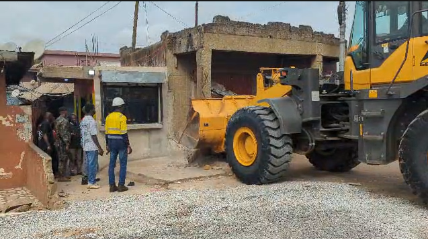
Demolition operations commenced Thursday morning at Abrepo Junction in the Ashanti Region, marking a significant escalation in the long-awaited Suame Roundabout Interchange Project — a major infrastructure initiative designed to transform transportation in Ghana’s second-largest city.
The exercise, which began at approximately 8:30 a.m., is being carried out by military personnel following a directive from the Kumasi Metropolitan Assembly (KMA) for all occupants along the Abrepo Junction–Suame Roundabout stretch to vacate the area by October 4, 2026.
The demolition has not proceeded without friction. Reports indicate chaotic scenes as traders clashed with security personnel over a GH¢200 fee related to the exercise, highlighting the tensions surrounding the displacement of businesses and residents in one of Kumasi’s busiest commercial corridors.
A Project of National Significance
The Suame Interchange Project represents one of Ghana’s most ambitious infrastructure undertakings in recent years. Initially conceived under the administration of former President Nana Addo Dankwa Akufo-Addo, the project was designed to address severe traffic congestion in Kumasi — a critical national transport hub linking the southern, northern, eastern, and western corridors of the country.
The original design envisioned a grade-separated, four-tier interchange based on extensive traffic modelling, engineering studies, and long-term urban planning. When completed, it was to become the first four-tier interchange in the Ashanti Region and the second in Ghana, following the Pokuase Interchange in the Greater Accra Region.
Phase One Scope and Objectives
The first phase of the project, now underway, will involve the construction of the main multi-tier interchange, including an overpass linking the Suame Roundabout to Abrepo Junction, as well as the widening of the road along the Western Bypass.
According to official project documents, Phase One encompasses:
· A three-tier interchange at Suame, incorporating a ground-level roundabout for left and U-turn movements, a second tier for through movement from Kejetia towards Offinso and Mampong, and a third tier for additional traffic circulation
· Two overpasses at Abrepo and Krofrom Junctions
· A grade-separated underpass at Abrepo Junction, designed to provide alternative routes for motorists and improve traffic flow
· Widening of the Eastern and Western Bypass Roads to increase capacity and reduce congestion
The project is expected to ease heavy traffic along the Suame–Afrancho stretch and improve vehicular movement within the Kumasi metropolitan area, reducing travel time and enhancing road safety through a reduction in accidents.
Phase Two Nears Completion
While demolition for Phase One proceeds, Phase Two of the project is reportedly 87 per cent complete and expected to open to traffic by the end of October 2026. The completion of Phase Two will pave the way for intensive construction works under Phase One.
The Director-General of the Department of Urban Roads, James Amoah, has confirmed that approximately 15 kilometres of inner roads have been completed for traffic diversion ahead of the main interchange construction.
Funding and Financial Background
The Suame Interchange Project has been financed through a combination of international loans and government allocations. In July 2022, Parliament approved a loan agreement of €156.4 million from Deutsche Bank S.A.E. of Spain to finance the design and construction of Phase One, backed by Spain’s export credit agency, CESCE.
Additionally, $47 million was approved from the African Export-Import Bank (Afreximbank) to support the project, with total financing commitments exceeding €200 million.
The contract for Phase One was awarded to Rango-Dizmar JV, a joint venture between Ghana’s Rango Construction Company Limited and Spain’s Tallers Dizmars S.L., for an amount of €140 million for the design and construction of the interchange and ancillary works.
In a significant development earlier this year, the government cleared outstanding debts totalling approximately $29.5 million owed to the contractor, ending months of stagnation and allowing construction to resume. Roads and Highways Minister Governs Kwame Agbodza also announced an additional GH¢3 billion allocation to support the completion of the revised project.
Design Controversy and Political Tensions
The project has not been without controversy. The decision to revise the original four-tier design to a three-tier structure has drawn sharp criticism from the Ashanti Minority Caucus in Parliament, which accused the government of downgrading a project of national importance.
Roads Minister Agbodza has defended the redesign, explaining that the original four-tier design was conceived when the Suame Interchange served as the only credible connection between the Ashanti Region and northern Ghana. He cited new transport developments under the government’s Big Push infrastructure programme, including alternative routes that have reduced the interchange’s traffic burden, as justification for the modification.
“The Suame Interchange is being modified in light of new developments within the greater Kumasi environs,” the Minister stated, adding that work is also ongoing to complete the Inner Ring Road from Asokwa to Sofoline to enhance traffic flow within the metropolis.
Expected Completion Timeline
According to current projections, the main three-tier interchange structure is expected to be delivered by October 2028, while some sections of the project will be completed earlier. The government has expressed confidence that the contractor, now fully mobilised on site, will work to complete the project by the end of 2027.
Impact on Kumasi and Beyond
The Suame Interchange Project is expected to have far-reaching effects on Kumasi’s urban landscape and the broader national transport network. The Suame Roundabout serves as a critical junction where the N6 highway from Accra connects to the N10 leading to northern Ghana, making it one of the busiest intersections in the country.
Once completed, the interchange is expected to:
· Reduce traffic congestion at one of Ghana’s most notorious bottlenecks
· Improve connectivity between the Ashanti Region and northern Ghana
· Enhance trade and commerce by reducing transportation costs and travel time
· Improve road safety through grade-separated junctions
· Stimulate economic activity in the Suame Magazine industrial area and surrounding communities
Community Concerns and Compensation
The demolition exercise has raised concerns among affected traders and residents. The KMA had issued multiple notices, with a final deadline of October 4, 2026, for occupants to vacate the designated project area. A designated demolition and enforcement team has been tasked with removing unauthorised structures, goods, equipment, building materials, and other items left within the project corridor.
The government has not yet announced a comprehensive compensation or relocation plan for affected businesses, a matter that community leaders say requires urgent attention to prevent further tensions.
Moving Forward
As military personnel continue clearing structures at Abrepo Junction, the Suame Interchange Project represents both the promise and the challenges of large-scale infrastructure development in Ghana. The project’s successful completion will depend not only on engineering expertise and adequate funding but also on effective stakeholder engagement and fair treatment of affected communities.
For the residents and traders of Abrepo Junction, the sound of demolition today signals the beginning of a transformation that will reshape Kumasi’s transport landscape for decades to come — a transformation they will witness from the frontlines.