



Ghana’s government has shifted its focus from economic stabilisation to a new phase of industrial transformation, targeting investments that create jobs, transfer technology and strengthen local supply chains under its flagship “New Economy” programme.
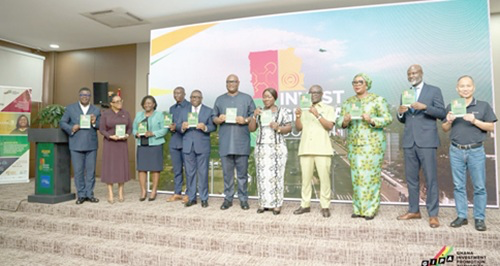
Launching the 2026 Invest Ghana Summit and the 22nd Ghana Club 100 Awards in Accra on Wednesday, the Minister of Trade, Agribusiness and Industry, Elizabeth Ofosu-Adjare, said the government was particularly interested in investments that would raise productivity and enable Ghanaian businesses to compete effectively in regional and global markets.
“Ghana’s new economy must be one that moves beyond the production and export of raw materials towards value addition,” she said. “We are targeting the right investment — investment that creates jobs, transfers technology, develops local supply chains and raises productivity.”
The Minister said such investments would help expand the country’s productive capacity while adding value to its natural resources, and urged investors and businesses to explore opportunities in Ghana and partner with the government to advance the country’s industrialisation agenda.
The launch was attended by the Chief Executive Officer of the Ghana Investment Promotion Authority (GIPA), Simon Madjie; CEO of the Ghana Free Zones Authority, Dr Mary Awusi; CEO of the Ghana Export Promotion Authority, Francis Kojo Kwarteng Arthur; and other officials.
Summit to Connect Investors with Projects
The maiden Invest Ghana Summit, scheduled for November 16 and 17, 2026, at the Kempinski Hotel Gold Coast City in Accra, is expected to bring together more than 2,000 local and global investors, diplomats, policymakers and business leaders.
Convened by GIPA under the patronage of President John Dramani Mahama, the summit will showcase investment opportunities across the country’s 16 regions, including projects linked to the African Continental Free Trade Area and the government’s 24-Hour Economy programme.
The two-day event, themed “Investing in Ghana’s New Economy: Building a Productive Economy that Creates Value and Competes Globally,” will connect investors with viable projects and provide a platform for Ghanaian businesses and project promoters to engage directly with financiers and technical partners. A key focus will be investment opportunities identified through GIPA’s Investment Opportunities Mapping Project, alongside initiatives linked to the 24-Hour Economy agenda and opportunities leveraging regional market access under AfCFTA.
The summit will be followed by the 22nd Ghana Club 100 Awards on November 18, 2026, at The Palms Convention Centre in Accra, where top-performing Ghanaian companies will be recognised for excellence, innovation, growth and contributions to national economic development. Entries for the awards close on October 23, 2026.
The New Economy: $10 Billion Over Four Years
The policy thrust articulated by the Minister forms part of the government’s broader “New Economy” programme, which President Mahama unveiled in August 2026 during a citizen engagement in Bolgatanga as part of his Resetting Ghana Agenda tour.
The programme involves a planned investment of US5 billion. The President said the investment would support the expansion of irrigation infrastructure, strengthen agro-processing and create opportunities for farmers to produce throughout the year. He cited the tomato revitalisation project, the rehabilitation of the Pwalugu Tomato Processing Factory and the completion of the Tamne irrigation dam as early interventions under the programme.
Finance Minister Dr Cassiel Ato Forson has described the shift in policy direction in stark terms. “Stabilisation was never the destination. It was the price of entry. Ghana has paid that price. What comes next is the work that changes lives at scale — the work of transformation,” he said during consultations with the Trade Ministry on the programme. The full details of the programme are expected to be presented in the 2027 Budget in November.
24-Hour Economy: From Policy to Action
The New Economy programme is being implemented alongside the government’s 24-Hour Economy initiative, which Parliament operationalised through the 24-Hour Economy Authority Act in February 2026. The government has allocated GH¢110 million in the 2026 Budget to kickstart the programme.
The initiative includes a suite of incentives designed to encourage manufacturers to expand production and operate multiple shifts. President Mahama has announced that factories registered under the programme will be allowed to import equipment for expansion or retooling duty-free and tax-free. Other incentives include shift-based allowances, off-peak electricity tariffs, enhanced night-time security and structured labour dialogue.
The 24-Hour Economy Authority is targeting the creation of 1.7 million decent jobs by 2028 and aims to reduce the national unemployment rate to below 5 per cent by 2034. The programme is being rolled out through initiatives such as the Volta Economic Corridor, which will integrate agriculture, manufacturing, aquaculture, logistics, inland water transport, renewable energy and export-led industrialisation.
Economic Fundamentals Strengthen
The policy shift comes against a backdrop of improving macroeconomic indicators. Foreign Direct Investment into Ghana rose to US617.61 million in 2024, with projections showing it could surpass US11.4 billion in announced investments by the end of 2026.
Ghana’s economy grew by 5.8 per cent in 2025, and growth is projected to moderate to 5 per cent in 2026, according to the African Development Bank. The World Bank has maintained its 2026 growth forecast at 4.8 per cent, citing stronger economic activity, falling inflation and progress in debt restructuring.
Inflation, which peaked at 54.1 per cent at the end of 2022, fell to 3.8 per cent by January 2026 — the lowest level in over a decade — while the cedi appreciated significantly against the US dollar.
A Reformed Investment Framework
The Invest Ghana Summit will be the first major investment event organised under Ghana’s new investment promotion framework. President Mahama signed the Ghana Investment Promotion Authority Act, 2026 (Act 1173) into law on July 15, 2026, transforming the Ghana Investment Promotion Centre into the Ghana Investment Promotion Authority with an expanded mandate and stronger institutional powers.
The Act repeals and replaces the Ghana Investment Promotion Centre Act, 2013 (Act 865), representing the most comprehensive reform of Ghana’s investment regime in over a decade. It removes blanket minimum capital requirements for wholly foreign-owned enterprises and joint ventures with Ghanaian partners, introduces a statutory Investor Grievance Mechanism, promotes technology transfer and sustainable investment, and establishes a One-Stop-Shop for investor facilitation.
Critically, GIPA now serves as Ghana’s national focal institution for implementing the AfCFTA Protocol on Investment, positioning the country to leverage its role as host of the AfCFTA Secretariat to attract investment targeting the continent’s 1.4-billion-person market.
Madjie: A New Investment Narrative
GIPA CEO Simon Madjie said the summit came at a pivotal time as Ghana strengthened its position as a preferred investment destination in Africa through ongoing economic reforms, industrialisation initiatives and the implementation of AfCFTA.
He said that as Ghana approached 70 years of independence, it was important for the country to embrace a new investment drive focused on productive investments that built industries, added value to local resources, strengthened Ghanaian enterprises, expanded exports and created sustainable jobs.
“This narrative must reflect not only the opportunities Ghana offers investors, but also our longstanding aspiration to build a prosperous and self-reliant economy that contributes meaningfully to Africa’s economic transformation,” Madjie said.
The Minister for Trade, Agribusiness and Industry urged businesses to participate in the Ghana Club 100 Awards by showcasing their achievements, innovation and contributions to economic development. She described the awards as an important platform for recognising enterprises that demonstrated excellence and competitiveness.
She said the new economy could not be built by the government alone, but required strong partnerships with domestic and foreign investors, businesses and other stakeholders to create jobs, expand production and develop local value chains.


