



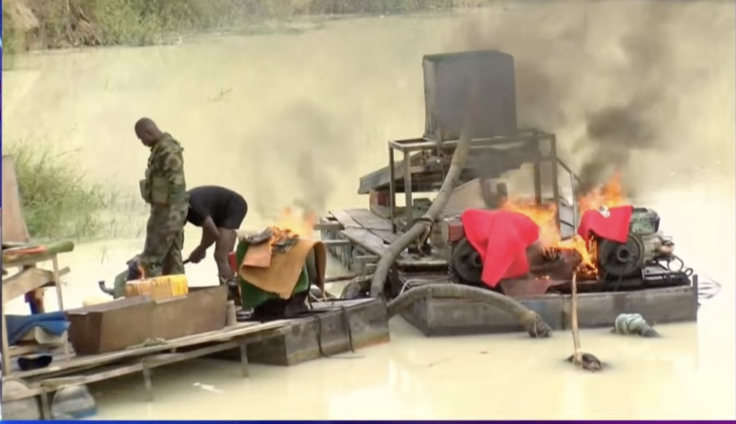
The National Anti-Illegal Mining Operations Secretariat (NAIMOS) has uncovered a brazen attempt by illegal miners to replace equipment destroyed in a previous raid, underscoring the formidable challenge of sustaining enforcement gains along the heavily degraded Pra River.
During a second sweep of mining sites at Tweapease and Adiemra in the Adansi South District, NAIMOS personnel discovered that illegal miners had already installed new Changfan machines to replace equipment burned just the previous day. Soldiers retrieved one newly installed Changfan machine hidden in the bush, while other equipment mounted on rafts was set ablaze.
In another section of the operation, the team found two rafts anchored deep inside mining pits, apparently placed to frustrate the soldiers’ efforts to reach them. One soldier subsequently dived into the water and pulled a raft to shore, where it was destroyed.
The repeated return of mining equipment to areas that have already been raided highlights what officials describe as the hydra-headed nature of Ghana’s illegal mining crisis, where enforcement victories are frequently reversed within hours.
Operation Water Shield and the Battle for the Pra
The latest operation forms part of NAIMOS’ Operation Water Shield, a sustained national enforcement campaign launched in September 2026 to protect Ghana’s major river systems from the ravages of illegal mining. The campaign marked a strategic shift from isolated raids to a sustained, intelligence-led offensive targeting priority river systems from source areas to downstream communities and water-treatment facilities.
Operation Water Shield focuses on some of the country’s most threatened rivers, including the Birim, Ankobra, Tano, Bia, Pra, and Offin, as well as affected sections of the Black and White Volta systems. The operation aims to protect strategic river source areas, deny illegal miners access to riverbanks and waterways, dismantle mining logistics networks, and disrupt the criminal and financial structures sustaining galamsey.
The campaign extends beyond miners at riverbanks to the networks that enable their activities, including facilitators, unauthorized fabricators of Changfan machines, and individuals or companies that rent or supply excavators and other machinery for illegal mining.
Environmental Devastation Along the Pra
The Pra River, one of Ghana’s most vital water bodies, has suffered catastrophic degradation from years of unregulated mining. A recent hazard mapping exercise conducted by the National Disaster Management Organisation (NADMO) in the Adansi South District revealed that illegal miners have diverted and blocked portions of the Pra River to facilitate washing operations. This obstruction creates severe environmental degradation, causes heavy siltation, and drastically increases the risk of major localized flooding during heavy rainfalls.
The assessment also found that uncontrolled pit excavation activities remain actively ongoing within the Twapease enclave, with open, un-reclaimed pits posing severe risks of accidental drownings, soil instability, and cave-ins.
The environmental toll extends far beyond the river itself. Rivers such as the Pra, Offin, and Ankobra are clogged with mud and heavy metals, their waters unsafe for drinking or farming. Treatment plants are breaking down under the pollution load. As of August 2026, raw water turbidity at the Daboase Water Treatment Plant had risen to 11,955 NTU, significantly exceeding the permitted level of 500 NTU.
The scale of destruction is staggering. Officials say more than 5,252 hectares of forest reserves—44 out of Ghana’s 288 reserves—have been devastated by galamsey. Rivers now record turbidity levels over 10 times the safe limit, with some readings exceeding 5,000 NTU when they should be below 500.
Community Livelihoods Under Siege
At Anwona Mensah, the Gyaasehene, Nana Akwasi Agyei, told JoyNews about the profound effects of illegal mining on livelihoods in the community. Residents also showed JoyNews how galamsey activities have affected the community’s only borehole, further compounding concerns over access to safe water.
The human toll is equally alarming. Doctors warn of a rise in kidney failure, neurological damage, and respiratory disease linked to mercury and cyanide contamination. Children are most at risk, exposed through water, food, and even the soil.
Farmers in affected communities have reported that cocoa trees are dying, crops refuse to grow, and fish have disappeared. Families who once drank from rivers now depend on sachet water—expensive and unreliable. COCOBOD reports over 19,000 hectares of cocoa farms destroyed or badly damaged in the Eastern, Western, and Ashanti regions—areas that supply more than 90 per cent of Ghana’s cocoa.
NAIMOS: A Coordinated Response
NAIMOS was established in June 2025 by the Ministry of Lands and Natural Resources as a central coordinating body to lead Ghana’s fight against illegal mining through intelligence-led, multi-agency operations. It serves as the operational nerve center for Ghana’s fight against illegal small-scale mining and its associated environmental destruction.
Since its inception, NAIMOS has recorded significant operational successes. Between July 2025 and March 2026, the Secretariat conducted 122 operations, leading to 237 arrests, including 144 foreign nationals. A total of 94 excavators were seized and immobilised, alongside 2,647 Changfan platforms destroyed. Additionally, 59 firearms and 208 rounds of ammunition were recovered, underscoring the growing militarisation of illegal mining activities.
The Director of Operations at NAIMOS, Colonel Dominic Buah, has described illegal mining as “an existential threat to Ghana,” emphasising that the crisis threatens water bodies, forest reserves, and livelihoods.
The Challenge of Sustaining Gains
The latest developments have renewed calls for stronger support from local authorities to help sustain the impact of enforcement operations and prevent illegal miners from returning to cleared sites.
Colonel Buah has acknowledged that threats to personnel remain a major concern, with reported attacks, injuries, and even fatalities during operations. Looking ahead, NAIMOS has announced plans for the phased deployment of nine permanent field task forces across key hotspots to ensure sustained presence rather than sporadic raids.
The Secretariat has also called on traditional authorities, Metropolitan, Municipal and District Assemblies (MMDAs), equipment owners, communities, and the public to support Operation Water Shield and provide credible information on illegal mining activities and those who finance or facilitate such operations.
As the operation continues along the degraded stretches of the Pra River in the Adansi South District, spanning parts of the Central and Ashanti regions, the challenge remains stark: how to translate enforcement victories into lasting environmental recovery in a country where the lure of gold continues to outweigh the cost of its destruction.


