



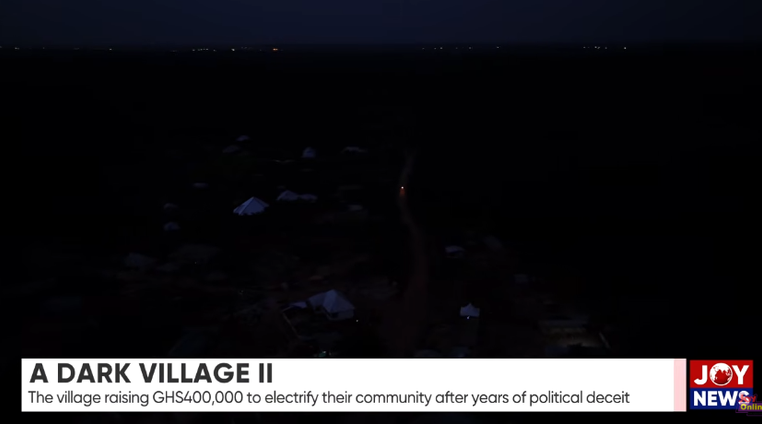
Residents of Amangoase, a farming community in the Juaben District of the Ashanti Region, are beginning to see light at the end of years of darkness after successfully mobilising over GH¢100,000 to mount electricity poles, marking a significant breakthrough in their determined effort to connect the village to the national grid.
For years, electricity has remained more of a distant promise than a reality for residents of Amangoase. But that story is beginning to change. The community has now taken a significant step towards ending years of living without power after residents successfully mounted electricity poles as part of an ongoing self-initiated effort to connect the village to the national grid.
For the residents, the poles are more than infrastructure. They represent hope — a visible sign that a community that has waited for years is finally taking matters into its own hands to change its circumstances.
A Community’s Struggle in the Dark
Amangoase is predominantly a farming community, with many residents depending on farming and other menial activities for their livelihoods. The prolonged absence of electricity, however, has gone beyond inconvenience. Residents say it has affected education, limited small-scale businesses, and slowed the overall development of the community.
Children have had to cope with studying under difficult conditions, while economic activities that could benefit from reliable electricity have struggled to take root. Despite these challenges, residents have refused to allow the lack of power to define the future of their community.
The situation in Amangoase reflects a broader reality across rural Ghana, where despite a national electricity access rate of 89.05 per cent, approximately 3.5 million Ghanaians remain unserved, concentrated in remote communities. The Juaben Municipality itself has seen mixed progress, with some communities like Yeboakrom recently connected to the national grid, while others like Amangoase continue to wait.
The Self-Help Electrification Initiative
In April this year, the community gathered with one vision — to raise GH¢400,000 to connect their homes to the national grid. After pulling their resources, including farm produce, together, the village managed to mobilise a little over GH¢100,000 for contractors to erect the poles for the electrification project.
The residents’ approach aligns with Ghana’s Self-Help Electrification Programme (SHEP), a complementary initiative instituted to support the main National Electrification Scheme. Under the programme, communities within 20 km of an existing sub-transmission line can bring forward their electrification projects, provided they procure all the poles required for the low-voltage network and have a minimum of 30 per cent of houses wired.
The Juaben Municipal Chief Executive, Madam Eunice Ohenewaa Ansu, has actively encouraged communities to embrace this self-help approach. During a community engagement tour, she admonished residents to “take advantage of the ‘Self-Help Project Initiative’ to speed up development,” citing communities like Atia, Achiase, and Adumasa as examples worth emulating.
Progress and the Road Ahead
The mounting of the poles is being celebrated as an important breakthrough — but the journey is far from over. The community still needs to accrue more than GH¢400,000 to complete the remaining works required to extend electricity to homes and fully connect Amangoase to the national grid.
For residents, the appeal is now simple: help them turn the poles they have already mounted into the electricity they have waited years to receive. The hope is that support from individuals, organisations, philanthropists, and other stakeholders will help raise the needed funds and bring the project to completion.
The funding gap mirrors the experience of other rural communities across Ghana. In the Kassena-Nankana West District, residents of Nakolo-Kaporinia spent over a decade mobilising funds for their own electrification project, ultimately requiring a GH¢8,800 corporate donation to bridge the final gap for cables and installation materials.
Broader Electrification Challenges and Opportunities
Amangoase’s efforts come amid renewed national focus on rural electrification. The government recently announced that 200 out of 400 communities under the Rural Electrification Programme have been connected to the national grid, bringing the national access rate to 89.05 per cent. However, the remaining 10.97 per cent of unserved Ghanaians — approximately 3.5 million people — remain concentrated in remote and hard-to-reach areas.
For communities like Amangoase that are far from the nearest grid access point, alternative solutions are being explored. In the same Juaben Municipality, the Onaa community has benefited from a 35 kW solar PV mini-grid facility established by the KNUST-based Ghana GOALS Project, providing household electricity and street lighting while enabling some residents to establish small businesses.
The Yeboakrom community, also in the Juaben Municipality, has similarly benefited from solar initiatives, with 46 solar-powered light poles installed in December 2022 before the community was scheduled for connection to the national grid.
A Community’s Determination
Despite the challenges, the people of Amangoase remain resolute. The sight of electricity poles now standing across the community has given residents something they have long been denied — a tangible reason to believe that their homes could soon be lit.
For a farming community that has spent years waiting for development to reach its doorstep, that first step could mean far more than electricity. It could mean opportunity, better education, stronger businesses, and a new chapter for Amangoase.
Community members are now appealing to the government, non-governmental organisations, philanthropists, and corporate bodies to support the completion of the project. The residents have demonstrated their commitment through their own contributions — including sacrificing income from farm produce — and are calling on stakeholders to match their determination with financial support.
As the people of Amangoase continue their journey from darkness to light, their story stands as a testament to the power of community self-help in bridging Ghana’s rural electrification gap.


