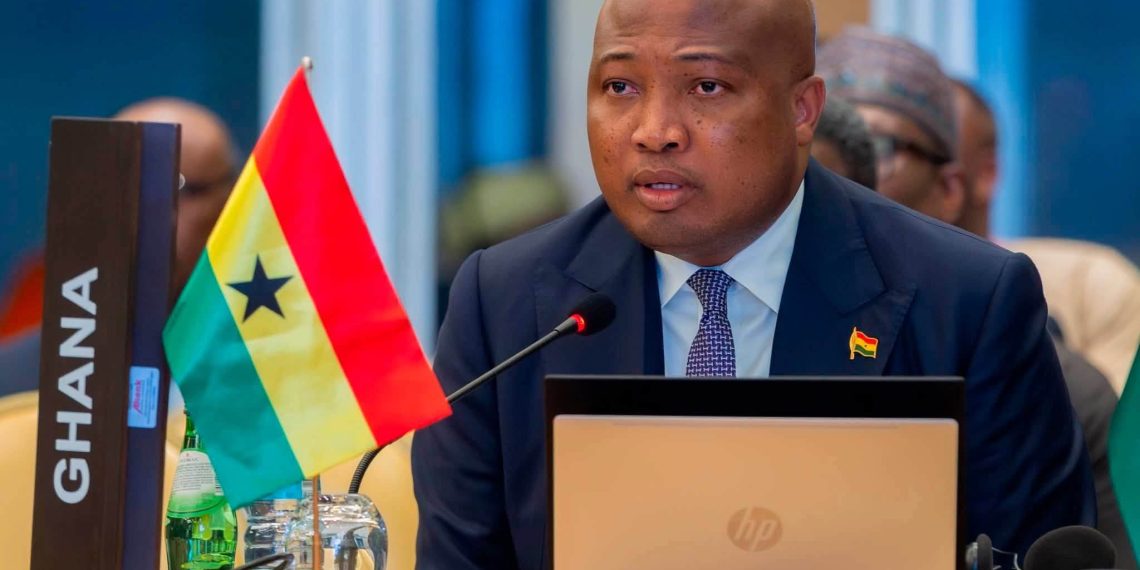
Ghana’s Cabinet has approved a formal application for the country to join BRICS, the intergovernmental organisation of major emerging economies, Foreign Affairs Minister Samuel Okudzeto Ablakwa announced on Tuesday during the official visit of India’s External Affairs Minister, Dr. Subrahmanyam Jaishankar, to Ghana.
Mr. Ablakwa said the decision, taken under President John Dramani Mahama, is aimed at diversifying Ghana’s international partnerships, expanding economic opportunities and strengthening cooperation with countries in the Global South. India’s membership in BRICS made it a strategic partner in Ghana’s bid, he added, disclosing that the government had already sought India’s assistance with the application process.
“The major highlight, which I am disclosing to the Ghanaian people for the first time, is that the Cabinet of President John Dramani Mahama has decided that Ghana will be joining BRICS,” Mr. Ablakwa said during a joint press briefing.
“We believe that joining India in BRICS will give us economic options, will diversify our base and our partnerships, and will also allow us to have more cooperation within the Global South framework, as far as South-South engagements are concerned”.
What is BRICS?
BRICS was originally formed by Brazil, Russia, India, China and South Africa as a platform for emerging economies to coordinate on trade, finance and global governance. In recent years, the grouping has undergone significant expansion. In January 2024, Egypt, Ethiopia, Iran, Saudi Arabia and the United Arab Emirates became full members, followed by Indonesia in January 2025, bringing the total to 11 full member states. A separate partner-country framework includes Belarus, Bolivia, Cuba, Kazakhstan, Malaysia, Nigeria, Thailand, Uganda, Uzbekistan and Vietnam.
The bloc, which represents nearly half of the world’s population and about 30 percent of global economic output, has increasingly positioned itself as a voice for the Global South, advocating for reforms to international institutions including the United Nations Security Council, the International Monetary Fund and the World Trade Organization.
Mr. Ablakwa was candid about the road ahead, noting that Ghana’s bid would require formal acceptance and admission by existing members. “We are now going to take baby steps to formally apply and to seek the support. You know you have to be accepted. You must be admitted,” he said.
Ghana-India Cooperation Deepens
The BRICS announcement came as Ghana and India moved to substantially expand their bilateral cooperation across multiple sectors. Mr. Ablakwa announced that the two countries had signed two Memoranda of Understanding covering agriculture and science and technology, alongside agreements on agricultural research and training, and biodiversity.
Plans are also underway to deepen collaboration in railway development, pharmaceuticals, ICT, defence and agriculture. “The two countries are working to expand collaboration in these critical areas as part of efforts to strengthen their comprehensive partnership,” Mr. Ablakwa said.
Dr. Jaishankar said Ghana and India are exploring stronger collaboration in pharmaceuticals, health, mining, defence, railways and digital technology. He noted that both nations share similar development challenges and could benefit from exchanging knowledge and experience. He drew parallels between Ghana’s Accra Reset, Feed Ghana and One Million Coders initiatives and programmes being implemented in India.
The Accra Reset is a major international initiative led by President Mahama, launched in late 2025 to transform global governance, particularly in health and development, moving from aid dependency towards health sovereignty and economic self-reliance for nations in the Global Majority.
Trade Growth and Strategic Partnership
Earlier on Tuesday, President Mahama held discussions with Dr. Jaishankar at Jubilee House, focusing on strengthening Ghana-India relations in trade, investment, railway development and pharmaceutical manufacturing. President Mahama highlighted the growth in bilateral trade, noting that Ghana’s exports to India have risen from about US7 billion, driven mainly by goods exports. Ghana continues to benefit from Indian agricultural machinery, automobiles and buses.
Bilateral trade between the two countries had already reached nearly US6 billion set under the comprehensive partnership framework. India has invested more than US$2 billion across over 900 projects in Ghana.
On pharmaceuticals, President Mahama reaffirmed Ghana’s openness to partnerships supporting local drug and vaccine production, in line with the health sovereignty objectives of the Accra Reset. He cited existing collaboration between Indian pharmaceutical company Atlantic Life Sciences and Ghanaian indigenous firm KinaPharma on vaccine development for Ghana.
Rail development featured prominently, with the two sides reviewing progress on the Tema-Mpakadan Railway Line, India’s largest development cooperation project in Ghana. The US$450 million project, financed by the Indian EXIM Bank and executed by AFCONS, was inaugurated in 2024. President Mahama also cited Jubilee House, built by an Indian company, and the Ghana-India Kofi Annan Centre of Excellence in ICT as enduring symbols of the partnership.
Call for UN Security Council Reform
Dr. Jaishankar welcomed Ghana’s role in the African Union and ECOWAS and called for stronger cooperation between the two countries at the United Nations, including on reforms to the UN Security Council.
In a social media post earlier in the day, Dr. Jaishankar said he looked forward to “productive engagements to advance our Comprehensive Partnership”.
The visit forms part of India’s broader diplomatic push into West Africa, with Dr. Jaishankar embarking on a five-day, three-nation tour that will also take him to Côte d’Ivoire and Ethiopia. The Indian Ministry of External Affairs said the visit reflects India’s commitment to deepen its partnership with Africa and advance solidarity with the Global South.
A Partnership with Deep Roots
The Ghana-India relationship dates back to Ghana’s independence in 1957, when India became one of the first countries to establish diplomatic ties with the newly independent nation. High-level engagements have intensified in recent years, including Indian Prime Minister Narendra Modi’s visit to Ghana in July 2025, during which he announced the establishment of a Skill Development Centre and the doubling of ITEC and ICCR scholarships for Ghanaian students.
Present at Tuesday’s meeting were Chief of Staff Julius Debrah, Foreign Affairs Minister Samuel Okudzeto Ablakwa and other government officials.
As Ghana moves to formalise its BRICS application and deepen ties with India, the developments mark a significant shift in the country’s approach to international partnerships — one that prioritises South-South cooperation, economic diversification and a more equitable global order that rejects unilateralism and the abuse of nations.