



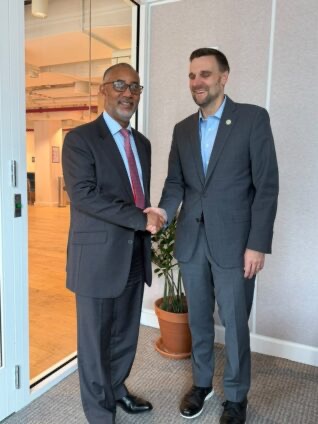
The Millennium Challenge Corporation (MCC) has signalled renewed interest in deepening its development partnership with Ghana, as the United States development agency welcomed a high-level delegation from the Millennium Development Authority (MiDA) for discussions on Ghana’s next phase of economic transformation.
The engagement, held in New York, brought together senior officials of the two institutions to reflect on Ghana’s longstanding partnership with MCC, the lessons and legacy of the country’s two completed Compacts, and opportunities for renewed collaboration. The meeting has opened fresh conversations around the possibility of Ghana working with MCC again, with energy and regional power integration emerging as potential areas of future cooperation.
The MiDA delegation was led by its Chief Executive Officer, Alexander Kofi-Mensah Mould, and Board Chairman, Charles Abugre, while the MCC delegation was led by Jason Small, Acting Vice President for Compact Operations, and Senior Policy Advisor Tariq Ahmed.
The discussions mark the first high-level engagement between the two institutions since Ghana was declared ineligible for MCC assistance in fiscal year 2026 due to a debt default restriction under Section 7012 of the FY 2025 State, Foreign Operations, and Related Programs Appropriations Act. The restriction, which applied pending the conclusion of a debt restructuring agreement, automatically disqualified Ghana from compact eligibility despite the country meeting the income threshold for consideration. Ghana was among 18 countries listed as ineligible for the 2026 fiscal year. The New York meeting has therefore taken on added significance, with MiDA seeking to demonstrate what has changed since those legal impediments arose.
MCC Wants to Know What Has Changed
Mr Small said Ghana’s track record with MCC would be an important consideration should the country seek to develop another compact. He explained that MCC has strengthened the way it assesses potential partner countries, including examining the prospects for increased U.S. investment, opportunities for U.S. exports and the development of supply chains involving critical materials and minerals.
For countries such as Ghana that have previously implemented MCC programmes, he said the agency would also examine how previous investments performed, whether they were fully implemented and whether the country had sustained the reforms and investments associated with earlier programmes. That assessment, he indicated, could provide Ghana with an opportunity to demonstrate the reforms and institutional improvements made since the challenges that affected the second Compact.
The $498.2 million Ghana Power Compact was signed in 2014 and entered into force in September 2016. However, following the termination of the ECG-PDS concession in 2019, MCC de-obligated the $190 million portion of the Compact that was conditional on the concession. The remaining programme was subsequently implemented through MiDA, with MCC and Ghana formally completing the Power Compact in June 2022. The Power Compact alone delivered major infrastructure investments, including four major power substations, while supporting reforms aimed at improving the reliability and sustainability of Ghana’s electricity sector.
Energy Remains a Potential Gateway
Mr Mould said Ghana’s energy sector could provide an important platform for renewed cooperation, particularly given the experience and infrastructure created through the previous Power Compact. He pointed to opportunities to strengthen Ghana’s electricity grid, improve the performance of distribution companies and deepen regional electricity integration across West Africa.
According to him, Ghana could also explore opportunities around natural gas infrastructure linking Ghana and Nigeria to support regional power generation and improve the reliability of electricity supply across West Africa. “We’re looking at the natural gas that we have, and also Nigeria, to see how we can work together — do the pipeline to ensure that we have gas flowing across the region to generate electricity and also to improve the grid,” Mr Mould said.
He also highlighted reforms undertaken in Ghana’s power sector since the implementation of the Power Compact, including the introduction of quarterly automatic tariff adjustments and a cash waterfall mechanism designed to improve the distribution of revenues across the electricity value chain. He said several of the reforms and projects that could not be completed under the Power Compact had subsequently been advanced through domestic efforts.
The West African Gas Pipeline, which transports natural gas from Nigeria to Ghana, Togo and Benin, has become a key component of Ghana’s energy mix, fuelling about 70 per cent of Ghana’s electricity generation. Gas supplies via the pipeline saved approximately $3 billion in power generation costs in Ghana from 2011 to 2025 compared to liquid fuels, with 2025 deliveries rising by 23 per cent year-on-year. The pipeline company, WAPCo, is targeting a 45 per cent capacity increase in 2026, adding 100 million standard cubic feet per day through upgrades in Nigeria and new supply deals.
Regional Power Projects Back on the Radar
Mr Small recalled that MCC had previously examined regional energy infrastructure involving Ghana and neighbouring countries, including proposed transmission interconnectors between Ghana and Côte d’Ivoire and Ghana and Burkina Faso. He said MCC would need to establish what had happened to those projects and assess their current viability.
The Ghana-Burkina Faso transmission line, connecting Bolgatanga in northern Ghana to Ouagadougou, has already been constructed as part of broader regional power integration efforts, enabling Burkina Faso to import clean and cheaper power from Ghana. At project conception in 2011, Burkina Faso had only one interconnection with Côte d’Ivoire with a capacity of 100 MW, making the Ghana link a critical addition to the region’s electricity network.
Mr Small stressed that any future MCC intervention would have to be based on evidence that the identified constraint remained a major impediment to economic growth. “There’s still an opportunity,” Mr Small said, while cautioning that MCC would have to undertake further analysis before determining the sector and nature of any future investment. He noted that energy could remain a significant constraint given the reliability and volume of electricity required to support Ghana’s future growth and emerging economic opportunities.
A New Lens for Future MCC Partnerships
Mr Small further disclosed that MCC had introduced a broader assessment framework that considers what he described as “American returns” when evaluating potential new compact countries. The assessment examines opportunities for increased U.S. investment, increased U.S. exports and the development of supply chains, particularly around critical materials and minerals important to the modern economy.
The “America First” framework was added to MCC’s country selection process in 2025 following a review of U.S. foreign assistance. MCC’s acting chief of staff, Daniel B. Petrie, told the U.S. House Foreign Affairs Committee in July 2026 that its programmes now serve “America First” priorities through private-sector opportunities, exports and secure supply chains for critical minerals. The agency has asked Congress for US$609 million for the 2027 fiscal year. The addition of the “American returns” criteria, which does not appear in the Millennium Challenge Act and has no public assessment methodology, has drawn scrutiny from development analysts who question its transparency.
For Ghana, this could add a new dimension to discussions about future cooperation, particularly as the country seeks to leverage its natural resources, infrastructure and regional position to attract investment and accelerate economic growth. Ghana’s mining sector, which produces gold, bauxite and manganese, could feature in future discussions given MCC’s focus on critical materials supply chains.
MCC, however, does not automatically guarantee a new compact to countries with previous programmes. Mr Small said the MCC Board would consider the available evidence before deciding which countries should be selected for new compact development. Countries must meet three minimum “hard hurdles” for the Board to consider them for a compact: pass more than half of the 20 policy indicators, meet a minimum score on one of the two democracy indicators, and surpass the median on the control of corruption indicator.
MiDA Builds on MCC Legacy
The meeting nevertheless underscored the enduring institutional relationship between MCC and MiDA. MiDA was established by an Act of Parliament (Act 702, 709 & 897 as amended) to oversee, manage and implement programmes under the Millennium Challenge Account for poverty reduction through economic growth. Over more than 15 years of execution, MiDA has managed over $1.1 billion in MCC-funded programmes and has evolved to position itself as the national implementation agency for Public-Private Partnerships and a key delivery partner for Ghana’s 24-Hour Economy initiatives.
Ghana has completed two MCC-funded programmes: the first Ghana Compact, a five-year $547 million programme signed on August 1, 2006, which supported agriculture, transportation and rural development with the aim of reducing poverty by raising farmer incomes through private sector-led agribusiness development; and the Ghana Power Compact, which focused on electricity infrastructure and power-sector reforms. MCC currently lists both programmes as closed.
For MiDA, the renewed engagement represents an opportunity to leverage the systems, experience and institutional credibility developed through more than a decade of implementing MCC programmes. The Authority says it remains committed to building on that legacy as it supports Ghana’s broader development ambitions and positions itself as a vehicle for delivering high-impact national and regional programmes.
The New York discussions therefore mark more than a reunion between two sister institutions. They provide a platform for Ghana to demonstrate what has changed since its previous MCC partnership — including the resolution of its debt restructuring, its sustained power-sector reforms and its institutional improvements — and to explore what a new chapter of cooperation could look like. For a country that has already benefited from two compacts totalling more than $1 billion, the stakes are high, and the message from New York is clear: the door is open, but the evidence will determine how far it swings.


