



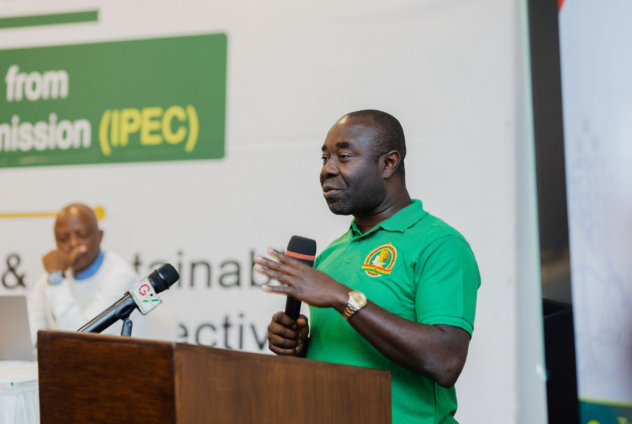
The Minister for Labour, Jobs and Employment, Emmanuel Kwadwo Agyekum, has called on Chief Executives of State-Owned Enterprises (SOEs) to actively contribute to the development of Ghana’s proposed new public sector compensation system, stressing that the government is not seeking to impose a foreign model but to build a home-grown, sustainable framework through broad consultation.
Speaking in Accra on Friday, September 25, 2026, at a stakeholder engagement organised by the Fair Wages and Salaries Commission (FWSC) with SOE CEOs, the Minister said the government wanted SOE leadership to openly share their views, concerns and suggestions to help shape a compensation framework that would be effective and sustainable.
“This is not coming to take your powers. We want you to support, we want you to contribute, we want you to give any other input that will be able to help us to bring in something that is new. Let it be the best system,” Mr Agyekum said. He emphasised that the reform was not about “lifting something from the United Kingdom or lifting something from another country and bringing it to the country”.
The engagement, held on the theme “Towards an Independent, Equitable & Sustainable Compensation System: Stakeholders’ Perspectives on Ghana’s Public Sector Pay Reforms,” formed part of the FWSC’s nationwide stakeholder consultations following President John Dramani Mahama’s declaration of the commission as an Institution in Transition in March 2026. It brought together CEOs, Deputy CEOs, Directors of Finance and Human Resources of over 100 SOEs, as well as representatives from the State Interests and Governance Authority (SIGA), development partners and the media.
Background: From FWSC to IPEC
The transition from the FWSC to the proposed Independent Public Emoluments Commission (IPEC) represents one of the most significant public sector pay reforms in Ghana’s recent history. The IPEC Bill, when passed, will repeal the Fair Wages and Salaries Commission Act, 2007 (Act 737), to address pay fragmentation, politicisation of salaries, and rising wage bill pressures.
President Mahama announced the reform agenda in March 2026, declaring 2026 the transition year and outlining plans for a comprehensive National Emoluments Policy to address salary disparities, harmonise allowances, strengthen performance-based compensation and align public sector pay with Ghana’s long-term development and fiscal priorities. The President has said the new IPEC will ensure that salaries and other compensation of chief executives and board members of SOEs are linked to the performance of their institutions.
Concerns and Assurances
During the engagement, some CEOs raised concerns about how the new system would affect existing Collective Agreements and the level of autonomy boards would have in determining market premiums. In response, Dr George Smith-Graham, Chief Executive of the FWSC, assured them that IPEC would not destroy performance-based incentives but would rather sanitise and harmonise them under a National Emoluments Policy and a National Negotiation Framework. He also announced that the reform would introduce a modern nationwide Job Evaluation exercise to establish fair grading and relativity across the public service, and a National Productivity Framework to link pay to performance.
“IPEC is not intended to weaken the role of boards of SOEs or impose the same remuneration on every CEO. Boards will continue submitting proposals for remuneration based on evidence,” Dr Smith-Graham stated. He explained that equity in public sector compensation did not necessarily mean equal pay for all, but that differences in remuneration should have an objective, transparent and defensible basis, linked to factors including the size and complexity of an organisation, profitability, capacity to pay, productivity and market scarcity.
Under the proposed arrangement, boards would originate remuneration proposals, SIGA would provide governance and financial performance perspectives, while IPEC would provide compensation oversight on behalf of government as shareholder.
Article 71 and Constitutional Considerations
The Minister also addressed concerns that the proposed IPEC framework was targeted at office holders covered under Article 71 of the 1992 Constitution, which governs the remuneration and conditions of service of specified public office holders including the President, the Vice President, Members of Parliament, ministers, deputy ministers and members of the judiciary.
Mr Agyekum clarified that the transition would not affect Article 71 office holders until a referendum is held as part of the constitution review process. “We know it has to go through a process,” he said. Article 71 is an entrenched provision of the Constitution, and any amendment requires a national referendum. The government has accepted the Constitutional Review Committee’s recommendation to establish IPEC to determine the salaries and benefits of Article 71 office holders.
SOE Performance and the Reform Context
The reform comes against the backdrop of improving SOE performance. SIGA’s 2025 State Ownership Report showed that SOEs moved from a net loss of GH¢2.26 billion in 2024 to a net profit of GH¢19.8 billion in 2025, with total SOE revenue increasing by 28.12 per cent from GH¢137.64 billion to GH¢176.43 billion. President Mahama has cautioned that this improvement, while encouraging, must translate into sustained operational efficiency and stronger performance, and warned against using profits “to finance the creature comforts of management and boards”.
Next Steps
Inputs from the SOE engagement will be incorporated into the final draft IPEC Bill, which is expected to be laid before Parliament before the end of October 2026. The engagement forms part of a broader consultative process that has already included consultations with Organised Labour, which brought together more than 50 labour groups including the Trades Union Congress (TUC), the Ghana Federation of Labour (GFL), CLOGSAG, GNAT, NAGRAT, UTAG, TEWU, GRNMA, GMA and JUSAG, among others.
The FWSC has projected that the new IPEC could lead to a 90 per cent or higher reduction in public sector strike actions once fully operational, addressing a persistent challenge that cost Ghana approximately GH¢1.47 billion in strike action in 2024 alone.
As the consultation process continues, the government has reiterated its commitment to building a compensation system that commands legitimacy across the public sector—one that is independent, equitable and sustainable, and that reflects Ghana’s own realities rather than externally imposed models.


