



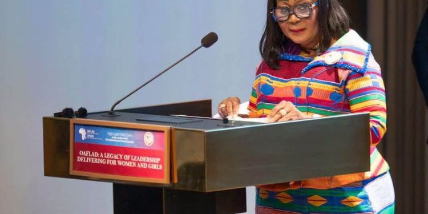
First Lady Lordina Dramani Mahama has called on African leaders and global partners to step up investments in healthcare, education and women’s economic empowerment, warning that the continent cannot achieve lasting prosperity while millions of women and girls are left behind.
Mrs Mahama made the call during the “Passing the Baton” session at a high-level Organisation of African First Ladies for Development (OAFLAD) side event held at the Ford Foundation Centre for Social Justice in New York, on the sidelines of the 81st United Nations General Assembly. The event, themed “A Legacy of Leadership: Delivering for Women and Girls,” brought together African First Ladies and a First Gentleman to discuss the organisation’s strategic direction for its next quarter-century.
A 25-Year Legacy of Collective Leadership
Reflecting on OAFLAD’s journey, Mrs Mahama recalled that the organisation was established nearly 25 years ago at a critical juncture when the HIV and AIDS pandemic demanded bold, urgent and unified African leadership. Founded in 2002 as the Organization of African First Ladies against HIV/AIDS (OAFLA) by 37 African First Ladies, the body was renamed OAFLAD to signal an expanded focus on contributing to Africa’s overall development.
She said that spirit of collective leadership remains vital as the continent works to address persistent challenges facing women and children. The Ghanaian First Lady emphasised the need to build resilient healthcare systems capable of reaching every mother and child, integrating maternal care with HIV prevention, early screening, nutrition and other essential lifesaving services.
Health Cannot Be Addressed in Isolation
Mrs Mahama stressed that improvements in healthcare must be supported by broader socio-economic interventions, delivering one of the most memorable lines of the session.
“Health cannot be addressed in isolation. Education, women’s economic empowerment, and gender equity are essential to creating healthier families, stronger communities, and more prosperous nations,” she said.
She added: “When a mother is healthy, when a young girl is shielded from harm and kept in school, and when a woman is empowered to build her own livelihood, the transformative ripple effects lift entire communities and drive national prosperity”.
Ghana’s Commitment and the Scale of the Challenge
Reaffirming Ghana’s commitment to these principles, Mrs Mahama said the country remained focused on embedding maternal healthcare, youth empowerment and gender equity into its national development agenda to ensure no woman or child is left behind.
The challenge remains substantial. Ghana recorded 955 institutional maternal deaths in 2025, translating to 235 maternal deaths per 100,000 live births — more than three times the World Health Organization’s target of 70 deaths per 100,000 live births. The country has an estimated 337,435 people living with HIV, with 13,951 new infections and 12,051 AIDS-related deaths recorded in 2025.
On women’s economic empowerment, nearly 44 per cent of businesses in Ghana are owned by women, yet they contribute approximately 20 per cent to GDP, with a gender wage gap of around 32 per cent and female labour force participation at 68 per cent compared to 78 per cent for men.
The Lordina Foundation: A Decade of Impact
Mrs Mahama’s advocacy on the continental stage is rooted in a decade of domestic humanitarian work through the Lordina Foundation, her philanthropic organisation dedicated to the welfare of the underprivileged in Ghana, particularly orphans, vulnerable children and women. In May 2026, the Merck Foundation honoured her for ten years of community impact, recognising her efforts in providing education and health support services to vulnerable people in deprived communities and financial empowerment for women.
Through the foundation, she has provided scholarships to 40 Ghanaian medical professionals, supported girls’ education through the “More Than a Mother” campaign and the “Educating Linda” programme, and funded free nationwide screening, examination, counseling and treatment for communities unable to afford medical care. She was also appointed Merck Foundation Ambassador in Ghana and accepted a role as Ambassador for the “More Than a Mother” campaign, which seeks to end stigma against women facing infertility challenges.
A Call for Strengthened Partnerships
Mrs Mahama urged her counterparts to leverage OAFLAD’s collective influence and strengthen global partnerships to advance these priorities, calling on governments, development organisations, the private sector and other stakeholders to work together.
She added that access to quality healthcare, dignity and economic opportunity must no longer be viewed as privileges for a few, but as guaranteed rights for every woman and child across Africa.
What Happens Next
The “Passing the Baton” session forms part of OAFLAD’s ongoing efforts to set its strategic direction for the next 25 years, building on its existing campaigns such as #WeAreEqual, which focuses on health, gender-based violence, education and economic empowerment, and its newer #BuildingResilience campaign addressing the dual crises of climate change and conflict.
For Mrs Mahama, the message to her fellow First Ladies was clear: the baton of leadership must be carried with renewed urgency, and the investments made today in Africa’s women and girls will determine the continent’s prosperity for generations to come.


