



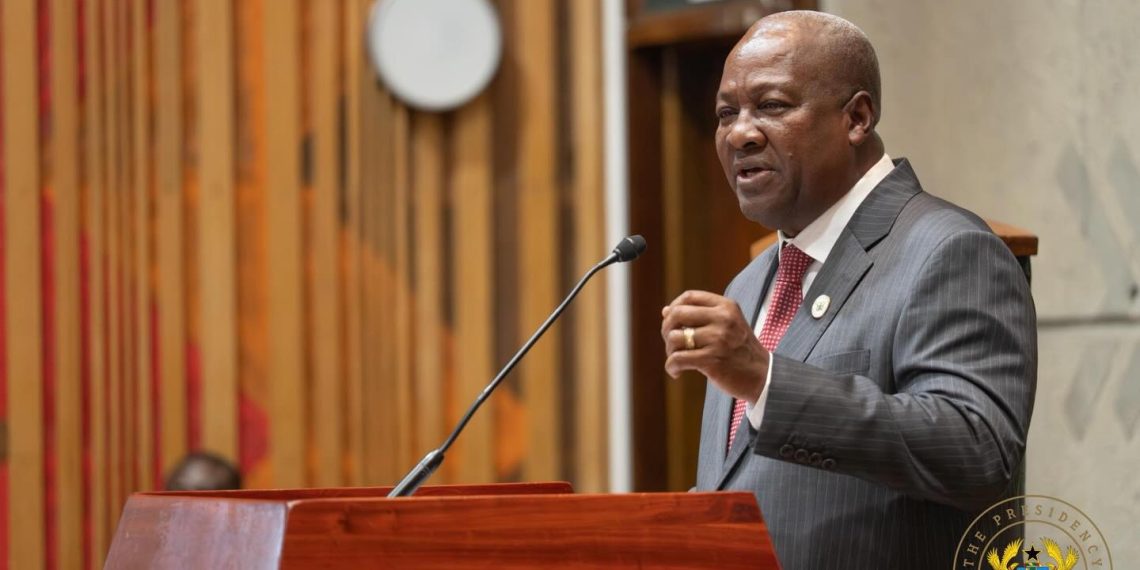
President John Dramani Mahama left Accra on Saturday for New York to participate in the 81st United Nations General Assembly, where he will host two high-level side events on global development and reparatory justice, deliver Ghana’s statement during the General Debate, and lead a week-long push to position Ghana as a premier investment destination.
The 81st session is being held under the theme “Restoring Trust, Managing Transformation: A United Nations that Delivers for All,” with the General Debate running from September 22 to 28, 2026. The theme, chosen by new General Assembly President Khalilur Rahman of Bangladesh, reflects a widespread recognition that the multilateral system must rebuild confidence and deliver tangible results for all nations.
The Accra Reset: A Global South Blueprint
On Monday, September 21, President Mahama will host a High-Level Event on the Accra Reset, themed “Full Circle: Making Global Development Work Again,” bringing together world leaders to examine how global development can be made to work for all countries, particularly those in Africa and the Global South.
The Accra Reset is a major international initiative launched by President Mahama in late 2025 to transform global governance, particularly in health and development, moving from aid dependency towards health sovereignty and economic self-reliance for nations in the Global Majority. It proposes new frameworks for financing, business and partnerships, emphasizing workable models, shared value and sovereignty, starting with health as proof of concept and expanding across development sectors.
“Friends, we didn’t come here to ask for charity. We came to propose a global partnership of the willing, based on a shared vision and mutual respect,” President Mahama said at the Davos Commitment earlier this year. He noted that the Accra Reset was building the architecture for a new kind of cooperation — “one where Global South countries don’t just receive programmes but co-design them with their partners in the global north; where they don’t just attract investment but shape it around their priorities.”
The initiative has already drawn significant international backing. In April 2026, President Mahama announced an eighteen-member high-level panel on the Accra Reset, co-chaired by four distinguished global health leaders: Peter Piot, former Director-General of UNAIDS; El Hadj As Sy, Chair of the Kofi Annan Foundation; Nisia Trindade, Minister for Health of Brazil; and Budi Gunadi Sadikin, Minister for Health of Indonesia. The panel has been mandated to produce concrete, actionable proposals to restructure the global health order, which has historically treated governments of the Global South as passive recipients rather than sovereign actors.
A Presidential Council for the initiative includes President Cyril Ramaphosa of South Africa, President Luiz Inácio Lula da Silva of Brazil, Prime Minister Narendra Modi of India, President Bola Ahmed Tinubu of Nigeria, Prime Minister Mia Amor Mottley of Barbados and other world leaders. A Circle of Guardians comprising former Nigerian President Olusegun Obasanjo, former Liberian President Ellen Johnson Sirleaf, former UK Prime Minister Gordon Brown, former Ghanaian President John Kufuor and other eminent statesmen provides strategic guidance.
Reparatory Justice: From Recognition to Action
On Wednesday, September 23, President Mahama will host a second high-level side event on reparatory justice, under the theme “From Commitments to Action on Reparatory Justice: Advancing International Cooperation for the Return and Restitution of Cultural Properties and Heritage.”
The event builds on a landmark achievement: in March 2026, the UN General Assembly adopted Resolution A/RES 80/250, declaring the transatlantic slave trade a crime against humanity, with support from 123 member states. The resolution was itself the product of an announcement President Mahama made before the General Assembly in September 2025, when he declared Ghana’s intention to introduce such a resolution.
Following the adoption, Ghana convened the Next Steps High Level Consultative Conference in Accra in June 2026, which established three global panels to move the agenda from recognition to implementation: a Global Advisory Panel on Reparatory Justice, comprising heads of state and eminent leaders; an Expert Panel on the Restitution of Cultural Artefacts, tasked with facilitating the return of cultural properties, archives, sacred objects and historical treasures to their rightful communities; and a Global Legal Panel on Reparatory Justice, bringing together distinguished jurists to explore legal pathways consistent with international law and human dignity.
President Mahama, who was named African Union Champion for Reparations following the June conference, said the UN General Assembly side event would provide an opportunity to assess progress and sustain international momentum. “As a follow-up, Ghana will host a high-level side event during the 81st UN General Assembly Session this September to receive progress reports from our established panels,” he said. “I have invited all Heads of State to join us as we continue to lead the charge for justice, restitution, and dignity for Africa and people of African descent worldwide.”
Ghana’s Statement and Investment Push
President Mahama is scheduled to deliver Ghana’s statement during the General Debate on Thursday, September 24.
Beyond the diplomatic engagements, the President’s programme includes a robust economic component aimed at courting international capital. He will ring the NASDAQ Closing Bell and meet business leaders at a US-Ghana Presidential Roundtable organised by the US-Africa Chamber of Commerce. He will also speak at the Council on Foreign Relations and attend the Ocean Panel Leaders’ Meeting.
The investment pitch comes as Ghana seeks to attract private capital into key sectors of the economy. The government has announced plans to channel GH¢2.5 billion annually into five sectors — pharmaceuticals, agriculture and agro-processing, tourism and power generation — with the money expected to support private-sector businesses rather than create new state-owned enterprises. President Mahama has said government cannot undertake every investment required for national development and that its role is to create conditions for businesses to invest and expand.
The US-Ghana Presidential Roundtable will provide an opportunity for the government to engage directly with businesses on investment opportunities and commercial cooperation, while meetings with executives of multinational companies will aim to strengthen partnerships and encourage investment in Ghana. The Presidency says the engagement is intended to promote Ghana as a leading destination for business and investment.
Engaging the Diaspora
President Mahama will conclude his New York engagements on Friday, September 25, with a Town Hall meeting with the Ghanaian community to share updates on his vision for national development.
Accompanying the President are the First Lady, Mrs Lordina Dramani Mahama; the Minister for Foreign Affairs, Samuel Okudzeto Ablakwa; other Cabinet Ministers; senior officials from the Presidency; and other government officials.
A Broader Diplomatic Push
The New York trip is part of a broader pattern of high-level international engagement by President Mahama in 2026. Earlier this year, he undertook official visits to France for bilateral talks with President Emmanuel Macron and the One Health Summit, and to the United Kingdom and Belarus. In June, he delivered a major address at Chatham House in London, calling for comprehensive reforms to global governance institutions, greater African representation in international decision-making, and stronger economic self-reliance for developing nations.
As President Mahama takes Ghana’s case to the world’s most prominent multilateral stage, his message is clear: the Global South is not asking for charity but for a seat at the table where the rules are written — and a fair share of the prosperity those rules produce.


