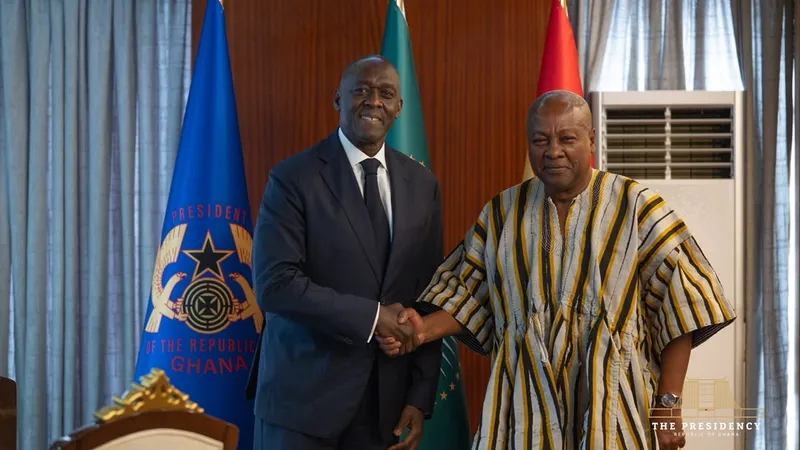
President John Dramani Mahama on Wednesday received the Managing Director of the International Finance Corporation (IFC), Makhtar Diop, at the Presidency to deepen a strategic partnership aimed at transforming Ghana’s economy through private-sector investment and industrialisation, with the discussions yielding a $300 million World Bank financing package to permanently end the double-track system in Senior High Schools by the end of 2027.
The meeting, held during Diop’s three-day visit to Ghana from September 15 to 17, focused on scaling up commercial agriculture in cocoa, oil palm and poultry, fulfilling the government’s policy to process at least 50 per cent of Ghana’s cocoa beans, agricultural produce and minerals locally, and expanding the transport network — including railways, aviation and roads — under the Big Push Infrastructure Development Programme.
President Mahama, joined by the Chief of Staff and the Ministers for Finance, Energy and Trade, highlighted what he described as a positive economic turnaround driven by prudent economic management and fiscal discipline, citing a sharp decline in inflation, reduced national indebtedness and restored investor confidence.
IFC Commits to Commercial Agriculture and Local Processing
The IFC Managing Director commended President Mahama for his commitment to decisive economic reforms and pledged the Corporation’s full readiness to support Ghana’s commercial agriculture sector and broader efforts toward building a resilient, sustainable economy.
The discussions also addressed critical challenges in the energy and education sectors, with Diop emphasising the importance of scaling investments in infrastructure, digital economy, healthcare and renewable energy — pillars he has championed since assuming leadership of the IFC in March 2021.
Diop, a Senegalese economist who previously served as the World Bank’s Vice President for Infrastructure and Vice President for Africa, disclosed that the IFC currently has a portfolio of approximately $500 million in Ghana, alongside a pipeline of about $1.2 billion in potential investments across key sectors of the economy.
“We have now a portfolio of 500 million dollars, and we have a pipeline of 1.2 billion,” Diop said, adding that the IFC would do more to support Ghana’s private-sector development priorities.
The IFC’s existing programme in Ghana focuses on export-led manufacturing, agribusiness, renewable energy and financial sector development. Recent investments include support for B5 Plus to expand construction materials production while reducing emissions through recycling and renewable energy, and financing for up to 200 megawatts of solar energy with LMI Holdings to provide stable, cost-effective power and reduce industrial energy costs.
In agribusiness, the IFC is scaling structured financing solutions through partner banks, including Access Bank Ghana and Société Générale Ghana, to provide liquidity to Licensed Buying Companies in the cocoa sector. In January 2026, the IFC and Access Bank Ghana announced a $134 million risk-sharing arrangement to strengthen liquidity across the cocoa value chain.
Ghana’s Economic Turnaround
President Mahama briefed the IFC delegation on Ghana’s macroeconomic recovery, which has been marked by a sharp decline in inflation and a significant reduction in national indebtedness. According to World Bank data, headline inflation fell to 3.3 per cent in February 2026, driven by cedi appreciation and fiscal and monetary policy tightening, while fiscal discipline delivered a 2.5 per cent primary surplus — exceeding the 1.5 per cent target.
The cedi has appreciated over 40 per cent against the US dollar since the end of 2024, while foreign reserves rose from $8.9 billion to $13.8 billion over the same period.
The IMF lifted Ghana from ‘critical’ to ‘moderate’ debt distress in August 2026, ending four years of the West African economy being in the extreme red, and approved a final $371 million disbursement under its $3 billion support programme. Ghana’s comprehensive debt restructuring was largely completed, with the Eurobond exchange in 2024 and the SADEREA notes exchange in July 2026 effectively concluding the restructuring of bonded external debt.
The Big Push Infrastructure Programme
The discussions also covered the expansion of Ghana’s transport network, including railways, aviation and roads, under the Big Push Infrastructure Development Programme. The government has allocated GH₵30.8 billion for the initiative in 2026, a massive increase from the GH₵13 billion invested in 2025, bringing total investment in the Big Push to over GH₵40 billion.
The allocation will cover improvements in roads, rail, aviation, health, education, agribusiness and manufacturing infrastructure across the country. A key component is the Accra-Kumasi Expressway, for which the government has deposited US$1.7 billion at the Bank of Ghana to finance construction under the programme.
The President said the government was investing aggressively in transport infrastructure — roads, railways and ports — and energy reliability, with the Big Push creating investment opportunities across road, rail, energy, housing, water systems and logistics infrastructure.
Ending the Double-Track System
As part of efforts to transform the economy and strengthen human capital, President Mahama announced that Ghana had secured the $300 million World Bank financing package to support the permanent elimination of the double-track system in Senior High Schools by the end of 2027.
The double-track system was introduced in 2018 under the previous administration as a stop-gap measure to accommodate the surge in enrolment following the rollout of the Free SHS policy. While it expanded access to education, it was criticised for reducing contact hours between teachers and learners and placing strain on infrastructure.
The World Bank financing will fund the Transformative Secondary Education for Access, Results and Relevance for Jobs (STARR-J) project, which was approved in June 2026. Under the initiative, 50 senior high schools will be upgraded nationwide, 16 new schools will be constructed, and the Community Day School concept will be operationalised to ease congestion in existing institutions.
The 24-Hour Economy
The meeting also touched on the government’s 24-hour economy policy, which aims to extend productivity beyond daylight hours and deepen manufacturing, logistics and agro-processing. Parliament passed the 24-Hour Economy Authority Bill in February 2026, establishing the legal and regulatory framework for the programme, with GH₵110 million allocated in the 2026 budget to operationalise it.
The policy is expected to unlock nearly 1.7 million jobs by incentivising businesses to run three shifts, with tax breaks for electricity consumed during off-peak hours and enhanced security for night-shift workers.
About Makhtar Diop
Makhtar Diop has served as Managing Director of the IFC since March 1, 2021. The largest development institution focused on the private sector in emerging markets, the IFC promotes private-sector-led development to advance the World Bank Group’s mission of reducing poverty and boosting shared prosperity.
Prior to joining the IFC, Diop served as the World Bank’s Vice President for Infrastructure from 2018 to 2021, where he led the Bank’s global efforts to build sustainable infrastructure in developing and emerging economies. Before that, he served for six years as the World Bank’s Vice President for Africa, overseeing the delivery of a record-breaking $70 billion to Sub-Saharan Africa to help tackle development challenges.
A recognised opinion leader in economic and social development, Diop has been named one of the 100 most influential Africans in the world. He holds degrees in economics from the Universities of Warwick and Nottingham in England, and served as Minister of Economy and Finance of Senegal, where he played a key role in instituting structural reforms that helped build a strong foundation for Senegal’s growth in the late 1980s.
Implications for Ghana’s Economic Transformation
The meeting underscores the deepening collaboration between Ghana and the IFC as the West African nation seeks to move beyond raw material exports toward value addition, industrial production and knowledge-based enterprise. President Mahama has emphasised that such transformation requires an environment conducive to investment, and his administration has moved quickly to implement reforms to stabilise and grow the economy.
With the IFC’s $1.2 billion pipeline poised to catalyse private-sector investment across agriculture, infrastructure, energy and digital connectivity, the partnership could play a pivotal role in supporting Ghana’s ambitious agenda to create sustainable jobs for its youth and build a resilient, diversified economy.