



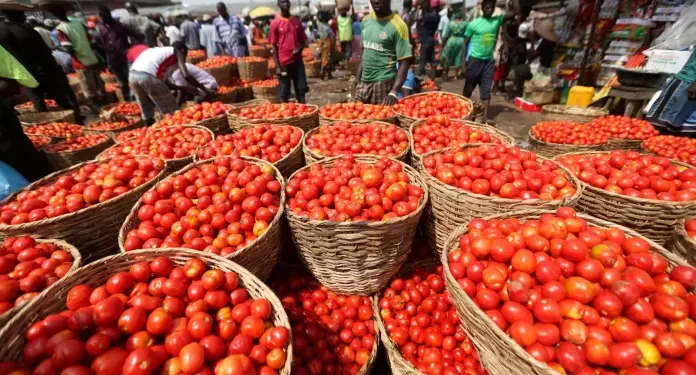
Ghana’s push to achieve tomato self-sufficiency could face a production shortfall of nearly 400,000 metric tonnes when post-harvest losses are fully accounted for, the Chamber of Agribusiness Ghana (CAG) has warned, raising doubts about whether the government’s flagship tomato initiative can close the country’s yawning supply gap.
Anthony Morrison, Chief Executive Officer of the Chamber, told Citi Business News that Ghana’s annual tomato demand is estimated at approximately 800,000 metric tonnes, against peak domestic production of roughly 510,000 tonnes — a baseline deficit of about 290,000 tonnes. But when post-harvest losses of between 20 and 30 per cent are factored in, the real gap approaches 400,000 tonnes.
“That tells you that our peak supply gap is around almost 400,000,” Morrison said.
His comments came days after the government launched the Ghana Tomato Self-Sufficiency Initiative (GHATSI) at Anloga in the Volta Region on September 15, under the theme “Produce at Home. Feed the Nation.” The initiative, a public-private partnership between the Ministry of Food and Agriculture (MoFA) and FarmMate Ltd, aims to end Ghana’s import dependency by building an integrated, year-round domestic tomato value chain.
The GHATSI Plan
GHATSI’s first phase, covering the 2026/27 production season, targets approximately 100,000 tonnes from more than 10,000 acres — equivalent to about 4,000 hectares — across 35 districts, 10 regions and over 100 communities.
The full rollout aims to scale to more than 40,000 acres, producing approximately 400,000 tonnes annually, with up to 200,000 tonnes eventually processed into tomato puree and other value-added products. The programme is projected to create more than 600,000 direct and indirect jobs when fully implemented, including about 200,000 year-round positions spanning nurseries, irrigation, packaging, transport, warehousing, processing, finance and retail.
Participating farmers will receive financed agro-inputs, irrigation support, extension and technical services, and multi-peril crop insurance, with repayment settled directly at off-take.
Food and Agriculture Minister Eric Opoku has said the first phase alone could support more than 150,000 jobs, describing tomato self-sufficiency as “a youth-employment opportunity.”
Chamber Questions 100,000-Tonne Target
While welcoming efforts to boost domestic production, the Chamber says the government must provide greater clarity on the assumptions underpinning the 100,000-tonne target.
Morrison wants to know whether the additional output will come from new farmers, expanded production by existing farmers, increased acreage, or improved yields.
“How do we mitigate that with regards to working around bringing on board additional 100,000? Are these additional 100,000 new farmers or already existing farmers?” he asked.
He also questioned whether the more than 10,000 acres identified under the initiative represent entirely new farmland or an expansion of acreage already under tomato cultivation.
“If they are already existing farmers, are their current crop size being increased? By what? Who is doing the data analysis?”
For the Chamber, the distinction is critical. Simply counting acreage without establishing expected yield per acre may not provide a reliable measure of the initiative’s potential contribution to national supply. Ghana’s average tomato yield stands at about 7.5 to 8 metric tonnes per hectare, compared to Burkina Faso’s 18 metric tonnes per hectare — a productivity gap that has persisted for decades and which the government’s own 448,000-tonne deficit analysis identifies as the core problem.
The Real Deficit: 448,000 Tonnes
Government data shows that Ghana’s raw production shortfall against national demand stands at roughly 295,000 metric tonnes, with domestic output at 510,000 metric tonnes against a demand of 805,000 metric tonnes. But post-harvest losses, estimated at approximately 30 per cent of total production, wipe out a further 153,000 metric tonnes annually through poor handling, inadequate storage and weak market linkages. Combined, the two gaps produce a total supply deficit of 448,000 metric tonnes each year.
Minister Opoku has acknowledged the post-harvest dimension as central to the government’s response strategy. “It is not about increasing the size of the land under cultivation. It is about developing the right variety and creating the conditions to maximise output,” he said, pointing to the need to close the yield gap with Burkina Faso.
Seed Performance Concerns
The Chamber is also raising concerns about the performance of some tomato seeds distributed to farmers under government-supported programmes — concerns that have already materialised in several parts of the country.
Morrison said data being compiled by the Chamber points to challenges in parts of the northern regions and the Adan area, where some farmers have reportedly recorded poor results. He also pointed to farmers in Kpetoe, who have begun late-season tomato production after disappointing outcomes from earlier cultivation.
Those concerns are echoed by tomato growers in Ada East and Ada West in the Greater Accra Region, who called on MoFA in late August to investigate the widespread dying of tomato seedlings following transplantation. Farmers in communities including Kasseh, Koluedor, Tehey, Luhour and Dorgobom said the premature death of transplanted seedlings had created uncertainty about the season’s prospects, with investments in seeds, farm inputs and labour already affected.
Bernard Mawutor Ametepe, a local geographer who spoke on behalf of affected farming communities, said the farmers had followed recommended agronomic practices, raising concerns about the viability or quality of the seeds used. The growers appealed to the Minister to constitute a technical team comprising crop scientists, certified seed inspectors and plant pathologists to assess the affected farms and determine the cause.
These concerns could have direct implications for the 100,000-tonne target if seed performance translates into lower yields or forces farmers to replant, delay production or absorb additional costs. More than 85 per cent of tomato seed planted in Ghana is commercial hybrid seed, increasing production costs and exposing the sector to external supply pressures, according to CSIR researchers.
Single-Partner Implementation Model Under Scrutiny
The Chamber is further questioning the decision to implement the tomato self-sufficiency initiative through a single private-sector partner.
FarmMate Ltd, the private-sector implementation partner, says it has approximately 4,000 acres of organised tomato production underway or entering production. Its out-grower programme covers more than 80 tomato-growing communities in 40 districts across 12 regions, with expansion planned to more than 130 communities. About 200 acres planted in Anloga in May and June are already being harvested, while additional acreage has been established in Ada East, Ningo-Prampram, Shai-Osudoku, Asunafo South, Offinso North, Bawku West, Talensi and Kassena Nankana.
FarmMate is also adding processing capacity. Its tomato processing facility at Legon, Accra, is scheduled to begin operations this month with an initial capacity of 1.5 to five tonnes per hour. Across three shifts, the facility could process up to 120 tonnes of fresh tomatoes in 24 hours, producing tomato puree under the CountryFresh brand. The company plans strategically located semi-processing facilities in major production zones.
But Morrison argues that other large-scale tomato producers and industry players should be incorporated into the programme to broaden production capacity and reduce implementation risks.
“For me, that is a problem,” he said. “We need to be working as an inclusive system that governs key players to be able to address this.”
The Chamber has previously proposed a 12-month National Tomato Emergency Strategy, which envisions scaling private-sector participation to 200 corporate partners and establishing three Tomato Agro-Industrial Zones, positioning Ghana to achieve an annual production trajectory of 300,000 metric tonnes within a year.
Background: Burkina Faso’s Export Ban and the Import Crisis
The urgency of Ghana’s tomato self-sufficiency drive stems from a supply crisis triggered in March 2026, when Burkina Faso — Ghana’s dominant supplier — indefinitely suspended fresh tomato exports to protect its own domestic supply and support newly established processing factories.
Ghana has long depended on Burkina Faso for about 70 to 80 per cent of its tomato supply, with imports valued at approximately $400 million annually. The ban triggered immediate shortages and sharp price increases across Ghanaian markets. A large basket of tomatoes that previously sold for GH¢3,000 rose to between GH¢8,000 and GH¢9,000, while retail prices more than doubled, with baskets previously sold at GH¢300 going for GH¢700 to GH¢800.
Fresh tomato prices surged by 158.3 per cent year-on-year in August 2026, making the commodity the biggest price mover recorded by the Ghana Statistical Service during the month.
Ghana’s annual import bill for fresh and processed tomatoes exceeds $168 million, while national demand for fresh and processed tomatoes exceeds 1.4 million metric tonnes, with domestic production meeting only about 15 to 18 per cent of that requirement, according to CSIR researchers. More than 60 per cent of fresh imports enter Ghana between November and April, when local supply declines.
The Productivity Challenge
The government’s response strategy has included collaboration with the West Africa Centre for Crop Improvement (WACCI) to develop higher-yielding seed varieties targeting at least 15 metric tonnes per hectare; cluster farming systems covering 60 hectares each in Ahafo and Fanteakwa; 250 boreholes being drilled across the northern regions; and the rehabilitation of an irrigation scheme that has released 500 hectares for immediate cultivation.
Minister Opoku has projected that Ghana could experience a glut of tomatoes within three to four months as these interventions take effect, and disclosed that solar-powered boreholes are being installed across the country to support year-round irrigation. “We are anticipating a glut of tomatoes in the coming months and are thinking about how we can get processors to off-take from our farmers,” he said.
But the Chamber’s assessment suggests that without addressing the structural questions it has raised — seed quality, yield assumptions, inclusive private-sector participation and accurate data on acreage and farmer numbers — the gap between ambition and delivery may remain wide.
The Chamber describes its proposed roadmap as both urgent and achievable, projecting that full tomato sufficiency with year-round supply could be attained within 12 months if executed at scale. Whether GHATSI’s first phase can deliver on its 100,000-tonne target will be the first critical test when the 2026/27 harvest season begins.


