



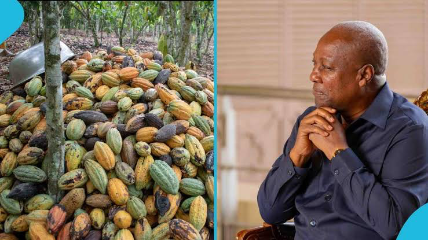
The Young Cocoa Farmers Association has issued a one-week ultimatum to Parliament to pressure the government and the Ghana Cocoa Board (COCOBOD) to announce a definite opening date, producer price and financing arrangements for the 2026/27 cocoa season, warning that farmers remain in the dark despite the season being formally underway.
Speaking on the Asaase Breakfast Show on Tuesday (22 September), the association’s convener, Martin Adu, said cocoa farmers were still uncertain about when they would be able to sell their produce, three weeks after the season was scheduled to begin on September 1.
“As we speak, 22nd September 2026, no clear signal, no information from Cocoa Board,” Adu said. He noted that COCOBOD had announced the opening of the previous season in July, but farmers had yet to receive similar clarity for the 2026/27 season.
The association has formally petitioned President John Dramani Mahama and contacted both the majority and minority leadership in Parliament, demanding action within seven days. In a press statement issued on Monday, September 21, the group called on “the leadership of Parliament, both the Majority and the Minority to urgently put pressure on the Government within one week to announce a definite date for the commencement of the 2026/2027 cocoa purchasing season”.
A season of uncertainty
Although Ghana and Côte d’Ivoire agreed in June to begin the 2026/27 cocoa season on September 1 and end it on August 31, the Young Cocoa Farmers Association says formal communication on operational arrangements for Ghanaian farmers and buyers has not been forthcoming. The two countries, which together account for about 60% of global output, had also agreed to harmonise guaranteed minimum farmgate prices.
“Farmers deserve a guaranteed market for our produce. There must be no room for delays or excuses when the purchasing season begins,” the association said in its statement.
Adu warned that some farmers already have dried cocoa beans stored at home which could lose quality if kept for too long. “Some of the cocoa beans are ready. And you know, when the cocoa sits in your house, on the roof for that long, when it is dried and then you keep it, and it is not at a safer place, it loses its value, its quality,” he said.
The association has more than 7,000 members nationwide, according to Adu.
The ghosts of 2025/26
The current anxiety is rooted in the severe disruptions that characterised the 2025/26 cocoa season. The season opened on August 7, 2025, with a producer price of GH¢51,660 per tonne, equivalent to GH¢3,228.75 for a 64-kilogramme bag, which the government said represented 70 per cent of a projected gross Free-on-Board (FOB) value of US$7,200 per tonne. The price was subsequently increased to GH¢58,000 per tonne in October 2025 following exchange-rate movements and concerns that a higher price in Côte d’Ivoire could encourage cocoa smuggling.
However, a sharp decline in international cocoa prices — from an average of about US4,100 per tonne — created severe liquidity challenges for COCOBOD. In February 2026, the government reduced the producer price to GH¢41,392 per tonne, or GH¢2,587 per 64-kilogramme bag, for the remainder of the season.
The financing difficulties resulted in delayed payments to thousands of farmers. The Minority in Parliament demanded the immediate payment of over GH¢10 billion owed by COCOBOD to Licensed Buying Companies (LBCs), alleging the debt had crippled the supply chain and left farmers unpaid for produce sold since November 2025. The state-owned Produce Buying Company (PBC) accumulated debts of GH¢673 million ($60 million) and was unable to purchase cocoa, with banks securing a court order to seize its assets. PBC owed growers GH¢24 million for over 9,000 bags already delivered and lacked the liquidity to resume purchases.
The Licensed Cocoa Buyers Association of Ghana (LICOBAG) said the funding crisis began in the 2023/2024 season when COCOBOD failed to secure its usual syndicated loan facility, forcing LBCs to rely on high-interest bank loans to pay farmers. Subsequent funding models introduced in the 2024/2025 and 2025/2026 seasons did not fully resolve the problem.
No money for buyers
Adu said there was currently no specific assurance from licensed buying companies that adequate financing was available for the new season. He cited the case of a purchasing clerk who, according to him, was asked by his company to collect money to buy cocoa but was subsequently instructed to stop on his way.
“So as you speak, the licensed buyers themselves do not have enough funds. And Cocoa Board is also not giving clear information as to what to do,” he said.
COCOBOD has announced plans to shift from the traditional annual syndicated loan facility to domestic fundraising through cedi-denominated commercial paper and other instruments. The Chief Executive of COCOBOD, Dr. Ransford Anertey Abbey, said the new model is expected to fund the 2026/27 crop and will promote efficiency in the sector. The regulator plans to issue 270-day commercial paper under a funding programme expected to operate over the next five years, aiming to raise about GH¢16 billion annually from a domestic market with over GH¢100 billion in pension fund liquidity.
But the association remains unconvinced. “We’re asking that there should be a guaranteed market,” Adu said. “Knowing that in respect of whatever happens globally, locally, there will be money available to purchase the cocoa from the cocoa farmer.”
Price expectations and the 70% formula
The association also wants the government to announce the producer price for the new season and explain how it will be determined under the proposed mechanism guaranteeing farmers at least 70% of the achieved FOB price.
Adu said farmers were hoping that the current producer price of GH¢2,587 per bag would at least be maintained, with any adjustment preferably being upward. “We are only praying that the 2,587 should not be reduced but rather be increased so that we can have some kind of hope,” he said.
Bloomberg reported in September that COCOBOD had proposed raising farmers’ pay by about 6% to GH¢2,737 per 64-kilogramme bag for the 2026/27 season, subject to the finance minister’s approval. The association has not been formally notified of this proposal.
“If it is maintained, my brother, we will take it because all that we are asking for is that if it is maintained, let money flow. If it goes up, let money flow. But don’t let it go down,” Adu said.
He also called for education on the proposed 70% FOB-based pricing formula, saying many ordinary cocoa farmers did not understand how the calculation translated into the price they received at the farm gate.
“There is a need for some kind of education so that we all understand how the calculations are done, how the FOB price is determined and how Cocoa Board will be able to give us the 70%,” he said.
Under the 70% formula, with world prices at around US$2,895 per metric tonne, the formula would yield roughly GH¢1,386 per 64-kg bag — significantly lower than the current GH¢2,587 price, which is about 86.65% higher than what current global prices would prescribe under the 70% rule. Ghana’s farm-gate price stands at more than double Côte d’Ivoire’s payout of GH¢1,216 per bag, highlighting a deliberate policy choice to maintain farmer income well above formula-derived levels in a low-price environment.
A sector under pressure
The 2026/27 season is expected to be challenging. COCOBOD projects production to fall by at least 16% from about 750,000 tonnes in 2025/26 to between 450,000 and 550,000 tonnes, citing adverse weather, the production cycle of cocoa trees, disease and pressure on cocoa-growing land. International prices have retreated sharply from their previous highs, reducing the value of cocoa sales and creating further liquidity pressure within the purchasing system.
Cabinet has directed COCOBOD to commence immediate payment to all affected cocoa farmers and has introduced sweeping reforms, including a new cocoa board bill to implement an automatic adjustment of producer price to align with movement in the world market price, exchange rate and other key variables to guarantee a minimum of 70 per cent of gross FOB price to be paid to the cocoa farmer.
The association wants young cocoa farmers to be actively involved in discussions surrounding these reforms. Asked whether young farmers were sufficiently involved, Adu said: “For now, no.”
He said the two key assurances farmers wanted before the new purchasing season were sufficient funds to buy cocoa throughout the season and a fair producer price.
“We, the farmers, cannot be left wondering when we will sell our produce or whether buyers will have the money to pay. We cannot afford another season of uncertainty, delayed purchases, and non-payment,” the association said in its statement.
“Parliament must act. The time for action is now. All who care about the cocoa farmer must rise, speak, and help save the industry from collapse”.
The Young Cocoa Farmers Association has more than 7,000 members nationwide. Ghana’s cocoa sector supports approximately 850,000 farming families and generates about $2 billion in foreign exchange annually.


