



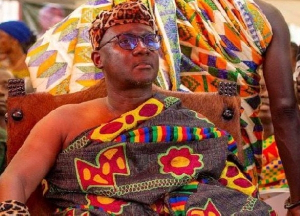
The long-running controversy surrounding Daasebre Akuamoah Agyapong II, the Kwahuhene and former Board Chairman of Agricultural Development Bank PLC (ADB), has taken a significant turn following the conclusion of an investigation by the Economic and Organised Crime Office (EOCO).
According to information available, the probe found no adverse findings against the traditional ruler . The Financial Intelligence Centre (FIC) has subsequently lifted restrictions previously placed on the chief’s accounts, restoring his full access to funds and bringing a major chapter of the financial allegations against him to a close .
How the ADB controversy began
Daasebre Akuamoah Agyapong II, known in private life as Eugene Asante Boadi, served as Board Chairman of the state-owned Agricultural Development Bank from 2021 until mid-2024 . His tenure became entangled in allegations of financial impropriety after a businessman accused the traditional ruler of demanding personal financial benefits in connection with a GH¢12 million commercial loan .
The allegations generated considerable public attention and prompted intervention from the Bank of Ghana, which directed him to resign as a director and Board Chairman of ADB . He subsequently left the position.
Dispute spills into chieftaincy affairs
The allegations did not end with his departure from the bank. They became intertwined with a bitter disagreement over his status as Kwahuhene, with some members of the Abene Traditional Council questioning his conduct and arguing that the controversy had brought disrepute to the Kwahu stool .
The dispute eventually produced rival claims over the Kwahu paramount stool, with Baffour Akoto Osei being presented by one faction under the stool name Daasebre Akuamoah Boateng III . This triggered a series of legal battles before the Eastern Regional House of Chiefs and the courts.
Daasebre Akuamoah Agyapong II was originally nominated, selected and enstooled as Kwahuhene on June 5, 2017, following the death of Daasebre Akuamoah Boateng II in September 2014. His name was subsequently entered into the National Register of Chiefs and gazetted on September 28, 2017 .
House of Chiefs intervenes
The Judicial Committee of the Eastern Regional House of Chiefs became central to the dispute. On June 24, 2025, the Committee granted an interlocutory injunction restraining Baffour Akoto Osei and other respondents from interfering with Daasebre Akuamoah Agyapong II’s functions as Omanhene of Kwahu . The ruling later became the basis for a police operation that restored Daasebre Akuamoah Agyapong II to the Abene Palace on November 17, 2025 .
Following his return to the palace, the Kwahuhene resumed his traditional duties and pledged to promote unity, peace and development in the Kwahu Traditional Area .
CHRAJ petition remains active
Despite the EOCO investigation concluding in his favour, a separate process before the Commission on Human Rights and Administrative Justice (CHRAJ) remains active . In January 2026, a section of the Abene Traditional Council petitioned CHRAJ to investigate allegations of conflict of interest, abuse of office, and administrative injustice related to his former position at ADB .
The CHRAJ inquiry focuses on whether his simultaneous responsibilities as a traditional ruler and public-sector bank board chairman resulted in breaches of constitutional and administrative standards. This process is separate from the EOCO investigation and continues independently .
The development marks a significant turning point in a controversy that has cast a shadow over the traditional leader since his tenure at the state-owned bank. For Ghana’s business community and traditional institutions alike, the outcome reinforces the importance of due process and evidence-based resolution of disputes .


