



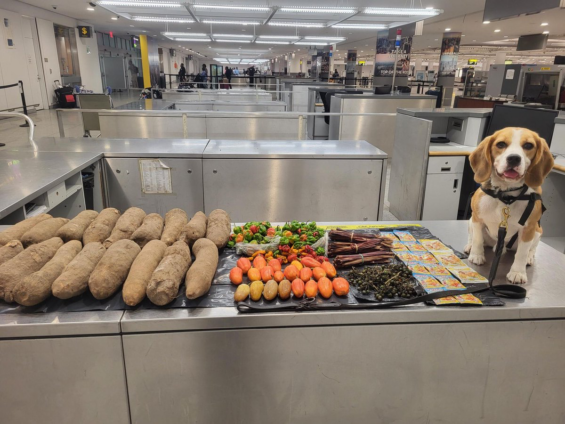
A United States Customs and Border Protection (CBP) agriculture detection dog named Rowdy has intercepted approximately 72 pounds of prohibited food items from Ghana at John F. Kennedy International Airport (JFK), authorities have announced.
The seizure was disclosed in a social media post on 1 October 2026 by Executive Assistant Commissioner Diane J. Sabatino of the CBP Office of Field Operations. According to the post, Rowdy alerted CBP officers to a bag arriving from Ghana during a routine inspection at JFK.
“K9 Rowdy had a busy day at JFK! He alerted to a bag from Ghana with 72 lbs of yams, veggies, and spices—all prohibited,” the post stated. “Thanks to Rowdy, these items were stopped at the border. Who’s a good dog?”
The bag was found to contain yams, vegetables and spices, all of which are classified as prohibited agricultural items under US federal regulations.
Why These Items Are Banned
The United States enforces strict restrictions on certain agricultural products brought into the country to protect its farming sector and prevent the introduction of pests and plant diseases. Fresh fruits, vegetables, plant materials and certain food items can be restricted or prohibited because they may carry pests or diseases that could threaten American agriculture.
Yams, a staple crop in Ghana and West Africa, are particularly susceptible to the yam nematode Scutellonema bradys, which causes a decay known as “dry rot disease,” resulting in blackening and deterioration of the tuber. Preharvest damage to yams by the nematode can reach as high as 40 per cent, with storage losses running between 80 and 100 per cent. The nematode is considered a quarantine pest in several countries and has restricted distribution in parts of the Americas. Ghana is currently the world’s second-largest producer of yams globally, with exports reaching a record $48 million in 2022, accounting for 24 per cent of the value of global yam exports. About 90 per cent of yams exported to the US, UK and the Netherlands come from Ghana, generating approximately $20 million annually.
Spices and fresh vegetables are also subject to US import restrictions, as they can harbour insects, larvae and plant pathogens that may devastate domestic crops if introduced.
The Beagle Brigade: A Critical Line of Defence
Rowdy is part of CBP’s agriculture canine programme, colloquially known as the “Beagle Brigade.” Established in 1984 by the US Department of Agriculture at Los Angeles International Airport with a single beagle, the programme has grown to over 180 canine teams operating at border crossings, preclearance locations, air passenger terminals, cruise terminals, cargo warehouses and mail facilities across the country.
Beagles and beagle mixes are the preferred breed for airport environments due to their keen sense of smell, non-threatening size, high food drive and gentle disposition with the public. Larger dogs such as Labrador retrievers are deployed in cargo and border operations under the “Border Brigade” and “Cargo Brigade” designations.
All detector dogs are adopted from rescue shelters in the US or come to the programme through private donations. Before deployment, each dog and its handler complete a rigorous 10-to-13-week training course at the National Detector Dog Training Center near Atlanta, Georgia. Dogs are trained to give either a passive sitting response or an active pawing response to indicate the presence of an agricultural product, with food treats and praise from handlers serving as rewards.
A trained agriculture dog can scan a piece of luggage for smuggled or forgotten fruits in mere seconds—a task that would take a human officer considerably longer to accomplish through visual inspection alone.
A Growing Challenge at JFK and Beyond
JFK is one of the busiest international entry points in the United States, processing thousands of bags from international flights every hour. The airport is a major arrival point for direct flights from Accra, Ghana’s capital, operated by Delta Air Lines with a flight time of approximately 10 hours and 15 minutes covering 8,265 kilometres.
The seizure reflects a recurring challenge for CBP officers at JFK, where agriculture specialists routinely confiscate prohibited items from travellers arriving from Africa and other regions. In a similar case, CBP officers in Seattle seized 114 pounds of yams from a traveller arriving from Ghana after finding live larvae during an inspection.
Under US regulations, travellers are required to declare all agricultural products in their possession on a customs form. Failure to declare food items can result in fines of up to $300,000, as stipulated in updated luggage rules issued ahead of the 2026 FIFA World Cup. Prohibited items include fresh meat, poultry and animal products such as bush meat, as well as most fresh fruits and vegetables, rice in some cases, and certain dried foods that may require inspection.
In Fiscal Year 2025, CBP intercepted 58,504 quarantine material interceptions of avian products alone, underscoring the scale of the agency’s agricultural protection mission.
A Broader Mission
Beyond their detection work, agriculture canine teams also serve a public outreach role, giving thousands of demonstrations to schools, fairs and media audiences. Their public appeal and specialised skills make them ideal ambassadors for CBP’s broader mission of safeguarding American agriculture and the national economy.
For now, Rowdy’s haul of yams, vegetables and spices has been stopped at the border—a small but significant victory in the ongoing effort to keep foreign pests and diseases out of the United States. As the CBP post concluded: “Who’s a good dog?”


