



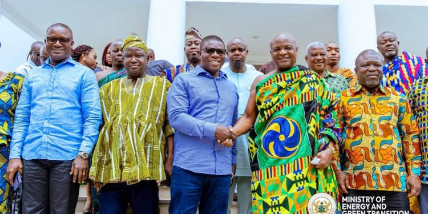
The Minister for Energy and Green Transition, Dr John Abdulai Jinapor, has engaged the leadership of agencies and institutions under the ministry to assess their 2026 performance and set priorities for 2027, with a renewed focus on delivering reliable and affordable electricity to Ghanaians.
The meeting, held in Accra, focused on reviewing progress in the energy sector, addressing outstanding challenges and identifying measures to improve operational efficiency, accountability and service delivery in the coming year.
Dr Jinapor said the government had made significant progress towards strengthening Ghana’s energy security despite persistent challenges in the sector.
Key developments highlighted included plans to install 3,000 transformers, progress in electricity generation, an increase in national electricity access to 89.13 per cent and renewed efforts to revitalise domestic oil refining.
The minister stressed the need for agencies to translate policy commitments into measurable results, insisting that accountability, efficiency, transparency and value for money must underpin their operations.
He urged the leadership of the various agencies and institutions to demonstrate tangible improvements in performance, warning that unnecessary delays and persistent underperformance would not be tolerated.
Dr Jinapor said the government’s priorities for 2027 would centre on building a reliable, affordable, sustainable and resilient energy sector capable of supporting economic growth and improving the livelihoods of Ghanaians.
He also underscored the importance of stronger coordination among agencies under the ministry to ensure that planned interventions deliver practical benefits to households and businesses across the country.
The engagement comes against the backdrop of a challenging year for Ghana’s power sector, which has faced system disturbances, aging infrastructure and financial pressures. In August 2026, the government initiated a comprehensive review of the national electricity grid following recent system disturbances, with the minister stating that consumers and businesses had limited tolerance for prolonged power interruptions. A team of experts, supported by the Africa Centre for Energy Policy (ACEP), was tasked with providing an independent assessment of the condition and performance of the country’s power infrastructure.
On the financial front, the government has paid $1.7 billion of inherited debt owed to Independent Power Producers (IPPs) and restored the World Bank guarantee, while reforms have enabled the state to meet almost all its IPP payment obligations in recent months. The government has also largely transitioned thermal power generation from liquid fuel to gas, resulting in savings of about $500 million in the previous year through fuel import substitution.
The 3,000-transformer rollout forms a central pillar of efforts to stabilise electricity supply, with the full programme expected to require at least GH₵4 billion in investment. The initiative aims to address long-standing weaknesses in Ghana’s distribution network, which has struggled to keep pace with rising demand in urban and fast-growing communities. The ECG is also implementing a US$278 million emergency investment programme to deploy 2,500 distribution transformers.
Ghana’s electricity access rate of 89.13 per cent places the country on track to expand access to 99 per cent by 2030 under the National Energy Compact, part of the broader Mission 300 initiative led by the African Development Bank and the World Bank Group. The country has mobilised a US2.6 billion is expected from the private sector, covering last-mile rural electrification, regional interconnections, transmission upgrades and utility-scale solar development.
On domestic refining, Ghana’s refined petroleum product imports fell 12.67 per cent in the first half of 2026 as domestic production rose 350.7 per cent to 719,414 tonnes, driven largely by the Sentuo Oil Refinery. The refinery has broken ground on a Phase 2 expansion that will raise its total refining capacity from 40,000 to 100,000 barrels per day, as Ghana pushes to process more of its own crude oil domestically. The Tema Oil Refinery has also resumed crude oil processing after completing its first major turnaround maintenance in four years.
The minister said the government was also preparing to procure 1,200 megawatts of thermal generation capacity through a competitive process, with the project expected to be completed by 2029. He noted that the planned capacity expansion would have to be carefully coordinated with existing generation commitments to prevent the government from paying for unnecessary or excess capacity.
Speaking at an earlier energy conference in Accra, Dr Jinapor emphasised that reliable and affordable electricity was essential to Ghana’s industrialisation ambitions, noting that the country could not achieve competitive manufacturing without dependable power.
“Regardless of how much generation capacity we install, the cost of that power is important,” he said.


