



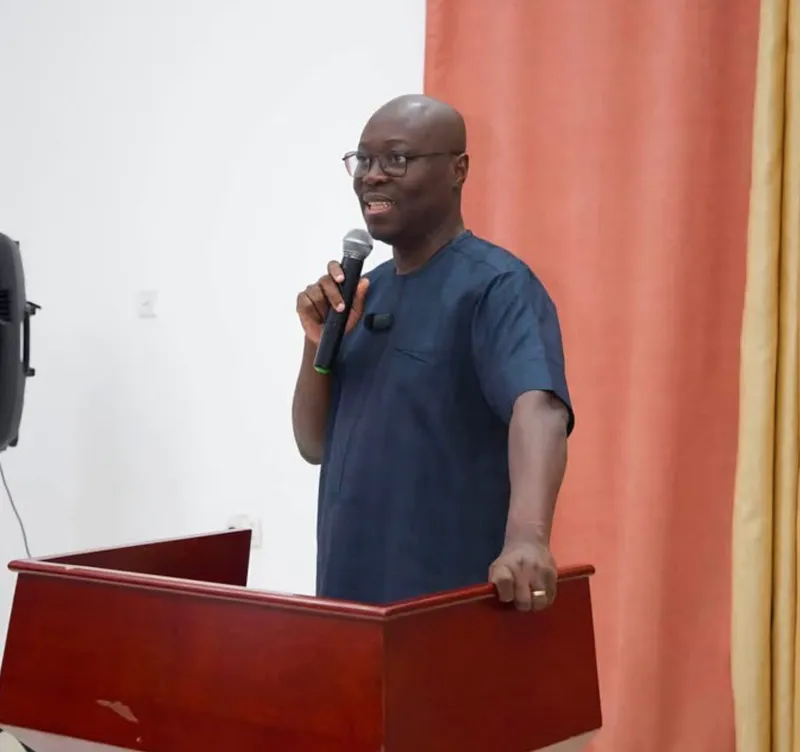
Finance Minister Dr. Cassiel Ato Forson has told regional and local government leaders that Ghana can no longer afford to waste public resources, calling for a renewed national commitment to recover, protect and properly account for every cedi of state money.
Speaking in Tamale at an engagement on the 2025 Auditor-General’s Report with Regional Ministers and Metropolitan, Municipal and District Chief Executives (MMDCEs), Dr. Forson said public funds must be treated as a trust that directly affects the lives of ordinary citizens.
The meeting, held under the theme “Recovering Every Cedi,” brought together key regional and local government leaders to strengthen financial accountability, improve compliance and ensure that public funds are used strictly for their intended purposes.
“Ladies and gentlemen, Ghana does not have the luxury of wasting public resources. Every cedi already has a job waiting for it,” Dr. Forson said.
“It can buy medicine, repair a classroom, desilt a drain, improve a market, or maintain a feeder road. So, when a cedi is wasted, left uncollected, or poorly spent, somebody, somewhere, loses a service.”
The Finance Minister said the theme must go beyond a conference slogan and become a practical discipline across all levels of government.
“That is why ‘Recovering Every Cedi’ cannot remain just a slogan on today’s banner. It must become a way of working: collect what is due; protect what is collected; spend what is approved; account for what is spent; recover what is owed; and prevent it from happening again,” he stated.
Dr. Forson stressed that financial accountability is not only about compliance with audit rules, but about protecting services that directly affect the lives of citizens. He said public funds must translate into visible improvements in communities, including better schools, roads, health facilities, markets, drainage systems and local infrastructure.
He urged Regional Ministers, MMDCEs and Coordinating Directors to take audit findings seriously, recover funds where necessary, close loopholes and strengthen internal controls to prevent future losses.
The engagement comes against the backdrop of Ghana’s ongoing fiscal consolidation efforts, as the government seeks to plug revenue leakages, control expenditure and ensure value for money in public spending. The Auditor-General is constitutionally mandated to audit public accounts and report to Parliament. In recent years, audit reports have repeatedly highlighted issues such as unaccounted funds, procurement irregularities, payroll fraud, abandoned projects and weak internal controls across ministries, departments, agencies and local assemblies.
Under Ghana’s Public Financial Management Act, 2016 (Act 921), public institutions are required to ensure efficient, effective and transparent management of public funds, while the Local Governance Act, 2016 (Act 936) places similar responsibilities on assemblies. Regional Ministers, MMDCEs and Coordinating Directors are key actors in the accountability chain, as they supervise local revenue collection, expenditure and project implementation.
The Finance Minister said the 2025 Auditor-General’s Report should not be treated as a mere document for the shelves, but as a management tool for enforcement, sanctions and recovery. He noted that failure to recover and account for public funds undermines trust in government and slows national development.
The meeting was attended by several Regional Ministers, including the Northern Regional Minister, Ali Adolf John; Savannah Regional Minister, Salisu Be-Awuribe Issifu; North East Regional Minister, Ibrahim Tia; Upper West Regional Minister, Puozuing Charles Lwanga; Oti Regional Minister, John Kwadwo Gyapong; and Upper East Regional Minister, Akamugri Donatus Atanga.
The Tamale engagement forms part of broader efforts by the Ministry of Finance to strengthen public financial management and ensure that audit findings lead to concrete action at the regional and local levels. For many Ghanaians, the success of the “Recovering Every Cedi” agenda will be measured not by speeches, but by whether stolen or wasted funds are recovered and whether public services visibly improve.


