



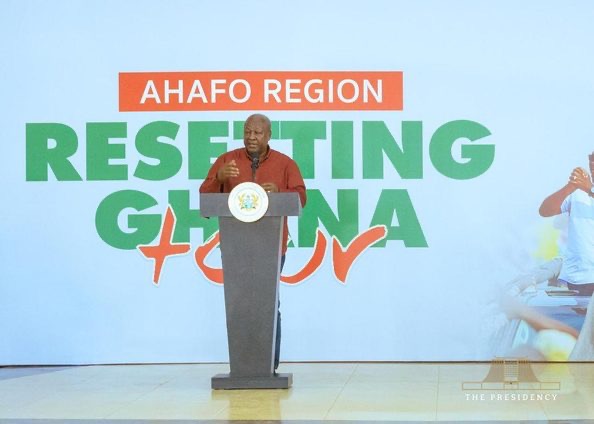
The United States is seeking to revise its proposed $109 million health compact with Ghana, including amending or removing clauses that led to its rejection by Cabinet, President John Mahama has disclosed.
Speaking at a citizens’ engagement in Goaso in the Ahafo Region, the President said the US government has requested further discussions on the agreement.
“The health compact the Americans brought to us, I have talked about it when I was in New York, so everyone knows about it. Later, they came back and said they wanted us to sit down and discuss the clauses we object to in the compact, with a view to either amending or removing them. We will sit down with them and discuss,” he said.
Background: The Collapse of USAID and the Birth of the Compact
The genesis of the proposed compact lies in the abrupt withdrawal of United States Agency for International Development (USAID) support. In 2025, the new US administration froze foreign aid, placed programmes under review, and ultimately closed USAID altogether. An amount of $174 million that had been programmed into Ghana’s national budget was withdrawn, creating a significant gap in education and health. The health sector alone faced a $74 million annual shortfall, affecting critical areas including medical research, HIV and AIDS testing laboratories, and the administration of the President’s Emergency Plan for AIDS Relief (PEPFAR), including antiretroviral drugs.
Across Africa, outside money for health fell by almost 70 per cent between 2021 and 2025, according to the Accra Reset initiative. In response, Ghana launched the Accra Reset — an initiative aimed at reducing Africa’s dependence on external health financing and strengthening local capacity to produce medicines and vaccines.
It was against this backdrop that the United States proposed a five-year health compact worth approximately $109 million, intended to replace some of the funding previously received through USAID. The compact was part of a broader US policy shift outlined in the America First Global Health Strategy, published by the State Department on 18 September 2025, which sought to move away from sending money through NGOs and instead sign five-year Memoranda of Understanding directly with governments.
Why Cabinet Rejected the Compact
President Mahama explained at a dialogue hosted by the Council on Foreign Relations in New York on 25 September 2026 that Ghana had followed its established procedures, with the Ministry of Health reviewing the document and submitting an information paper to Cabinet. The review identified provisions the government considered problematic.
One major concern was a requirement for Ghana to provide the United States with its pathogen profile, which contains information about disease-causing organisms circulating in the country. The President also objected to provisions he said required Ghana to share medical records.
“It states that we shall give the United States our pathogen profile. I’m sure there are medical experts who understand that better than me. And it also says we should give our medical records. I mean, who takes another country’s medical records?” he asked.
President Mahama further said the agreement required Ghana to commit its own funds to the programme — a fixed amount of counterpart funding — while restricting the FDA’s authority to inspect medicines and other medical products brought into the country under the arrangement. The Daily Graphic noted that demanding a fixed counterpart funding amount undermined Parliament’s power of the purse, as Ghana’s budget is approved by Parliament, not by a donor compact.
Describing the conditions, he said, “I mean, it was humiliating.” He added that Cabinet rejected the agreement in record time. “It was the compact that was thrown out in record time in our Cabinet. I’ve never seen anything thrown out as fast as that. And so, of course, we rejected it,” he said. The Health Minister was subsequently instructed to inform the US Ambassador that Ghana would not accept the proposed compact.
The US Embassy’s Response
The United States Embassy in Ghana defended its request for access to Ghana’s health data, insisting that the arrangement was consistent with international best practices and would not involve the disclosure of patients’ personally identifiable information.
Speaking on behalf of the Embassy, Rolf Olson said the proposed agreement was intended to strengthen Ghana’s capacity to manage its own health programmes rather than undermine the country’s sovereignty. “Our intention has always been to strengthen our partners’ sovereignty,” he said. He disclosed that the US invested $82 million in Ghana’s health sector during the first year of the new Trump administration and provided an additional $53 million in fiscal year 2026.
Olson explained that the proposed US Global Health MOUs sought aggregate health data — information compiled at a broader level for purposes such as assessing health programmes and measuring their impact — similar to data sharing that has been done with the PEPFAR programme and many other international health partners over the years. He also said the MOUs included provisions for the sharing of pathogen specimens, which he likened to international coordination during the fight against Ebola.
However, analysts noted that the Embassy’s statement was silent on several contentious provisions, including a reported 25-year data term on a five-year programme, commercial use of the data by American pharmaceutical firms, the FDA exemption, and the asymmetry of obligations between the two parties.
Broader Implications and the Path Forward
The proposed compact was one of several similar agreements offered to African countries. According to J.B. Allotey, a columnist for Citi Newsroom, 35 countries signed such compacts, but Ghana became one of the few to reject it outright. Ghana’s refusal echoes similar sovereignty and data governance concerns raised by Namibia, Zambia, and Zimbabwe over US-proposed health deals.
The dispute has also sparked a broader conversation about data sovereignty in Africa. Arnold Kavaarpuo, executive director of Ghana’s Data Protection Commission, told Sputnik Africa that “Africa’s DNA is one of the most diversified DNAs of all races or of all regions. And so our information is very valuable to us.” He added that “agency is not a function of how many resources you have; it’s a function of independence of thought”.
The withdrawal of $174 million from Ghana’s national budget created significant funding gaps, with the health sector alone facing a reported annual shortfall of $74 million. The President said the experience reinforced the need for African countries to build stronger and more self-reliant health systems. Domestically, the government removed the cap on the National Health Insurance Levy, which now pays for free primary health care and the Ghana Medical Trust Fund, MahamaCares.
With the US now seeking to revise the compact, the coming negotiations will test whether the two countries can bridge their differences on health data governance, regulatory authority, and the balance between partnership and sovereignty. President Mahama has maintained that Ghana remains firm in protecting its sovereign rights as discussions over the proposed health funding agreement continue.
“We said ‘no, we don’t want it’ and we’re doing fine,” he said.


