Ghana has become a nation “drunk on symbols,” fixated on professional titles, ceremonies and social media validation while neglecting the engineers, scientists and technical experts needed to build the country, according to a feature article by columnist Sulemana Mohammed published by ModernGhana.
In the piece, titled “Ghana’s Corporate Illusion: Why We Celebrate Professional Titles More Than National Progress,” Mohammed argues that the country’s obsession with prestige over productivity is holding back real development.
“We’ve become overly fixated on titles, ceremonies, professional prestige, and social media trends, while neglecting the practical skills and innovations that could truly transform our society,” he wrote.
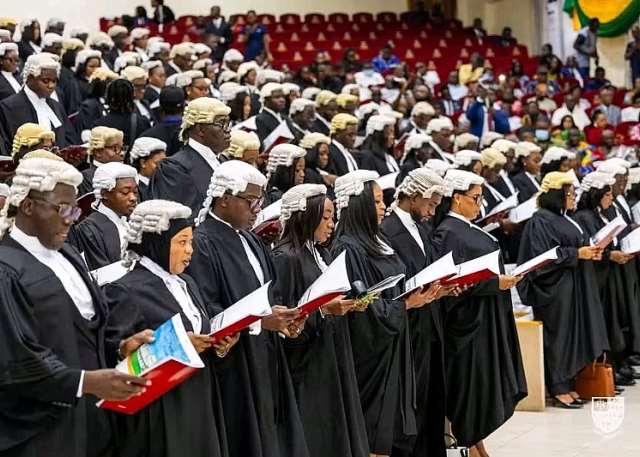
The article follows the 2026 Call to the Bar ceremony on October 9, at which the General Legal Council admitted 1,568 newly qualified lawyers at the ICGC Christ Temple in Accra. The event dominated social media, with videos and photos flooding platforms as families and friends celebrated the new lawyers.
Mohammed used the occasion to question whether the national spotlight on the legal profession reflects the country’s most pressing needs. “There’s nothing wrong with choosing to be a lawyer. The real issue lies in the excessive glorification of certain professions, overshadowing others that are equally, if not more, vital to our national progress,” he wrote.
A nation short on engineers, not lawyers
The article poses a direct challenge: “What if all these lawyers were engineers, scientists, IT experts, peace and security specialists, water engineers, and healthcare professionals?”
That question resonates against a backdrop of documented skills shortages across critical sectors. The Roads and Highways Minister has said current staffing levels are insufficient to meet the demands of ongoing infrastructure projects nationwide, noting that engineers and quality assurance personnel are particularly stretched, affecting project supervision and delivery. The country does not have enough electrical engineers trained to design, commission and maintain utility-scale renewable energy systems, according to a report in the Daily Graphic, which described the deficit as a structural gap. Ghana also relies heavily on foreign technical labour for industrial welding and inspection due to a shortage of locally certified professionals. While the country produces engineers and architects, there is a critical shortage of certified skilled tradespeople such as masons, carpenters and electricians, with over 91 per cent of young people in construction working informally without certification or formal training.
Meanwhile, over 1.3 million young Ghanaians are unemployed, a situation partly attributed to a mismatch between education and industry needs, with many graduates lacking the practical skills employers require. Only about 10 per cent of Ghanaian graduates secure employment within a year of graduation, according to data from the Institute of Statistical, Social and Economic Research cited in Parliament.
The country is also grappling with a brain drain. Over 100,000 trained health professionals are currently unemployed, even as doctors, nurses and other health workers continue to travel abroad in search of better opportunities. A 2025 study found that nearly 70 per cent of surveyed Ghanaian health workers intended to migrate within five years, including 85 per cent of doctors. The attrition rate among scientists at institutions including the Ghana Atomic Energy Commission and the Council for Scientific and Industrial Research reflects a broader exodus of technical talent.
A culture of titles over transformation
Mohammed’s critique echoes a growing body of commentary on Ghana’s relationship with honorifics. A July 2025 analysis described the obsession with titles as “a quiet crisis eating away at the soul of Ghanaian society,” noting that respect has become “a currency tightly bound to labels,” leading to a nation “increasingly blind to substance, and drunk on symbols.” The Ghana Tertiary Education Commission has raised alarm over the misuse of academic titles, writing to ministers, MPs, businessmen and entertainers who put “Dr.” before their names after receiving honorary degrees, instructing them to drop unearned designations.
In some Ghanaian workplaces, titles have become social currency. One professional writing on LinkedIn observed that after every data analytics training session, the most consistent question is not “Can I apply this to my job?” but “Will there be a certificate?” The same writer identified three functions that titles perform in Ghana: unlocking visibility and respect, restoring personal dignity, and increasing perceived market value.
Mohammed’s article argues that this culture has national consequences. “A country can’t thrive on courtroom debates, fancy titles, graduation ceremonies, and likes on social media alone,” he wrote.
What Ghana needs instead
The article calls for a reorientation of national values toward practical achievement. “What we really need are engineers to construct our infrastructure, scientists to push the boundaries of innovation, IT experts to propel technology forward, water engineers to ensure everyone has access to clean water, security specialists to bolster national stability, and healthcare professionals to safeguard our well-being,” Mohammed wrote.
He argues that until the country prioritises skills, innovation and productivity over professional prestige, “we’ll keep celebrating appearances while the country struggles to make real strides forward.”
The World Bank has warned that while Ghana’s economy is recovering, growth has not yet generated enough quality jobs to absorb the expanding working-age population, with poverty remaining elevated in parts of the country. The African Development Bank has similarly noted that economic gains remain “insufficiently inclusive due to structural labour market imbalances and limited economic transformation.”
For Mohammed, the solution begins with a shift in mindset. “Ghana should focus less on self-congratulatory ceremonies and more on honoring the practical achievements that truly change lives,” he wrote.
Sulemana Mohammed is a Ghanaian columnist whose work has appeared in ModernGhana and other publications. He writes on national development, youth affairs and social issues.