



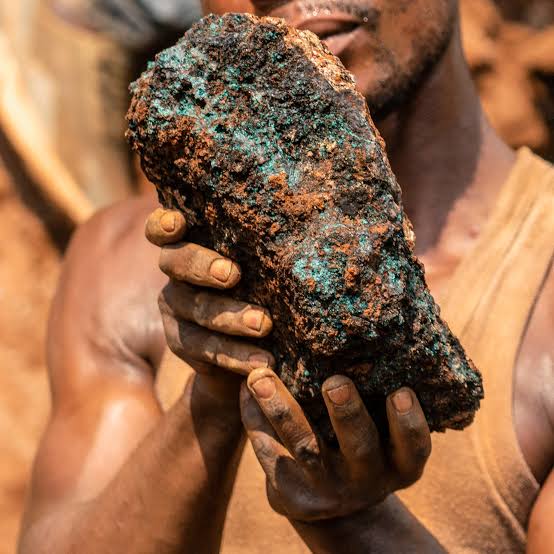
An investigation by Lighthouse Reports, The Financial Times and Le Monde has uncovered that between 2,000 and 5,000 tonnes of natural uranium were likely exported from the Democratic Republic of Congo to China embedded in cobalt hydroxide shipments over a 24-year period — despite a formal ban on uranium extraction and export.
The investigation, published on July 30, 2026, was triggered by a previously undisclosed internal memorandum from the International Atomic Energy Agency obtained in 2024. The 2009 document cited credible information indicating that uranium was present in “significant quantities” in most cobalt ores from Katanga and was “effectively exported as a cobalt by-product”.
A legacy of uranium in the Copperbelt
Katanga, in southeastern DRC, sits within Central Africa’s Copperbelt — one of the world’s richest mineral provinces. The region has long been known for its uranium. A significant proportion of the uranium used in the Manhattan Project, which developed the first atomic bombs, came from Katanga’s Shinkolobwe mine. The mine was closed after independence and placed within an exclusion zone. In 2004, President Joseph Kabila declared the area a prohibited mining zone, citing national security and the presence of uranium, which Congolese law classifies as a reserved mineral substance.
Yet uranium and cobalt frequently occur together across the Congolese and Zambian Copperbelt. “It is not limited to specific locations; it is a constant feature,” said Tomas Statius, a Lighthouse Reports journalist and co-author of the investigation.
The science behind the estimate
To estimate the uranium volumes, Lighthouse Reports collaborated with Sébastien Philippe, then a senior researcher at Princeton University, and geologist Ryan Manzuk. Their peer-reviewed study, published in Nature Communications on July 30, 2026, combined geological mapping, mineralization data, geochemical models and mine-level trade records from 2000 to 2024.
The researchers estimated that 2,000–5,000 tonnes of uranium were shipped from the DRC in cobalt hydroxide — the export form for over 95 per cent of DRC cobalt production. Less than 10 per cent of this material has been publicly declared and placed under international safeguards. An additional 1,000–4,000 tonnes were likely discarded to tailings in easily mobilised forms, posing environmental and health risks.
The uranium contained at the lower end of the estimate would, after recovery and processing, be sufficient to fuel a one-gigawatt nuclear reactor for at least a decade.
Tenke Fungurume: the mine at the centre of the probe
The most extensively documented site was Tenke Fungurume Mining, one of the DRC’s largest copper and cobalt operations. The mine was owned by US company Freeport-McMoRan until it was acquired by Chinese mining group CMOC in 2016.
Internal company documents reviewed by investigators recorded uranium-rich cobalt samples, including a peak concentration of 1,100 parts per million in December 2016 — approximately 15 times the export limit cited by the investigation. Testing records showed concentrations above that threshold on more than 70 per cent of recorded days between June 2016 and December 2020. Further documents indicated significant uranium concentrations remained in cobalt produced at TFM in June 2021.
Internal memoranda also described experiments intended to remove uranium from cobalt hydroxide during the period covered by the records.
Steve Muanza, head of the DRC’s nuclear energy agency, told the Financial Times that it was “technically possible” and even “probable” that Chinese companies were extracting uranium from cobalt ore exported from the country, though he said there was no direct evidence. His agency has requested funding to install radioactivity detectors on trucks travelling from the DRC into Zambia.
Two supply chains, one destination
Interviews with mining executives, traders and metallurgists indicated that testing across the supply chain was inconsistent. Some industry specialists described separate supply chains for higher-grade material subjected to additional treatment and lower-quality cobalt products containing more impurities — including uranium — destined mainly for China.
Import data for phosphoric acid, a chemical used to separate uranium from cobalt material, appeared insufficient to support widespread removal at the scale assumed in the model. Large imports of the chemical often followed incidents in which contaminated shipments had been flagged.
China refines about 80 per cent of the world’s cobalt supply, while an estimated 95 per cent of Congolese cobalt is sent to China.
CMOC rejects findings
CMOC has categorically disputed the investigation’s conclusions. The company said all cobalt hydroxide currently produced by Tenke Fungurume complied with Congolese regulations and international customer standards, with no recorded breaches of permitted limits or trade rules.
CMOC said it did not know the source of the investigation’s historical data and maintained that uranium levels were below the relevant threshold, making a dedicated removal process unnecessary. The company denied carrying out uranium separation or extraction in either the DRC or China.
The Union of Chinese-Capital Mining Companies in the DRC also rejected the allegations, describing the claims as “unfounded” and insisting that all Chinese companies operating in the region “scrupulously respect Congolese mining regulations and international standards”.
Kinshasa launches counter-verification
The DRC government officially responded on August 7, 2026, acknowledging the study while contesting certain methodological elements. In a statement from the Ministry of Communication, Kinshasa noted that the study relied on modelling rather than direct measurements on exported shipments.
The government announced the opening of a “counter-verification analytical campaign” to conduct fresh analyses of the composition of the mineral products concerned. It also plans to establish an inter-ministerial working group to assess health and environmental risks, with a report to be presented within 60 days. Kinshasa has requested technical support from the IAEA.
A regulatory blind spot
The investigation exposes a critical gap in nuclear accountancy. Since a 2002 amendment to the DRC’s mining code designated uranium as a restricted material, its extraction and export have been officially prohibited. Yet the co-occurrence of uranium with cobalt in Katanga’s ores has created a pathway for incidental co-extraction that appears to have gone undetected for decades.
As Statius told RFI: “There are always by-products in Congolese mining exports — particularly cobalt — and these by-products are effectively monitored by the Congolese authorities. All except one: uranium.”
The investigation did not establish whether the uranium was subsequently extracted or used in China. But the findings have already prompted action: the DRC government has launched its own probe, and the IAEA has been asked to assist in verifying the composition of mineral exports.
The investigators said they stood by their findings. “Our investigation is based on internal documents from the mine and its owners, spanning nearly a decade, that reveal both the contamination and attempts by certain metallurgical engineers to address the issue,” Statius said. “It also draws on a peer-reviewed scientific paper published in one of the world’s top journals.”


