



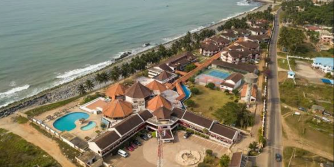
The Ghana Tourism Authority (GTA) has intensified its regulatory crackdown in the Central Region, temporarily shutting down four hospitality establishments—including the popular Elmina Beach Resort—for flouting multiple tourism laws and operating standards.
The affected facilities, which were caught in a pre-festival enforcement sweep, include Savoy Hotel, Veke Executive Lodge, and Wiz Homes—an unregistered Airbnb property in Cape Coast. While Elmina Beach Resort and Savoy Hotel were sanctioned for non-payment of the mandatory tourism levy and failure to maintain standard service levels, Veke Executive Lodge and Wiz Homes were found to be operating without valid licences altogether.
The enforcement action, which commenced on Monday, comes as the region gears up for the annual Oguaa Fetu Afahye—a major traditional festival scheduled for September that draws thousands of domestic and international visitors to Cape Coast and its environs.
Background: A Sector Under Scrutiny
The shutdowns mark the latest phase of a nationwide campaign by the GTA to sanitise Ghana’s hospitality industry, which has faced mounting criticism over unregulated short-term rentals, substandard amenities, and widespread tax evasion. Under the Tourism Act, 2011 (Act 817), all accommodation providers—including hotels, guest houses, motels, and increasingly popular short-term rental platforms such as Airbnb—are required to register with the GTA, obtain a valid operating licence, and remit a 1% tourism levy on their gross earnings.
However, industry watchers note that the rapid proliferation of unlicensed Airbnb-style properties has created a regulatory blind spot, with many operators failing to meet health, safety, and fire standards. In a statement to the Ghana News Agency (GNA), Mr. Charles Buabin, the Regional Director of Tourism for Central Region, clarified the legal position regarding such platforms.
“In the laws of Ghana, ‘Airbnb’ is not explicitly listed as a separate category. However, all accommodation enterprises—whether traditional hotels or short-term rentals—are required by law to be registered and licensed before they can commence operations. The mode of booking does not exempt an operator from these statutory obligations,” Buabin said.
Repeated Warnings Ignored
The Regional Director disclosed that the affected establishments had been issued multiple caution notices and given ample time to regularise their status, but they continued to operate in defiance of the law.
“These facilities were not caught by surprise. We had engaged them on several occasions, but they chose to ignore the warnings. The GTA cannot compromise on the safety and comfort of patrons, especially during a high-profile event like the Fetu Afahye, where the eyes of the nation and the world are on us,” Buabin added.
Patrons who had booked rooms at the affected facilities were turned away at the weekend, with some expressing frustration. However, the GTA insists public safety takes precedence.
Conditions for Reopening
For the closures to be lifted, the management of each establishment must rectify all identified infrastructural and operational defects, settle outstanding tourism levy arrears, and pay applicable regulatory fines. The GTA has not disclosed the exact penalty amounts, but sources indicate they could range from thousands of cedis, depending on the severity and duration of the violations.
Buabin further urged the general public to verify the licensing status of any accommodation facility before making bookings, particularly during the upcoming festive season. “Patrons should ask to see the facility’s valid licence. If it is not displayed, that is a red flag. We encourage the public to report unlicensed operators to the nearest GTA office,” he advised.
Looking Ahead
The Central Region is a key tourism hub, home to major historical sites such as Cape Coast Castle, Elmina Castle, and Kakum National Park. With the Fetu Afahye—celebrated by the Oguaa traditional area—drawing crowds from across the globe, the GTA has pledged to sustain its enforcement operations throughout the season.
“This exercise is not a one-off. We will continue to inspect and monitor all hospitality establishments in the region, and we will not hesitate to shut down any facility that does not meet the standards set by law. Our goal is to protect the reputation of Ghana’s tourism brand and ensure that every visitor receives the service they deserve,” Buabin concluded.
The GTA has also hinted at rolling out a digital verification portal in the coming months, allowing patrons to instantly check the licensing status of any accommodation provider via a mobile app or SMS service—an initiative aimed at curbing the growing menace of unlicensed operators across the country.


