



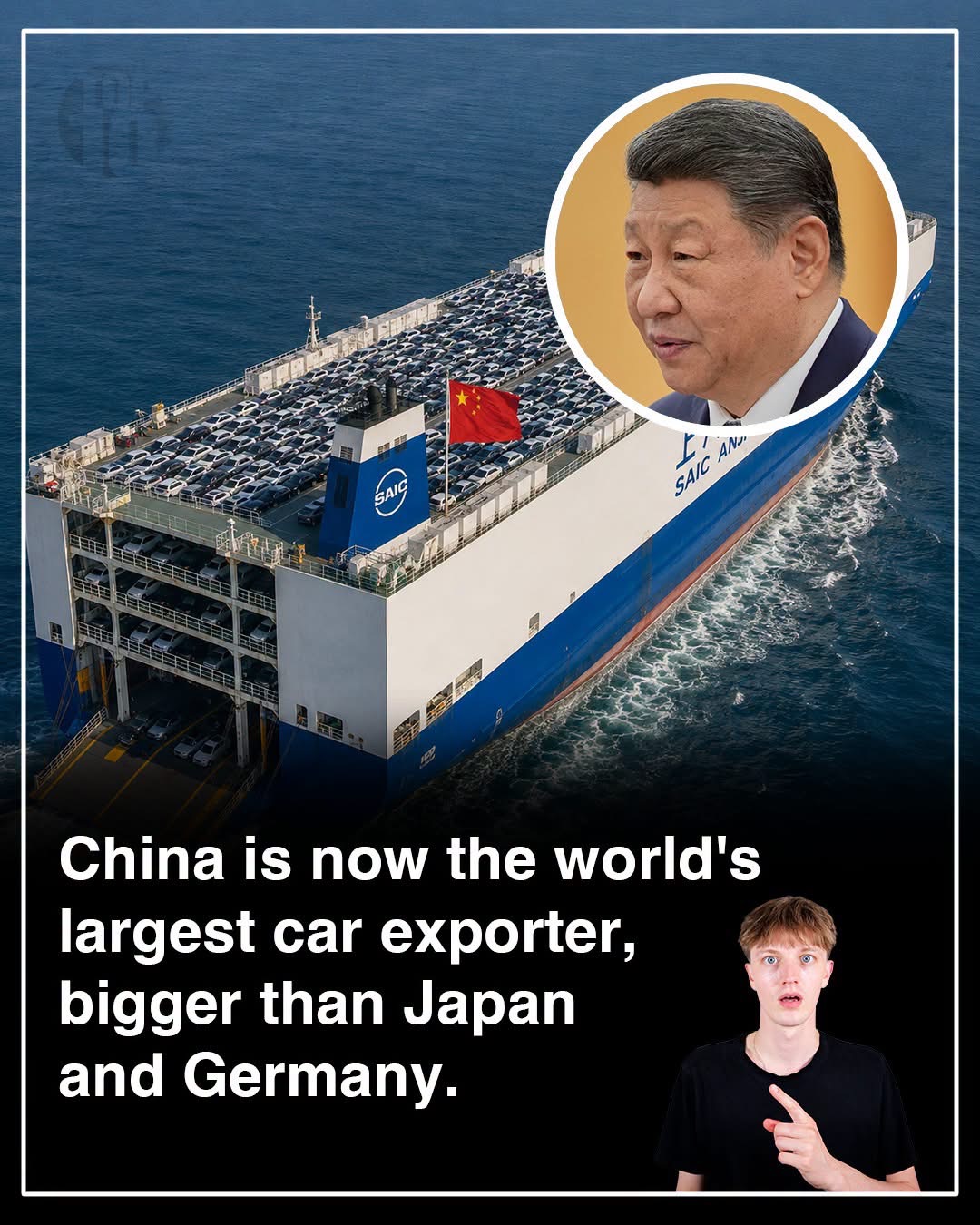
China has officially become the world’s largest vehicle exporter, surpassing longtime automotive giants Japan and Germany in a dramatic rise that has reshaped the global automotive industry in record time.
For decades, Japan and Germany dominated global car exports. That landscape has changed remarkably quickly. In 2023, China overtook Japan for the first time. By 2025, the nation had secured its position for the third consecutive year, with total vehicle exports reaching 8.32 million units—a 30 per cent increase from 2024. China’s export volume now exceeds the combined totals of Japan and Germany.
The Numbers Tell the Story
The pace of China’s ascent is nothing short of remarkable. In 2019, China exported approximately 700,000 vehicles, ranking as a relatively minor player in global car exports. By 2024, that figure had surged to roughly 5.5 million vehicles, surpassing Japan’s 4.2 million and Germany’s 3.4 million. The momentum continued into 2025, with China’s exports climbing past 7 million vehicles—officially reaching 7.098 million units according to the China Association of Automobile Manufacturers (CAAM), a year-on-year increase of 21.1 per cent. Other data sources, including the China Passenger Car Association (CPCA), put the figure at 8.32 million vehicles.
By comparison, Japan’s 2025 vehicle exports stood at approximately 4.2 million units, while Germany exported around 3.17 million passenger cars. Chinese exports have now surpassed the combined total of both nations.
Electric Vehicles Drive the Boom
A huge part of that growth has come from Chinese brands expanding aggressively overseas, especially with electric vehicles (EVs) and plug-in hybrids. New energy vehicles (NEVs)—including battery electric, plug-in hybrid, and fuel-cell vehicles—have been the primary catalyst behind China’s export surge.
In 2025, China’s NEV exports reached 2.615 million units, more than doubling from the previous year. According to other data sources, NEV exports reached 3.43 million units, a year-on-year increase of 70 per cent. NEVs now account for approximately 40 per cent of China’s total vehicle exports. China’s total production of NEVs topped 16 million units in 2025, while EV exports alone hit a record 2.6 million units, with an export value of $69.6 billion.
China’s EV exports have expanded to more than 150 countries and territories. In April 2026 alone, China’s EV exports jumped 40 per cent year-over-year to 278,081 units.
Chinese Brands Go Global
Companies such as BYD, Chery, and Geely are now selling cars across Europe, Southeast Asia, Latin America, and the Middle East.
Chery Auto remained China’s largest car exporter in 2025, with exports reaching 1.344 million units, a 14.7 per cent year-on-year increase. This marks the 23rd consecutive year Chery has ranked first among Chinese brands in passenger vehicle exports. In 2025, Chery’s overseas revenue reached 157.42 billion yuan ($21.7 billion), accounting for 52.4 per cent of total revenue—the first time its overseas business surpassed its domestic market.
BYD delivered equally impressive results. In 2025, BYD’s overseas sales exceeded one million units for the first time, reaching 1.05 million vehicles—a staggering 145 per cent year-on-year increase—spanning 119 countries and territories. The company’s overseas selling price averages approximately 180,000 yuan ($24,800), with gross margins approaching 28 per cent.
Geely also posted strong results, with overseas sales reaching nearly 30,000 units in the first nine months of 2025. In April 2026 alone, the combined exports of Chery, BYD, and Geely exceeded 390,000 vehicles, with new energy vehicles accounting for more than 50 per cent of monthly exports.
Global Reach Expands
Chinese vehicles are now present across multiple continents. Europe remains a primary market, accounting for about half of all Chinese EV exports. Southeast Asia represents the second-largest segment at approximately 20 per cent of exports. Latin American sales reached approximately $6 billion in 2025, while the Middle East has emerged as a significant growth market. Africa recorded the most dramatic growth, with a 184 per cent year-over-year increase in EV imports during the first nine months of 2025.
In 2025, Mexico overtook Russia as China’s largest export destination, with 625,200 vehicles shipped—an increase of 180,500 units year-on-year. Russia followed with 582,700 vehicles, while the United Arab Emirates ranked third with 571,900 units.
The top 10 export destinations for Chinese vehicles in 2025 were: Mexico (625,200), Russia (582,700), UAE (571,900), United Kingdom (335,600), Brazil (322,100), Saudi Arabia (302,200), Belgium (300,100), Australia (297,400), Philippines (256,700), and Kazakhstan (211,500).
For new energy vehicles specifically, the top five markets in 2025 were Belgium, the United Kingdom, Mexico, Brazil, and the Philippines.
Quality and Value Rising
Beyond volume, Chinese car exports are also moving up the value chain. The average price of Chinese vehicle exports has risen from approximately 100,000 yuan (41,400) in 2025. This reflects a significant shift from low-cost, entry-level vehicles to higher-value, more sophisticated offerings.
Chinese automakers are also transitioning from simple “product exports” to “industrial chain exports.” By the end of 2025, Chinese automakers had established more than 100 overseas production bases worldwide, with planned overseas capacity exceeding 2.5 million vehicles. BYD has built factories in Thailand, Brazil, and Hungary, while Chery operates 16 knockdown (KD) assembly plants globally.
Japan and Germany Feel the Pressure
The rise of Chinese automotive exports has placed significant pressure on traditional automotive powerhouses. In 2025, Japan’s auto exports fell 1.0 per cent year-on-year to 4.17 million units, marking the second consecutive year of decline. Exports to the United States, which account for 32.3 per cent of Japan’s total vehicle exports, dropped 1.7 per cent to 1.35 million units. Meanwhile, Japanese auto parts suppliers are also feeling the pinch. Denso Corporation reported a 28 per cent year-on-year decline in parts exports to China, as Chinese EV manufacturers increasingly source components domestically.
Germany’s passenger car exports stood at 3.17 million units in 2025, remaining well below pre-crisis 2019 levels—a gap of 9 per cent. German automakers have also seen their market share erode in key regions. In Southeast Asia, German brands’ share of new vehicle registrations in Singapore fell to 28 per cent in 2024 from 32 per cent the previous year. German car exports to China plummeted 45 per cent year-on-year, falling to just 98,000 units.
Historic Shift
China’s ascent is one of the fastest shifts the global car industry has seen in decades. China went from being known mainly as the world’s biggest car market to becoming the country shipping more vehicles abroad than anyone else. In 2009, China surpassed Japan to become the world’s largest car producer. Today, China accounts for nearly one-third of global vehicle production, with annual output exceeding 30 million vehicles. In 2024 alone, China produced over 31 million vehicles.
The country’s auto trade with the European Union also shifted from a deficit to a surplus in 2025, while car exports boosted China’s trade surplus with Africa.
Challenges Ahead
Despite the remarkable growth, challenges remain. In 2025, traditional automotive powerhouses in Europe and elsewhere launched various anti-dumping investigations and imposed high tariff barriers in response to the surging Chinese auto exports. Chinese automakers have responded by accelerating localised production to circumvent tariffs.
Industry analysts also caution that Chinese automakers must avoid falling into a “victory mentality” trap and instead focus on establishing new rules for sustainable growth and long-term value creation. As overseas production capacity continues to expand, technology research and development deepens, and market diversification strategies advance, China’s auto exports are expected to maintain their growth trajectory—though risks related to trade barriers, supply chain disruptions, and intensifying global competition remain.


