



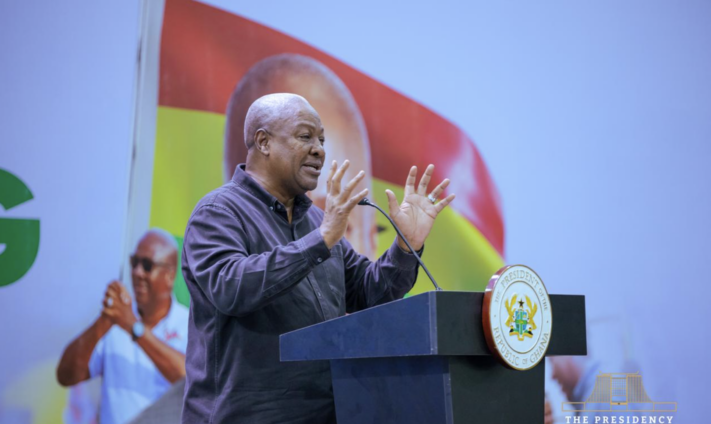
President John Dramani Mahama has announced a major shift in the government’s strategy to combat illegal mining, revealing that permanent military detachments will now remain in reclaimed forest reserves to prevent illegal miners from returning.
The decision, announced during the President’s tour of the Upper East Region, follows the failure of the previous approach under which cleared forest reserves were simply handed back to the Forestry Commission.
New Strategy Addresses Previous Weaknesses
Under the new arrangement, soldiers will remain in the reserves after illegal miners have been removed, providing permanent security presence in areas that have been cleared of galamsey activities.
“Before, what we did was when we cleared, we handed over to the Forestry Services Commission. But they don’t fear the Forest Service; they go and drive the forest guards out, and they go back into the mine. And so now we put a military detachment,” President Mahama explained.
He acknowledged that the new approach would come at a significant cost to the state. “After we’ve cleared the forest reserve, we leave a military detachment there. And that means we have to spend more money. One, you must feed the soldiers; you must provide them with the logistics to continue to stay there in the forest,” he said.
Despite the additional financial burden, the President reaffirmed his administration’s commitment to the fight against illegal mining. “But we will not give up; we will continue the fight against illegal mining,” he declared.
Massive Scale of Forest Destruction
The scale of the challenge facing Ghana’s forest reserves is staggering. According to the Ministry of Lands and Natural Resources, the country has lost an estimated 8,900 hectares of forest reserves to illegal mining—an area equivalent to approximately 12,500 football fields. Nine out of Ghana’s 288 forest reserves have been severely affected by illegal mining.
The government has so far cleared as many as possible of the nearly 49 forest reserves that had been invaded by illegal miners. Deputy Minister for Lands and Natural Resources, Alhaji Yusif Sulemana, recently disclosed that nine forest reserves previously under the control of illegal miners had now been reclaimed.
NAIMOS Intensifies Operations
The National Anti-Illegal Mining Operations Secretariat (NAIMOS) has been at the forefront of the government’s enforcement efforts. President Mahama acknowledged the agency’s work, stating: “We are working; NAIMOS is working very hard. We’ve seized excavators, we’ve seized Changfan machines, and you drive them out of this area, they run to this other area. But we are making progress”.
According to figures from the Lands Ministry covering operations up to July 2026, 258 people have been arrested in connection with illegal mining activities in forest reserves. Enforcement operations have also led to the seizure or immobilisation of 234 excavators, 2,728 pumping machines, 1,724 Changfan machines, and 461 motorbikes and tricycles.
NAIMOS has conducted numerous operations across the country. In a recent operation at Mpohor Fiase in the Western Region, the secretariat arrested 19 suspected illegal miners. Another dawn operation at Adiewoso in the Ahanta West Municipality resulted in the arrest of 49 suspected illegal miners. The secretariat has also intensified operations within the Atiwa Forest Reserve in the Eastern Region, where patrols uncovered extensive illegal mining along river systems.
Prosecution Remains a Major Challenge
Despite the arrests, securing successful prosecutions remains the government’s biggest difficulty. Lands and Natural Resources Minister Emmanuel Armah-Kofi Buah acknowledged this challenge, stating: “The challenge we are having is not the arrest. It is the prosecution”.
The Ministry is engaging the Attorney-General’s Department to address bottlenecks affecting the prosecution of persons arrested in illegal mining operations. The government has also introduced tighter documentation and clearance requirements for excavators, with more than 4,000 excavators currently being held at Ghana’s ports pending compliance.
Military Protection Camps Underway
The Forestry Commission has initiated steps to complete ten military protection camps at strategic locations in forest reserves that are hotspots for illegal mining and timber activities. Each camp, which will host up to 12 forestry guards, will be equipped with communication gadgets, drones and arms to enhance surveillance.
The initiative focuses on 44 forest reserves severely impacted by illegal mining, with nine designated as “red zones”. Forestry Commission Chief Executive Dr Hugh Brown said tenders had already been issued for the project, with funding support from donor institutions. “We expect 10 more camps by the end of the year, and by next year, we expect all 34 to be stationed at hotspot areas,” he added.
Government Targets Formalisation of Mining
While stressing the need to curb illegal mining, President Mahama said the government also recognised the potential of the mining sector to create jobs for young people, particularly in the Upper East Region.
“Upper East has good potential, and mining can create jobs, but we need to make sure that these are formalised mines so that they can employ our young people to operate,” he said.
The President cited the opening of Cardinal Mine (Cardinal Namdini Mining Limited) in the Upper East Region as an example of how formal mining operations could contribute to job creation. Cardinal Namdini, one of West Africa’s largest single-stream gold mines based in the Talensi District, has injected over $100 million into Ghana’s economy through its operations.
He also pointed to the Black Volta mine development in the Upper West Region as another example of the potential for properly regulated mining to create employment. The Black Volta Gold Project, located in the Wa West District, is expected to create 1,700 long-term jobs for communities in the region.
“Our target is to formalise the mining activity so that we have greater control over it than the current scattered illegal mining that takes place,” President Mahama said.
Regional Distinction: Upper East vs Southern Forests
President Mahama drew a distinction between mining activities in the Upper East Region and the environmental damage associated with illegal mining in forested areas in southern Ghana.
According to him, much of the gold in the Upper East Region is found in rock formations, which means mining there does not cause the same level of environmental destruction associated with mining in forest reserves in the south.
“The advantage with the Upper East Region is that most of the places where the gold is found are found in rock. And so it does not create the kind of environmental destruction that we see in the south,” he said.
He explained that mining in such areas involves blasting rock and processing it to extract the gold, resulting in less devastation than what occurs in southern forest reserves.
Forestry Commission Faces Severe Staffing Shortages
Ghana’s forest protection system remains under severe strain. The Forestry Commission has disclosed a shortfall of over 2,500 forest guards, as illegal mining and logging continue to outpace enforcement efforts across major forest reserves.
The current arrangement, where forest guards reside among community members, has been described as counterproductive to the fight against galamsey, particularly in forest reserves. The establishment of military camps closer to the reserves is expected to place security personnel in a better position to detect and respond to illegal activities before they are carried out.
Government Commits to Long-Term Fight
President Mahama stressed that the government’s new strategy represents a fundamental shift from simply removing illegal miners to maintaining a permanent security presence in reclaimed areas, while pursuing the formalisation of mining activities outside protected zones.
“Forests and river bodies have been declared security zones. Permanent military bases have been established and offenders have been arrested and are being prosecuted,” the President said earlier this year.
The government’s revised strategy combines tighter controls on mining equipment, stronger enforcement, reforms to the licensing regime and greater community participation in decisions concerning mining concessions. Proposed reforms include reducing the maximum initial duration of large-scale mining leases from 30 years to 20 years, and requiring holders of exploration and prospecting licences to demonstrate actual work on their concessions within specified periods.


