



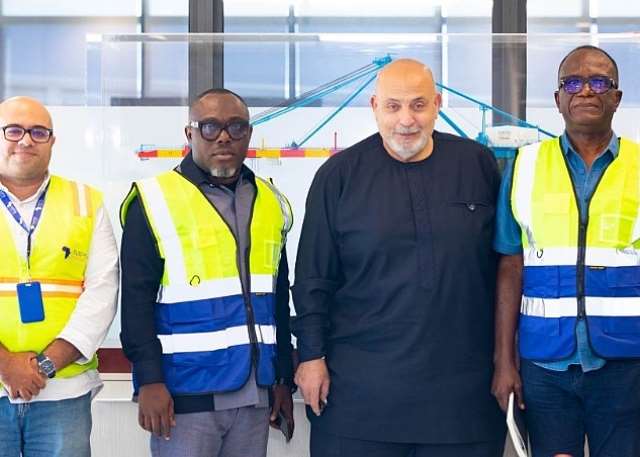
The Ghana Shippers’ Authority (GSA) has stepped in to address growing congestion at the Tema Port, with its leadership undertaking a fact-finding mission to assess operational pressures and identify urgent solutions as cargo volumes skyrocket and stakeholders warn of severe economic consequences.
Led by Board Chairman Mike Allen Hammah and Chief Executive Officer Prof. Ransford Gyampo, the delegation engaged key port managers—including Ghana Ports and Harbours Authority (GPHA) Director-General Major-General Paul Seidu Tanye-Kulono and Meridian Port Services (MPS) Chief Executive Officer Mohammed Samara—to explore immediate measures to ease cargo clearance and vessel turnaround .
Volumes Skyrocket While Infrastructure Lags
The visit comes amid mounting concern from importers, exporters, freight forwarders, and the public as container traffic surges. MPS CEO Mohammed Samara revealed that cargo volumes at Tema Port have grown from approximately 700,000 TEUs (twenty-foot equivalent units) in 2020 to 2.7 million in 2025, with current throughput at 2.5 million TEUs—even before the peak Christmas season begins .
This represents a staggering 22 percent increase in cargo volumes in the first quarter of 2026 compared to the same period in 2025 . The Bank of Ghana confirmed this trend, reporting that total laden container traffic reached 237,018 containers between January and March 2026, up 15.5 percent from the corresponding period in 2025 .
However, Mr. Samara cautioned that while congestion is currently “manageable,” failure to act swiftly could escalate into serious disruption. He noted that despite the expansion of Terminal 3 advancing Ghana’s position as a shipping hub, supporting infrastructure—particularly roads and inland depots—has not kept pace with growth .
Excessive Inspections Identified as Key Bottleneck
The fact-finding mission identified systemic challenges contributing to delays, with excessive physical inspections emerging as a critical concern. According to MPS, approximately 70 percent of containers undergo intrusive physical inspections, compared to a global standard of around 10 percent .
Ghana’s “Red Lane” inspection rate runs at roughly 74 percent, creating significant bottlenecks. Ineffective joint inspections, where state agencies inspect containers separately rather than concurrently, were identified as major contributors to clearance delays .
Mr. Samara highlighted cases where state agencies conduct inspections individually, adding to delays and costs. The delegation proposed several interventions, including:
· A GRA-Customs-led review of the risk classification system
· Wider use of post-audit clearance procedures
· Better coordination of concurrent inspections among state agencies
· Stricter enforcement of penalties for wrong declarations by non-compliant customs officers, clearing agents, and freight forwarders
The GSA has committed to pushing for a multi-stakeholder action plan aimed at accelerating cargo release while safeguarding government revenue .
Economic Fallout Hits Businesses and Consumers
The congestion crisis has already begun to impact the broader economy. In August, the Ghana Institute of Freight Forwarders (GIFF) warned that an accumulation of empty containers was consuming valuable space and driving up costs . The Importers and Exporters Association of Ghana (IEAG) has called for urgent expansion of container handling capacity, urging GPHA to convert selected spaces into modern container terminal facilities .
Shippers have complained bitterly that containers remain grounded at MPS Terminal 3 for weeks instead of being positioned at Inland Container Depots (ICDs) for clearance, with rent, demurrage, and other time-related penalties continuing to accrue at importers’ expense .
Transport Minister Joseph Bukari Nikpe has raised concern over rising costs passed on to consumers due to delays, describing the situation as “not the best” .
Cement manufacturers have been particularly hard hit. The Chamber of Cement Manufacturers, Ghana (COCMAG) announced a temporary GH¢12.00 per bag “clinker demurrage surcharge” after vessel waiting times surged from an average of seven days in January to between 30 and over 40 days in August 2026 .
Industry-wide demurrage costs have reached an estimated US50 million within the first eight months of the year, with individual vessels incurring charges ranging from US1 million . CUTS International has raised competition concerns over the uniform surcharge while acknowledging the serious cost pressures confronting manufacturers .
Road Infrastructure and Regional Competition
MPS pointed to inadequate road infrastructure as a key constraint, noting that a proposed eight-lane road from the GNPC Junction to the Ashaiman Overhead—which the company has offered to fund—has yet to receive the necessary support to begin construction .
Mr. Hammah emphasized the competitive imperative: “Ghana is competing with neighbouring ports, so we need to improve our efficiency. GSA has a responsibility to make Ghana competitive. We can only be an efficient shipping and logistics hub with improved infrastructure in and around the port” .
He noted that the GSA’s expanded mandate under Act 1122 (2024) requires proactive engagement with challenges affecting commercial shipping . The Authority will continue to bring regulators, service providers, and industry players together through quarterly stakeholder meetings to address long-standing challenges affecting international trade .
Looking Ahead
The GSA has indicated it will push for a multi-stakeholder action plan with clear timelines, as industry players welcome the Authority’s efforts to create a single platform for confronting the challenges. COCMAG has indicated that the GH¢12 surcharge is strictly temporary, remaining in effect until December 31, 2026, with a formal review scheduled for January 2027 .
As stakeholders await concrete action, the urgency of addressing the congestion crisis grows. With the peak Christmas season approaching and cargo volumes already at 2.5 million TEUs, the need for immediate and coordinated intervention has never been more critical .


