



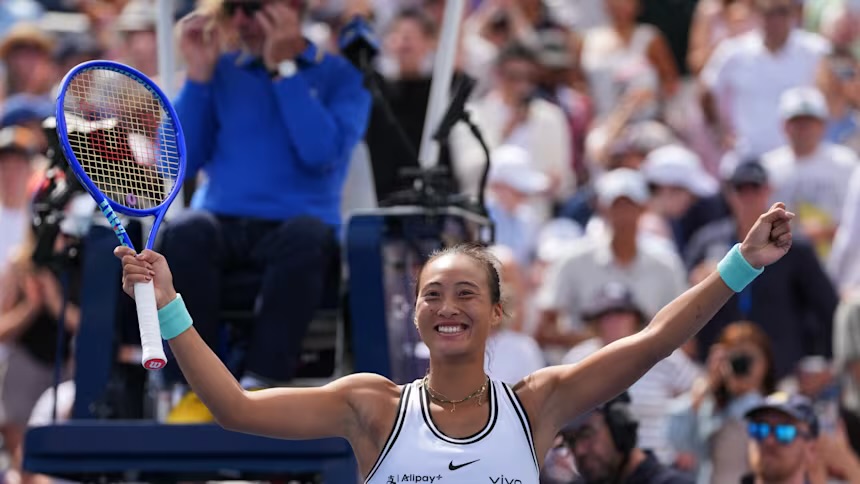
Just over two years after she stood atop the podium at Roland Garros as an Olympic champion, Zheng Qinwen found herself on the outer courts of Flushing Meadows, fighting not for gold but for a place in the main draw of a Grand Slam.
The 23-year-old Chinese superstar’s dramatic fall from grace—and her equally dramatic return—has been one of the most compelling storylines of this year’s US Open. After dropping out of the world’s top 100 following a torrid battle with a chronic elbow injury, Zheng has reignited her career with a stunning run from qualifying to the fourth round, culminating in a comeback for the ages .
The Injury That Derailed a Meteoric Rise
Zheng’s trajectory in 2024 was nothing short of spectacular. She reached the Australian Open final, clinched a historic Olympic gold medal in Paris—becoming the first Asian player to win a singles tennis gold—and climbed to a career-high ranking of world No. 4 . Her powerful serve and crushing forehand made her one of the most feared baseliners on tour.
However, a chronic elbow injury caused by small pieces of bone floating in her joint brought that momentum to a screeching halt . Zheng underwent arthroscopic surgery on her right elbow in July 2025 and attempted an early comeback at the China Open in October, only for the premature return to aggravate the issue . The injury struck at the core of her game; an aggressive baseliner, she relies heavily on the power generated through her elbow for her signature serve and groundstrokes . Sidelined again, she was forced to skip the 2026 Australian Open and only returned fully to the WTA Tour in February . But her form failed to return, with a string of early exits at Indian Wells, Roland Garros, and Wimbledon . “After coming back from injury… I forgot how to compete,” Zheng admitted, reflecting on her struggles .
With her ranking plummeting outside the top 120, she was no longer guaranteed a place in the major draws .
The Grind of Qualifying
For the first time since the 2022 Australian Open, Zheng had to play through three rounds of qualifying just to reach the main draw at Flushing Meadows . “I was crying after I won the third match to reach the main draw,” she revealed. “The main draw is just the beginning where all the players start. I fought so hard just to start like everyone else. For me, that was really not easy” .
The Comeback: ‘Finally, Luck is on My Side’
That hard work paid off in spectacular fashion. Having won three qualifying matches, she stormed past 22nd seed and 2025 Australian Open champion Madison Keys on September 5 in the third round .
The victory itself was a microcosm of her career—a refusal to surrender despite impossible odds. After dropping the first set 6-1, Zheng rallied to take a tense second-set tiebreak. She then found herself staring down the barrel of defeat, trailing 5-0 and facing a match point in the third set against the American crowd favorite . “It was a very dramatic match,” Zheng later said .
“I was just telling myself, ‘Never give up. Please, I don’t want to be beaten 6-0,'” Zheng recalled . She then reeled off an astonishing seven consecutive games, clinching the match 1-6, 7-6(3), 7-5 and collapsing to the court in relief . “Finally, a bit of luck is on my side after all these three or four months I’ve been suffering a lot,” she said .
Belief Reignited
Zheng credited a decision to skip the Cincinnati tune-up event in favor of an intensive training block for her resurgence . “We’ve been working really hard before the US Open to try to get a good result here. But I actually never think about the result because I just want to fight every single match,” she said . “After this block of training, I felt I really came back stronger, physically and also mentally” .
Zheng, who is now on a six-match winning streak in New York, will face six-time Grand Slam champion Iga Swiatek for a place in the quarter-finals . Her journey from an Olympic champion forced to grind through qualifiers to a fourth-round contender stands as a testament to her resilience and fighting spirit .


