



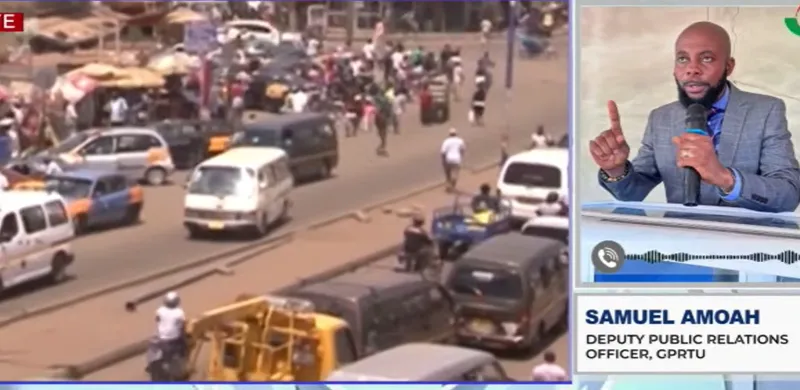
Public transport fares across Ghana will rise by 8% starting Saturday, September 26, 2026, following a final agreement between the Ghana Private Road Transport Union (GPRTU), the Ghana Road Transport Coordinating Council (GRTCC), and the Ministry of Transport. The decision, reached after weeks of intense negotiations, falls significantly short of the 30% increase the unions had initially demanded.
The Deputy Public Relations Officer of the GPRTU, Samuel Amoah, confirmed the resolution on TV3’s Ghana Tonight on Tuesday, September 22. “We jaw-jaw and at the close of the meeting, we all came up with an agreement that we will come up with 8% increment which will take effect on Saturday, September 26,” he said.
Weeks of Tough Negotiations
The road to the 8% agreement was anything but smooth. The GPRTU and GRTCC first proposed a 30% increase in early September 2026, citing rising fuel prices, spare parts, vehicle maintenance, insurance premiums, and DVLA charges. At a meeting with the Ministry of Transport on September 8, the unions presented their proposal, while the government outlined support measures for transport operators, including a GH¢2 per litre intervention on diesel. A joint team comprising the Ministry, GPRTU, and GRTCC was then formed to review the actual cost of operating commercial transport.
However, discussions grew contentious. The government initially proposed an increase of between 10% and 15%, which the GPRTU flatly rejected, insisting that any adjustment must be at least 25%. Speaking on JoyNews, Amoah detailed the cost pressures drivers were facing: “For a 15-seater, we were paying GH¢837 yearly. Now we are paying GH¢994. Likewise, a Sprinter, 23 passengers, were paying GH¢930. Now we are paying GH¢1,194”. Taxi operators had also seen insurance premiums rise from about GH¢701 to GH¢744, while DVLA charges were increased in April, adding further strain.
On September 21, the National Petroleum Authority (NPA) suggested that the planned fare increase had been put on hold after discussions between the government and transport operators. The GPRTU swiftly rejected that characterization. “There has never been any agreement with the government that we are suspending our proposed increment,” Amoah said, explaining that the union’s last meeting with the Transport Minister had ended without a conclusion and had been postponed to Tuesday, September 22.
A final meeting on Tuesday, September 22, brought both sides to the table once more. The GPRTU had been pushing hard: “Our expectation is strong on the 30% increment. Our last meeting that we had last Friday, we made the ministry understand that we are not looking at anything less than 25%,” Amoah had said ahead of the decisive talks. During the Tuesday meeting, the Minister of Transport conveyed that the President had given a directive, and there was hope for further reductions on petroleum products. The unions ultimately accepted the 8% compromise.
The Fuel Price Factor
Fuel prices have been a central driver of the negotiations. In April 2026, prices at the pump surged by 15%, with petrol reaching GH¢13.3 per litre and diesel climbing to GH¢17.1 per litre amid a Middle East crisis. The government responded by absorbing GH¢2.00 per litre on diesel and GH¢0.36 per litre on petrol as a temporary measure to ease the burden on households.
The relief proved short-lived. By mid-August 2026, the GPRTU had suspended a planned fare increase after the government announced the GH¢2 diesel reduction. Amoah commended the intervention at the time, noting that diesel could have risen to nearly GH¢20 per litre without it. But by September, the NPA had raised the price floor for petrol to GH¢16 per litre and diesel to GH¢16.77 per litre from September 16, 2026, with Star Oil selling petrol at GH¢16.77 per litre and diesel at GH¢17.77 per litre. The union’s earlier optimism faded. “The situation has returned to the point at which we initially decided to announce an increase,” Amoah had warned in August.
Fares to Be Circulated Before Saturday
With the agreement now in place, the GPRTU is working to finalize the details. “We have come back to work on the percentage and circulate all information that has to go to our members to make sure that by Saturday, every member of our Union will get this information for the increment to take place,” Amoah stated. The 8% increase will affect trotros, shared taxis, and other commercial public transport services, with the new fares applied according to the fare structure agreed by the government and transport operators.
A Critical Sector Under Pressure
The fare adjustment comes against the backdrop of broader challenges in Ghana’s transport sector, which serves as the backbone of the national economy. Roads carry more than 95% of the country’s passenger and freight traffic, and the transport sector accounts for about 12.3% of services GDP, recording real growth of 7.5% in 2024 and an estimated 8.7% in 2025.
Yet the sector faces mounting structural problems. A World Bank report released in September 2026 revealed that only 58% of road-user-charge collections are transferred to road maintenance, leaving more than half of Ghana’s 94,200-kilometre road network in fair or poor condition. Only about 27% of the network is paved, and feeder roads — which connect farming communities to markets — are in worse condition, with over 60% rated fair or poor. Poor roads increase travel times and vehicle operating costs, making the movement of goods and people more expensive. The World Bank has called for maintenance funding to be strengthened alongside new road investment to prevent existing infrastructure from deteriorating further.
Context of Previous Adjustments
The 8% increase represents a modest adjustment compared to recent fare movements. In May 2025, fares were reduced by 15% following a drop in fuel prices. That reduction was reversed in August 2025 when the GRTCC announced a 20% increase, citing the failure of spare parts and service costs to decline despite the earlier fare cut, the introduction of a GH¢1.00 per litre fuel levy, and deteriorating road conditions. In June 2026, fares rose again by 20% as transport operators cited continued increases in fuel prices and spare parts.
The GPRTU, established in 1941, is one of Ghana’s oldest and most influential trade unions, representing hired drivers, owner-drivers, and vehicle owners across the country. It operates at branch, regional, and national levels, with its basic units running individual routes and terminals.
As the new fares take effect on Saturday, commuters across the country will bear an additional 8% on transport costs, adding to the broader cost-of-living pressures that have characterized much of 2026. For the GPRTU’s members, the adjustment offers only partial relief against a backdrop of persistent operational cost increases that the union says have eroded their margins for months.
About GPRTU: The Ghana Private Road Transport Union is a pioneer trade union established in 1941, representing commercial transport operators across Ghana. It operates through a hierarchical structure at branch, regional, and national levels, with its basic units organized around individual routes and lorry terminals.


