



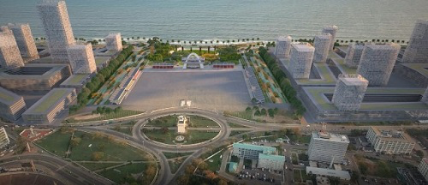
The government has launched a renewed push to revive the long-delayed Accra Marine Drive Tourism Investment Project, with a new board and steering committee now in place to accelerate implementation as authorities seek fresh funding through public-private partnerships and co-financing arrangements.
The 241-acre waterfront redevelopment initiative—originally conceived during the era of Ghana’s first President, Osagyefo Dr Kwame Nkrumah—is designed to transform Accra’s coastline from the Osu Christiansborg Castle enclave to the Jamestown Arts Centre into a world-class tourism, commercial and cultural hub.
A decade of delays
Speaking at the Government Accountability Series on Monday, August 10, 2026, Minister for Tourism, Culture and Creative Arts, Abla Dzifa Gomashie, described the Marine Drive Project as “one of the biggest challenges inherited by the Ministry,” requiring a renewed push to get it back on track.
The project has suffered chronic delays since its inception. Although the government acquired the 241-acre land parcel in 2016 under Executive Instrument 59, and former President Nana Akufo-Addo cut the sod in 2017 under a public-private partnership structure, actual construction never commenced. Past misuse and misapplication of funds, combined with weak project governance, left insufficient capital to sustain implementation. In January 2023, the Ministry disclosed to Parliament’s Public Accounts Committee that the project’s financial account was empty.
New governance structure
The Ministry convened a stakeholders’ meeting in June 2025 to assess the project’s status, review previous decisions and identify outstanding issues delaying implementation. Following the assessment, the government reconstituted and inaugurated a five-member Board of Directors in December 2025, chaired by Deputy Minister for Tourism, Culture and Creative Arts, Yussif Issaka Jajah.
In April 2026, Gomashie inaugurated a 17-member Technical Committee to oversee implementation, tasking it with delivering visible construction progress within 18 to 24 months. The committee brings together representatives from the Ghana Tourism Authority, Ghana Tourism Development Company, Accra Metropolitan Assembly, Lands Commission, utility service providers, the Ministry of Finance, the Attorney-General’s Department and other key state bodies.
“You have a crucial task over the next 18 to 24 months to ensure that processes are expedited, bureaucratic bottlenecks are addressed, and all stakeholders work together to achieve the objectives of the project,” Gomashie told the committee.
Investor roadshow and phased implementation
Gomashie said she had tasked the new board to prioritise transparency, discipline and measurable results while moving quickly on strategic decisions and investor engagements.
“I started the investor engagement myself when I joined His Excellency the President in the London Business Week to pitch to the business community that we do have this facility ready,” she said.
The anchor developer, Attachy Construction Ltd, is preparing a roadshow to attract investors. The revitalised project will be implemented in phases, with early attention given to public promenades, cultural spaces and mixed-use precincts—an approach aimed at building investor confidence while demonstrating tangible progress.
A flagship vision
Valued at approximately US214 million across all three phases, the project is expected to create more than 150,000 direct and indirect jobs and attract over one million tourists annually when fully operational.
The redevelopment master plan was designed by renowned architect Sir David Adjaye and his firm, Adjaye Associates. Key components include waterfront promenades, luxury hotels, shopping centres, cultural pavilions, a national amphitheatre, a public park dedicated to Ghana’s independence forefathers, accessible beaches, an African Heritage Walk, and the Ghana National Museum of Contemporary Arts.
Upon completion, a wholly government-owned special purpose vehicle—Accra Marine Drive Enclave Limited—will issue commercial leases to private developers vetted against the project masterplan. The enclave is planned around three tourism categories: business activities along Accra High Street, leisure along the seafront, and cultural tourism preserving heritage sites including Osu Castle, Black Star Square, Asomdwe Park and the Kwame Nkrumah Mausoleum.
As of May 2026, site clearing, foundation works and the construction of roads, drainage systems and utility infrastructure were ongoing in sections of the project area. Officials say the development will provide significant infrastructure support for Ghana’s creative arts and tourism sectors while establishing a vibrant waterfront destination linked to the Osu Castle and Independence Square enclave.


