



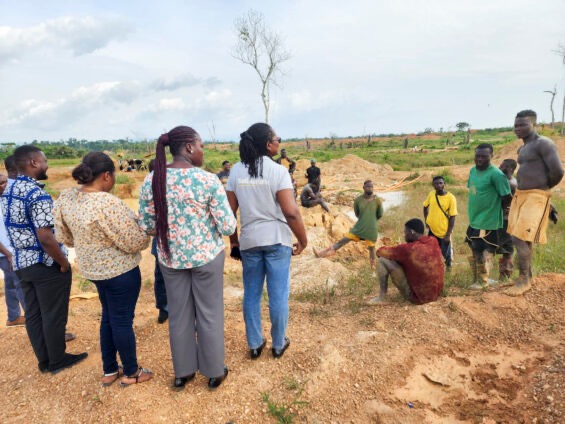
In the mining communities of Pameng, Asamang, Akwaboaso and Abrenya in Ghana’s Eastern Region, a 16-year-old boy can earn up to 1,000 cedis (approximately $65) in a single day supervising ore washing at his father’s mining site. Across the same communities, school attendance is collapsing, and children as young as 10 are abandoning classrooms for abandoned, unregulated pits — exposing themselves to collapsing shafts, heavy machinery, mercury poisoning and sexual exploitation.
These findings emerge from a rapid participatory study conducted in April 2026 by Solidaridad West Africa in collaboration with the Minerals Commission of Ghana, as part of broader efforts to tackle child labour in the country’s small-scale gold mining sector.
More than poverty: peer pressure, quick cash and role models
While poverty remains the dominant driver, researchers found that child labour in mining is equally fuelled by behavioural and social factors: peer pressure, the lure of immediate income, weak parental supervision, and a growing perception that formal education offers no immediate economic benefit.
Some children reported earnings ranging between GH₵100 and GH₵1,000 on productive days, though amounts vary widely depending on the task and access to proceeds. The trend is reinforced by successful miners who serve as role models, and by social media portrayals of wealth.
One 16-year-old participant told researchers: “I have worked at my father’s mining site for two years and can earn up to GH₵1,000 a day supervising ore washing.”
Empty classrooms, fractured futures
The Atiwa West District Education Directorate confirmed that child involvement in illegal mining has led to sharply declining enrolment and attendance, with many parents benefiting directly from their children’s earnings. The directorate also flagged related social ills including drug abuse, teenage pregnancy and prostitution — all linked to the broader galamsey economy.
John Kwasi Osafo, District Director of Education, warned:
“When children leave school for mining, the consequences extend far beyond lost classroom time. Education equips young people with knowledge, skills and opportunities to build better lives. Without it, many children are more likely to remain trapped in low-paying and hazardous work, limiting not only their own potential but also the future development of their communities and the nation.”
A poisoned playground: mercury, kidney failure and dialysis
The physical dangers are devastating. At a forum organised by OAfrica at the University of Ghana in August 2025, paediatric consultant Professor Anthony Kwame Enimil described a four-year-old child who had ingested bottled mercury used for gold extraction at home — X-rays showed mercury particles lodged in the child’s intestines and rectum.
“Mercury exposure in children causes long-term damage to the brain, kidneys and lungs,” Professor Enimil warned. “This is not an isolated case. Thousands of children working in illegal mining sites face similar or worse exposures, often without access to medical care.”
In October 2025, Minority Leader Alexander Afenyo-Markin told Parliament that children in some mining communities were already requiring dialysis treatment due to mercury poisoning. He cited research by Pure Earth and Ghana’s Environmental Protection Agency showing mercury contamination in some mining areas 134 times above safe limits, and arsenic levels exceeding WHO safety standards by more than 4,000 per cent.
Francis Anipa, Project Manager at OAfrica, put it bluntly:
“We call them illegal mining sites, but for the children trapped there, they are poisoned playgrounds. They inhale mercury vapour, carry heavy loads of ore, and suffer abuse — just to survive. Ghana must act.”
Schools without bridges, teachers without hope
The crisis is compounded by collapsing educational infrastructure. The NGO As I Grow visited three schools in the Atiwa West District and documented a bridge across the River Birim that is so dilapidated that during rainy seasons, teachers cannot cross to reach the school and students are stranded at home.
Classrooms are overcrowded, with multiple grade levels taught together. Students lack exercise books, pens, uniforms and even shoes. Many parents, having lost faith in education, actively encourage their children to join them on mining sites. Local leaders have appealed for government intervention — boreholes, toilets, roads and a new bridge — stressing: “These children are not lazy; they are simply neglected.”
Alarming statistics: only 18% of 13-14-year-olds in school
A report by Child Rights International, “The Hidden Cost of Illegal Mining on Ghana’s Children” (April 2025), found that in mining communities, only 18 per cent of children aged 13–14 were enrolled in school, and just 17 per cent of those aged 15–17. The organisation called for the abolition of the community mining policy and stricter enforcement of child protection laws.
UNICEF data from 2022 estimated that between 20,000 and 30,000 children in Ghana are engaged in mining-related activities — some as young as five — performing the worst forms of child labour: digging pits, crushing ore and handling mercury and cyanide without protective equipment.
A path forward: community-led protection
In response, Solidaridad supported the Minerals Commission’s Gender Unit to develop the Child Labour Eradication Framework (CLEF) for Ghana’s small-scale gold mining sector in 2023. The framework is now being piloted in the Atiwa West District through an incentive-based “child labour-free community” initiative.
The pilot aims to establish Community Child Protection Committees, encourage school attendance and retention, reward communities that maintain child-labour-free standards, and build sustainable livelihood alternatives for families.
Monalynn Anokye-Bempah, Principal Officer at the Minerals Commission’s Gender Unit, said the collaboration seeks to “identify and eliminate child labour risks, strengthen local child protection systems, and foster community ownership in protecting children.”
Rosemary Addico, Programme Manager for Responsible Gold at Solidaridad, emphasised:
“Ending child labour in mining communities requires more than enforcement. It also calls for collective action to address the social and economic factors that place children at risk. At Solidaridad, we are committed to working with government, communities, the private sector and development partners to promote sustainable, community-led solutions.”
‘Galamsey’ as a career aspiration
Perhaps the most chilling moment came when an 11-year-old girl was asked about her future dream. Her reply: “When I grow up, I want to do galamsey.”
For generations, Ghanaian children dreamed of becoming doctors, teachers and engineers. Today, illegal mining has become a career aspiration — a stark indictment of a national crisis that has already poisoned rivers, destroyed forests, turned farmlands into wastelands and now threatens to sacrifice an entire generation.
As Minority Leader Afenyo-Markin warned in Parliament:
“If we cannot protect our rivers, our land and our communities, we risk failing an entire generation.”


