



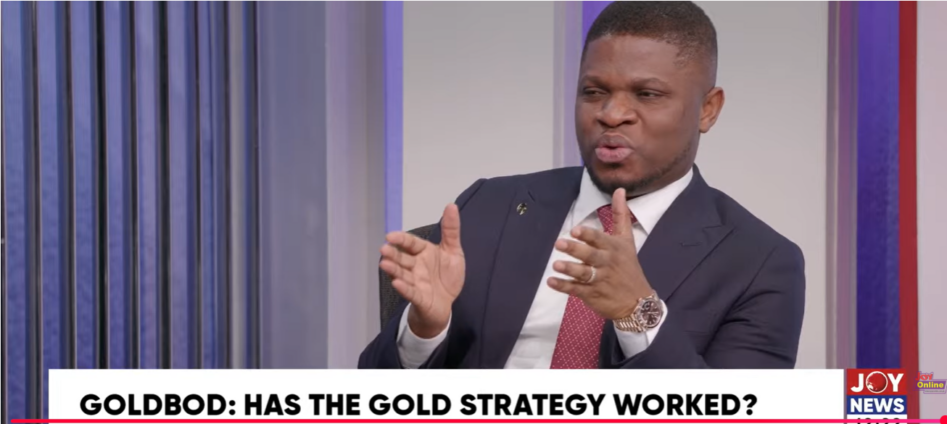
The Ghana Gold Board (GoldBod) generated GH¢970 million in non-tax revenue for the state in 2025 through assay fees charged on gold transactions, Chief Executive Officer Sammy Gyamfi has announced — a figure that underscores the institution’s direct fiscal contribution just months after its establishment.
Mr Gyamfi said the revenue came from fees paid for the assaying of gold, including transactions involving the Bank of Ghana and licensed gold-buying companies. Assaying involves testing gold to determine its purity and other characteristics necessary for accurately establishing its value.
“GoldBod’s non-tax revenue was GH¢970 million in 2025,” Mr Gyamfi said, explaining that the fees are part of GoldBod’s operations and are paid by institutions and licensed operators that use its assaying services.
A young institution, a striking contribution
GoldBod was established under the Ghana Gold Board Act, 2025 (Act 1140) , passed by Parliament in March 2025. The Board is the sole authority with exclusive rights to buy, sell, weigh, grade, assay, value and export gold and other precious minerals in Ghana. Its core object is to oversee, monitor and undertake the buying, selling, assaying, refining and exporting of gold; generate foreign exchange for the country; and support the accumulation of gold reserves by the Bank of Ghana.
The institution took over the rights, obligations, assets and workforce of the Precious Minerals Marketing Company (PMMC) , which previously served as the state’s gold trading intermediary. Mr Gyamfi, a former National Democratic Congress Communications Director, was appointed by President John Dramani Mahama in January 2025 as Acting Managing Director of PMMC with a specific mandate to establish GoldBod.
Assay fees: a statutory charge
GoldBod charges a statutory assay fee of 0.2524 per cent of the total value of gold being assayed, alongside a service charge. In December 2025, the Bank of Ghana secured an agreement with GoldBod to reduce its agent service charge to 0.4 per cent and the assay fee to 0.2 per cent.
While Mr Gyamfi attributed the entire GH¢970 million to assay fees, audited accounts show the non-tax revenue stream was driven by a combination of sources. The artisanal and small-scale mining (ASM) gold aggregation service charges contributed approximately GH¢558 million, while assay fees generated about GH¢337 million. The remaining revenue came from licence fees and other service charges.
Beyond fees: a broader reform agenda
Mr Gyamfi said the GH¢970 million generated in 2025 highlights the potential of Ghana’s gold industry to provide the state with additional revenue when activities within the sector are properly regulated and accounted for.
Beyond assay fees, GoldBod’s operations are aimed at formalising the domestic gold trade, improving foreign exchange mobilisation and supporting the accumulation of Ghana’s gold reserves. The institution’s reforms are intended to ensure that Ghana retains a greater share of the value generated from its gold resources rather than allowing significant economic benefits to accrue outside the country.
Under Mr Gyamfi’s leadership, GoldBod has introduced a new licensing regime, initiated the rollout of District Gold Buying Centres, and commenced the implementation of a national gold traceability system to track gold from mine to market. The Board has also partnered with local refineries to promote value addition, with a target to ensure that all mineral resources mined in Ghana are refined locally before export by 2030.
Financial independence and reserve accumulation
The revenue announcement comes as GoldBod moves toward greater financial independence. On August 3, 2026, the Board raised $75 million to finance gold purchases without relying on the Bank of Ghana as an intermediary — a pilot transaction under a new model using advance dollar payments from international buyers and forward foreign exchange transactions with commercial banks.
GoldBod ended the Bank of Ghana’s intermediary role in July 2026, aiming to avoid complications with the International Monetary Fund and establish financial autonomy. “It is our expectation that once we are done, the Gold Board will stand on its own,” Mr Gyamfi said.
Finance Minister Dr Cassiel Ato Forson has praised the pace of work at GoldBod, noting that progress achieved within a few months would typically take several years under conventional timelines. The institution has earned national recognition, including honours as State-Owned Enterprise of the Year, Most Profitable State-Owned Enterprise and Overall Best Specified Entity at the Public Enterprises League Table Awards.


