



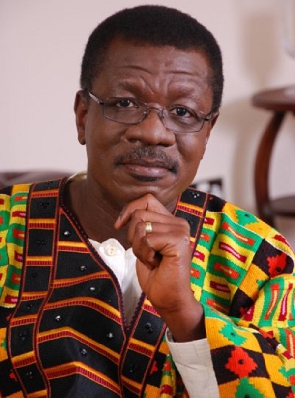
Pastor Mensa Otabil’s recent defence of Ghana’s stalled National Cathedral project has drawn sharp public rebuke, with many Ghanaians pointing to his unaddressed role in the collapse of Capital Bank and questioning why a man who once served on the cathedral’s own board chose to distance himself from the project while now criticising those who opposed it.
Speaking at the annual Greater Works programme in Accra, the founder and General Overseer of the International Central Gospel Church (ICGC) accused Christians of allowing partisan politics to undermine the cathedral project.
“We are so small-minded, so small-minded that we allow politics to blind us. We allow politics to just crush our thinking,” he said, urging Ghanaians to “build massively to the glory of God” and pointing to other countries that have pressed ahead with major monuments.
Unanswered questions from Capital Bank collapse
But Otabil’s sudden return to political commentary has reopened painful questions about his own entanglement in one of Ghana’s most high-profile financial scandals. He served as non-executive Board Chairman of Capital Bank before its collapse in August 2017. The bank’s founder, William Ato Essien, was convicted of stealing over GH¢90 million of Bank of Ghana liquidity support and sentenced to 15 years’ imprisonment before being pardoned in 2025 on health grounds.
Despite evidence of governance failures at the bank — including sanctions on the misapplication of GH¢610 million in liquidity support — Otabil was never prosecuted. In August 2018, he broke his silence, insisting he was “not involved in the day-to-day management and operations of the Bank”. Critics have long alleged that his close ties to the previous Akufo-Addo administration shielded him from prosecution. His ICGC church held a 3 per cent stake in the bank.
A board seat he never occupied
Otabil was listed for years as a member of the National Cathedral’s Board of Trustees. However, records show he excused himself at the point of registration of the Directors in July 2019 and has not been a member since. In 2023, his resignation was confirmed, with Joyce Aryee stating he had “never been an active member” despite his selection by the president. The Cathedral Secretariat later removed his name from its website.
Where was ICGC’s contribution?
A document sighted by MyJoyOnline revealed that ICGC and Lighthouse Chapel International were among the churches that had not donated towards the construction of the National Cathedral. Many attributed the absence of ICGC on the donor list to the exit of its founder from the board.
A project mired in scandal
The National Cathedral, initiated under former President Nana Akufo-Addo, has remained one of the most contentious public projects in recent Ghanaian history. A Deloitte and Touche audit commissioned after President John Mahama took office found significant procurement breaches and unaccounted funds, including GH¢4.9 million wrongly paid to the architect’s firm. Total public expenditure now stands at approximately $98 million. The government dissolved the project’s Secretariat in May 2025 and began terminating the original construction contract.
Public fury: ‘They are gods to some people’
Otabil’s defence of the cathedral has drawn sharp criticism from Ghanaians who question his moral authority. One citizen, responding to his remarks, accused religious leaders of exploiting public ignorance to enrich themselves.
“After Ofori-Atta saved him from the Capital Bank mess he chaired, he has absconded from the consequences of wrecking Ghana’s economy,” the citizen charged, referring to former Finance Minister Ken Ofori-Atta, who was also a board member of Capital Bank.
The citizen further questioned why Otabil — who once expressed belief in former President Akufo-Addo’s vision to “build God a cathedral” — did not join Victor Kusi Boateng and Kwabena Adu Gyamfi on the cathedral’s board. Kusi Boateng, who served as Secretary to the Board of Trustees, was later arrested by the National Investigations Bureau amid dual-identity allegations.
“These people have taken advantage of the ignorance of the masses to enrich themselves. And they continue to influence minds because they cannot be questioned. They are gods to some people,” the citizen added.
A pattern of silence and selective engagement
Otabil’s recent outburst marks a dramatic reversal for a man who for more than eight years maintained a studied silence on national affairs, declaring in 2018 that he found Ghanaian media “depressing” and preferred watching National Geographic to avoid “contamination” of his soul. His sudden re-emergence on the cathedral debate — while maintaining silence on his own role in Capital Bank’s collapse — has left many Ghanaians demanding accountability.
As one commentator put it: “Otabil breaks silence on the cathedral but not on the GH¢90 million liquidity scandal.”


