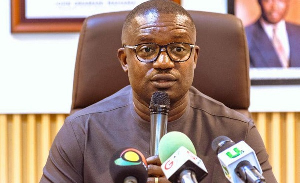
The government has paid off approximately US750 million in savings through a series of financial and operational reforms, Minister for Energy and Green Transition, Dr John Abdulai Jinapor, has disclosed.
Addressing the press on Thursday, August 20, 2026, Dr Jinapor said the measures were aimed at restoring financial stability, viability and confidence in Ghana’s power sector. He was speaking at the commissioning of the new headquarters of the Public Utilities Regulatory Commission (PURC), where he also represented President John Dramani Mahama as Guest of Honour.
“We have so far cleared about $1.47 billion in legacy debt alone,” Dr Jinapor said.
Major sources of savings
According to the Minister, the savings were achieved through three key interventions:
Shift to natural gas: The government saved approximately US$500 million by shifting power generation from expensive liquid fuels to relatively cheaper natural gas. Dr Jinapor explained that the move had reduced the country’s dependence on imported liquid fuels while saving significant foreign exchange.
Renegotiations with IPPs: Working with the PURC, the government renegotiated agreements with Independent Power Producers, yielding an additional US$250 million in savings.
Cash Waterfall Mechanism reforms: Reforms to the Cash Waterfall Mechanism significantly improved the flow of funds to power producers and helped prevent the accumulation of new arrears.
Cash Waterfall Mechanism overhaul
The Cash Waterfall Mechanism is a transparent, rule-based financial model used to equitably distribute electricity revenues collected by the Electricity Company of Ghana (ECG) to power sector players, including independent power producers.
Dr Jinapor said monthly declarations into the mechanism had increased from about GH¢6 billion to nearly GH¢15 billion. He noted that while IPPs previously received only about 42% of their invoices, most are now receiving close to 100% of their invoice bills.
“Before we came to office, just about 6 billion was declared monthly into the Cash Waterfall. IPPs were receiving just about 42%. Because of the work we did together and the policy reforms that we implemented, today we declare close to about 15 billion every month into the Cash Waterfall mechanism and almost all the IPPs receive about 100% of the invoice bills,” he said.
The improved payment system, he added, was helping to prevent the accumulation of fresh arrears.
Legacy debt and the fuel levy context
When the government assumed office, outstanding energy-sector debt stood at approximately GH¢80 billion.
Last year, the Mahama-led government implemented a GH¢1 fuel levy on petroleum products under the Energy Sector Levies (Amendment) Act, 2025 (Act 1141), which was assented to by the President on June 5 to address energy-sector shortfalls, reduce legacy debts and stabilize power supply.
Dr Jinapor also disclosed that the government had reviewed contracts at the Electricity Company of Ghana, resulting in the cancellation of 202 contracts valued at about US$227 million, £1.17 million and €4 million.
Call for stronger regulation
Despite the progress, Dr Jinapor cautioned that financial stability in the energy sector would depend heavily on stronger commercial performance, particularly at ECG, which he described as a critical financial link in the electricity value chain.
He urged PURC to intensify scrutiny of utility companies and strengthen regulatory enforcement, even where doing so may prove uncomfortable.
“You have to step on some toes sometimes to ensure that you achieve the objective,” he said.
He also challenged PURC to make its presence more visible to consumers beyond tariff announcements and ensure utility regulation supports industrial competitiveness and the government’s 24-Hour Economy programme.
“Clearly, we are making significant progress. But I would urge you to strengthen the regulation of your sector,” he said.
Power supply challenges persist
The government has linked the reforms to improved power supply. In January 2026, Dr Jinapor said Ghana had gone for about 10 months without a day of load shedding, attributing the stability partly to increased gas utilisation and reduced reliance on liquid fuels.
However, recent challenges have resulted in widespread outages. The Minister said the government would continue implementing measures aimed at strengthening the financial position of the energy sector while ensuring reliable and affordable electricity supply.