



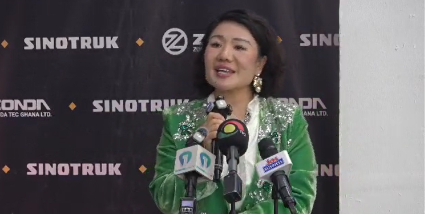
Zonda Tec Ghana CEO Yang Yang has issued a strong call for a fundamental shift in Ghana’s economic mindset from trading to engineering, arguing that the country risks missing a major opportunity if it continues to focus on importing and selling machinery without developing the skills needed to maintain and build them.
Speaking at the launch of Zonda’s new light-duty truck range in Accra on Thursday, October 15, Madam Yang said Ghana’s long-standing trading culture must increasingly give way to technical expertise capable of supporting the country’s growing industrial base.
“Me, Madam Yang, as the CEO of Zonda, I strongly advocate that we need to shift from trading to engineering,” she said.
A Company Built on Local Assembly
Her comments come as Zonda Tec expands local assembly of light trucks, SUVs and pickups, creating a platform for technical training alongside vehicle production. The company, which began as a vehicle distributor in 2010, has grown into Ghana’s leading assembler of heavy-duty vehicles, SUVs and small cars, operating one of the most modern vehicle assembly facilities in the West African region.
In September 2026, President John Dramani Mahama commissioned Phase III of Zonda Tec’s vehicle assembly plant in Kpone near Tema, a facility with a minimum production capacity of 12,000 vehicles annually, designed to support the assembly of SUVs, pickup trucks and electric vehicles. The expansion is expected to directly employ at least 1,000 more Ghanaians, with the company already employing over 800 skilled Ghanaian workers.
Madam Yang explained that the company is deliberately bringing engineers into Ghana to train local personnel rather than simply importing finished vehicles for sale.
“If everyone is only concentrating on trading, who is here to service the machinery, the trucks for our customers?” she asked.
She pointed to the company’s work with major customers, including Kofi Jobs, where Zonda has deployed engineers to train local engineers. At its assembly operations, engineers from the manufacturer are also training Ghanaian technicians to assemble the new 2.7-tonne, 5-tonne, 8-tonne and 12-tonne trucks.
The HOWO Light-Duty Truck Range
The trucks launched on Thursday form part of the HOWO range, a truck brand under China National Heavy Duty Truck Group (SINOTRUK). The range includes trucks with payload capacities of 2.7 tonnes, 5 tonnes, 8 tonnes and 12 tonnes, available in open-bucket and cargo configurations to meet different commercial transportation needs. The launch targets farmers, wholesalers, retailers, fast-moving consumer goods (FMCG) distributors, logistics operators and entrepreneurs seeking vehicles suited to their operations.
Madam Yang highlighted the importance of reliable transportation to agriculture and commerce, noting that efficient delivery systems were essential to moving produce from farms to markets and goods from warehouses to retail outlets.
“It carries farmers’ produce from the fields to the market. It delivers goods from warehouses to shops,” she said.
The Ministry of Food and Agriculture has endorsed the initiative, with Deputy Director of Policy Planning Ruby Neils-Palme stating that efficient transportation must complement efforts to increase agricultural production under the government’s Feed Ghana Programme. She emphasised that affordable vehicle financing and reliable after-sales support would be critical to moving produce efficiently from farms to markets.
A Growing Skills Gap in Ghana’s Automotive Sector
Madam Yang’s call for a shift to engineering comes amid growing concerns about Ghana’s automotive skills gap. A baseline assessment conducted for the Plan Ghana-Hyundai-KOICA NextGen Project found that 80% of Ghana’s automotive institutions lack current curricula, 70% use equipment over 10 years old, and only 12.5% of instructors have experience with electric vehicles. Employer satisfaction with technical graduates stands below 40%.
For decades, automotive mechanics in Ghana, often trained through informal apprenticeships or traditional vocational schools, have relied on mechanical diagnostic skills suited for petrol and diesel engines. The introduction of high-voltage battery systems, regenerative braking, and electronic control units requires an entirely different set of competencies.
Madam Yang believes this technical transfer could have implications beyond the automotive industry, particularly for Ghana’s young population.
“Ghana, we are full of not only mining resources, but we are also full of human resources,” she said.
She therefore urged government to place greater emphasis on engineering, particularly automotive engineering, as part of efforts to create decent employment and strengthen industrial capacity. She argues that local assembly should not end with putting vehicles together, but should create a pipeline of engineers and technicians capable of servicing, maintaining and eventually developing industrial equipment locally.
“That’s why I bring Sino trucks to come to Ghana to assemble the light trucks. I can just bring the complete products for trading. It will earn me more money,” she said, stressing that Zonda chose assembly despite the additional complexity because the company sees a gap that needs to be filled.
Building an Automotive Industry from Ghana
Zonda Tec has partnered with universities and trained hundreds of technicians in automotive engineering, diagnostics and other specialised areas. The company has also established a technical academy and plans to provide learning opportunities for young people, with selected students from universities given opportunities to train at Zonda’s factories in China to strengthen their technical skills.
“Our ambition is therefore not limited to selling vehicles in Ghana. We want to build an automotive industry from Ghana, for Ghana and for Africa,” Madam Yang said at the commissioning of the Phase III plant.
The company’s expansion aligns with broader national efforts to develop Ghana’s automotive industry. President Mahama has urged Zonda Tech to begin producing vehicle components locally, including batteries, tyres, wiring harnesses, seats, glass, plastics and metal parts.
“Assembling, however, cannot be our final destination. Our goal is to develop an integrated automotive industry in which locally produced materials and components feed directly into vehicle manufacturing,” the President said.
He also emphasised the government’s commitment to positioning Ghana as a leader in electric mobility by leveraging strategic minerals, including lithium, and growing renewable energy capacity.
“Our vision is clear: from minerals to batteries, from batteries to vehicles, from vehicles to exports, all proudly made in Ghana,” he said.
Madam Yang called on agricultural organisations, FMCG companies, distributors, logistics providers and other businesses to explore opportunities to improve transportation efficiency.
“Let us move goods more efficiently. Let us help businesses grow stronger. Let us create more opportunities for Ghana youth. And together, let us move Ghana forward,” she said.


