



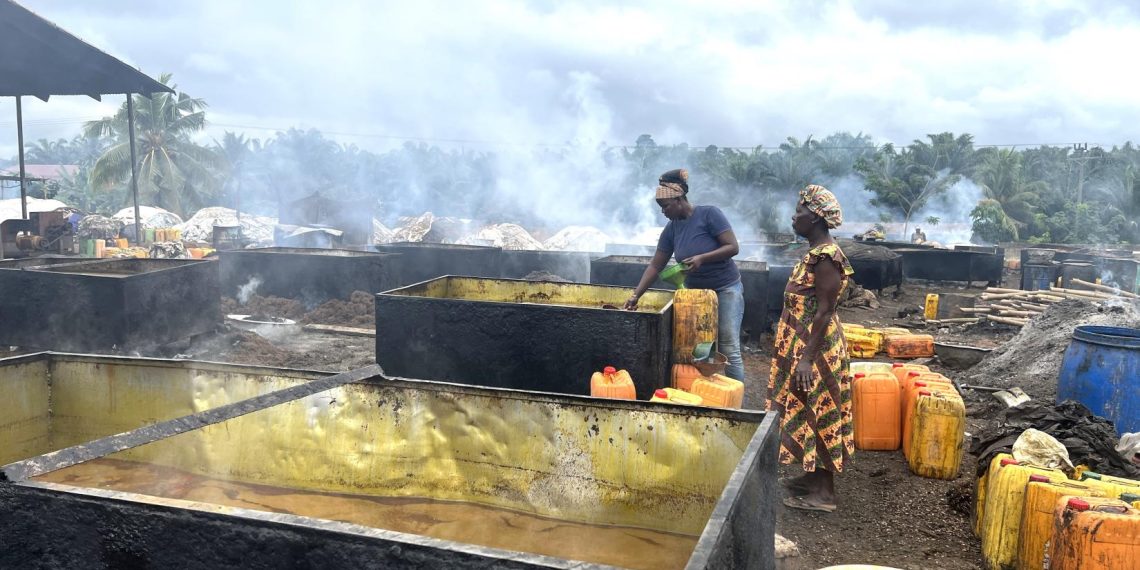
Ghana is grappling with an estimated 150,000-metric-tonne deficit in crude palm oil (CPO) supply, the Oil Palm Development Association of Ghana (OPDAG) has disclosed, despite the sector’s vast production potential and a long history of government policy interventions.
Speaking at a one-day Stakeholders in the Oil Palm Sector Workshop in Accra on Wednesday, OPDAG President Paul Kwabena Amaning revealed that Ghana currently produces about 250,000 metric tonnes of CPO annually against a domestic demand of 400,000 metric tonnes.
“Despite our potential, Ghana produces approximately 250,000 metric tons of crude palm oil annually, against an estimated demand of 400,000 metric tons,” Amaning said. “This leaves a supply gap of about 150,000 metric tons, presenting a major opportunity to increase local production, improve processing efficiency, and strengthen our competitiveness.”
Sector’s Scale and Historical Context
The shortfall occurs even as the sector cultivates an estimated 360,000 hectares of oil palm, supporting approximately 631,000 people across the value chain. Oil palm ranks second only to cocoa among Ghana’s cash crops, and successive administrations have pursued various initiatives to develop the industry—including the President’s Special Initiative on Oil Palm, the drafting of a sector masterplan, and the establishment of the Oil Palm Research Institute.
Yet domestic demand has consistently outstripped supply. A production shortfall of 32,000 metric tonnes in 2010 was projected to reach 127,000 metric tonnes by 2024, and the current deficit of 150,000 metric tonnes suggests the gap has widened beyond earlier projections.
A key structural challenge is the dominance of smallholder farmers, who account for over 80 percent of total production but achieve yields of only 4 to 6 tonnes per hectare, compared with a potential of 15 to 22 tonnes under optimal management. Many plantations are over 25 years old—beyond their productive life—and replanting is rare due to high establishment costs and limited access to long-term finance suited to the crop’s three-to-four-year gestation period.
$500 Million Financing Window Welcomed
Amaning welcomed the proposed $500 million Oil Palm Development Finance Window, announced in Ghana’s 2026 Budget, as a potential catalyst for addressing the sector’s structural constraints. The facility, to be established in collaboration with the World Bank, other development finance institutions, and Development Bank Ghana, is intended to provide long-term financing, including a five-year grace period. The government has committed to cultivating 100,000 hectares of new plantations and creating over 250,000 direct and indirect jobs across the value chain.
However, Amaning stressed that financing mechanisms must reflect the realities of businesses across the entire value chain, particularly smallholder farmers, aggregators, and artisanal processors.
“As OPDAG President, I consider the inclusion of these small operators particularly important,” he said, noting that artisanal processors contribute significantly to local production, employment, and rural economic activity but continue to face limited access to affordable financing, modern equipment, and formal business support.
Digital Finance as a Transformative Tool
The OPDAG President also identified digital financial services as critical to improving efficiency across the oil palm value chain, noting that farmers, aggregators, processors, traders, transporters, and exporters all depend on secure transactions and timely payments.
“Digital financial services can help improve payment security, strengthen record-keeping, increase transparency, and create opportunities for businesses to access savings, credit, insurance and other financial products,” he said. He cautioned, however, that digitalisation must go beyond merely moving money onto mobile platforms, requiring reliable network connectivity, affordable transaction charges, accessible payment agents, interoperable systems, effective consumer protection, and practical education to build user confidence.
Traceability and Revenue Assurance
Amaning further noted that reliable digital transaction records, subject to appropriate consent and safeguards, could help financial institutions better understand small businesses and assess their financing needs. “Such records will help guarantee credit, but they can support more informed financial decisions,” he said.
Discussions around the traceability and revenue assurance system being developed for the sector could also provide an opportunity to improve industry records and support access to financial services. OPDAG has previously disclosed a collaboration with Royvia Plus International on the DJER System, which introduces end-to-end traceability from plantation through processing, storage, transport, and export, and which the association says will support compliance with international market requirements and reduce illicit trade.
Call for Collaborative Action
Amaning emphasised that transforming Ghana’s oil palm industry would require stronger collaboration between government agencies, financial institutions, fintech companies, mobile network operators, mills, buyers, and industry associations.
“Policies and financial solutions will be more effective when voices of farmers, processors, and other industry participants are heard and reflected in their design,” he said.
The workshop, held on October 7, 2026, brought together stakeholders to discuss strengthening financing and digital financial services across the oil palm value chain, as Ghana seeks to close its supply gap, reduce imports, and unlock the sector’s full industrial potential.
OPDAG, launched in 2015, is a private sector, non-governmental association comprising growers, processors, refiners, and marketers who together account for more than 240,000 jobs in the Ghanaian economy.


