



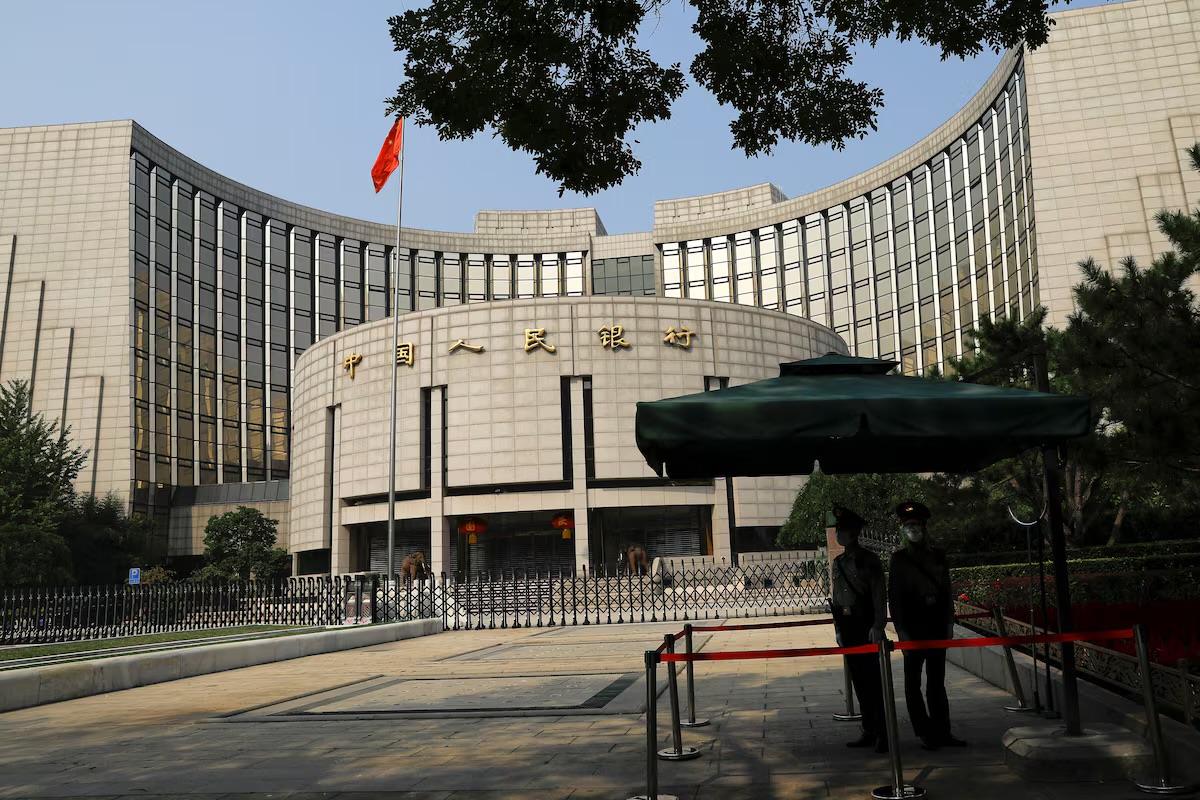
China kept its benchmark lending rates unchanged for a 16th consecutive month on Sunday, in line with market expectations, underscoring the limited scope for fresh monetary easing after major global central banks recently adopted a more hawkish stance, even as the yuan continued to strengthen.
The one-year Loan Prime Rate (LPR) was held at 3.00%, while the five-year LPR remained at 3.50%, according to the National Interbank Funding Center. All 21 market participants in a Reuters survey had forecast no change to either rate.
The LPR is the reference rate for banks’ lending to their best clients. The one-year rate mainly affects corporate and household short-term loans, while the five-year rate is a key benchmark for mortgages.
Why It Matters
The steady LPRs highlight how China’s room for broad monetary easing has narrowed. The Federal Reserve raised interest rates last week and signaled more hikes in the coming months, putting pressure on the yuan and complicating Beijing’s efforts to support growth through lower borrowing costs.
The Fed’s move came as China’s economy remains broadly resilient but faces persistent structural headwinds, particularly from a shrinking property sector and weaker local government financing demand. Policymakers are trying to balance support for emerging industries against financial stability risks and narrowing bank margins.
Rates Held as Expected
The LPR has now been unchanged since May 2025, when both tenors were cut by 10 basis points. Since then, the People’s Bank of China’s 7-day reverse repo rate — a key policy rate that guides the LPR — has remained at 1.4%.
Banks have also had little incentive to lower lending rates. The net interest margin of Chinese commercial banks stood at 1.41% in the second quarter, up 0.01 percentage point from the first quarter, the first rebound since early 2022, but still near historic lows. In August, the average rate on new individual housing loans was 3.1%, while the average rate on new corporate loans was slightly below 3.0%.
Wang Qing, chief macro analyst at Orient Golden Credit Rating, said the stable pricing anchor had largely predetermined the unchanged LPR. He added that banks lacked the motivation to cut rates further given rising wholesale funding costs and thin margins.
Wen Bin, chief economist at China Minsheng Bank, said actual lending rates had already edged down and continued to provide adequate support to the real economy, reducing the urgency for a direct policy rate cut.
Fed Tightening Clouds Outlook
The Federal Reserve on Sept. 16 raised its benchmark federal funds rate by 25 basis points to a range of 3.75%–4.00%, the first increase since July 2023. The decision was unanimous, with newly installed Fed Chair Kevin Warsh joining the vote. Policymakers’ dot plot indicated one more hike later this year.
After the Fed move, the yield premium on benchmark 10-year U.S. Treasuries over Chinese government bonds hovered near its highest level on record, adding to pressure on the yuan and capital flows.
Still, some analysts argued that external constraints on China’s monetary policy remain manageable. Wang Qing noted that U.S. consumer inflation was 3.4% in August, while China’s price pressures remain mild, meaning the two countries’ monetary cycles are driven by very different domestic conditions. He also said China’s macro-prudential and micro-regulatory framework for cross-border capital flows can help contain excessive volatility, so the impact on the yuan should not be overstated.
Wen Bin added that although the European Central Bank and the Bank of Japan raised rates in June and September respectively, Chinese bond yields have remained stable and the yuan has stayed stable with a slight appreciating bias. That, he said, reflects the safe-haven attributes of Chinese assets and supports a monetary policy stance that is “domestically oriented.”
Credit Growth Is Slowing — and Changing Shape
Beyond cyclical factors, the LPR’s long pause reflects a deeper shift in China’s credit structure.
In an article published in Qiushi magazine, PBOC Governor Pan Gongsheng wrote that slower loan growth is becoming the “new normal” as shrinking property and local government financing sectors sap credit demand faster than emerging industries can fill the gap. He noted that real estate and local government financing vehicle loans — which account for a large share of China’s more than 280 trillion yuan in outstanding loans — are no longer growing and are instead contracting.
Data supports that trend. At the end of the second quarter, outstanding individual housing loans stood at 36.29 trillion yuan, down 3.8% year-on-year. In the first half of 2026, housing loans fell by 716.3 billion yuan. The 15 largest listed Chinese banks reported a combined decline of 607.285 billion yuan in their mortgage balances in the first half.
At the same time, credit is shifting toward new-economy sectors. At the end of July, loans to technology enterprises reached 26.9 trillion yuan, up 17.9% year-on-year, while manufacturing loans totaled 41.7 trillion yuan, up 9.8%. Pan said that because innovative, high-end manufacturing and green industries tend to be more asset-light, they require less bank debt per unit of economic growth. “One cannot simply measure financial support for the real economy by credit growth,” he wrote.
Divided Views on the Path Ahead
Market participants are split on whether the PBOC will cut rates before the end of the year.
HSBC Global Investment Research noted that the PBOC removed language about “potential RRR or rate cuts” from its first-quarter monetary policy report, reducing expectations for further easing in 2026.
Serena Zhou, senior China strategist at Mizuho Securities, said: “Unless domestic demand weakens a lot more materially, the likelihood of broad-based monetary easing in Q4 has diminished in our view, particularly against the backdrop of a more hawkish U.S. Federal Reserve.”
Jacqueline Rong, chief China economist at BNP Paribas, said: “On monetary policy, we believe that China is in the late stage of its rate-cutting cycle. Our base case remains that the People’s Bank of China will stay on hold for the rest of this year, constrained by tight net interest margins of banks and a transition from deflation to mild inflation. The risk to our view is tilted to a cut if economic growth disappoints.”
Wang Qing, however, said the July 30 Politburo meeting’s call to “comprehensively use and timely adjust monetary policy tools” leaves the door open to new incremental measures. That could bring LPR cuts later in the year as part of efforts to boost consumption, stabilize investment and shore up domestic demand.


