



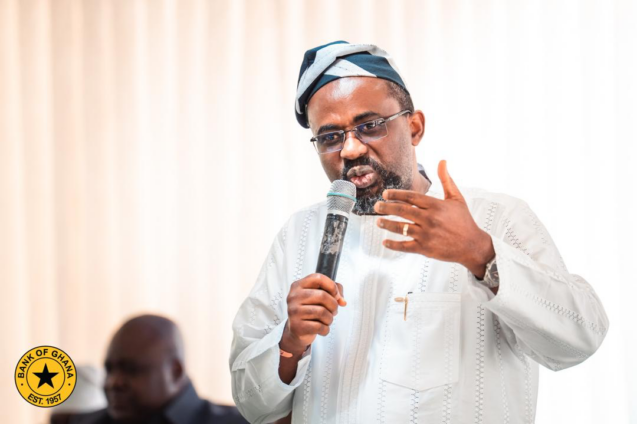
The Bank of Ghana has issued a comprehensive twenty-point advisory to the public on digital financial fraud, warning that the rapid expansion of mobile money and online banking has created new vulnerabilities for consumers across the country.
In a press release issued by its Communications Department on Wednesday under the title “Digital Fraud and the Cost of Ignorance,” the central bank cautioned customers against sharing confidential financial information—including Mobile Money PINs, ATM PINs, internet banking passwords, One-Time Passwords (OTPs), and verification codes—with unknown persons, even if they claim to represent a financial institution or telecommunications operator. It stressed that no legitimate bank, mobile money operator, payment service provider, or financial institution would request a customer’s PIN, password, or OTP via phone calls, text messages, emails, or social media.
A Digital Economy Under Siege
The advisory comes against the backdrop of a sharp escalation in digital financial crime. According to the Bank of Ghana’s 2025 fraud report, reported fraud cases across the financial ecosystem rose from 16,733 in 2024 to 24,778 in 2025—a 48 per cent increase—with digital fraud incidents surging by 98 per cent between 2022 and 2025. Between January and July 2026 alone, the Cyber Security Authority recorded 3,876 cybersecurity incidents, with online fraud accounting for approximately 47 per cent.
The scale of Ghana’s mobile money ecosystem explains why it has become a prime target. The system processed roughly 9.7 billion transactions valued at approximately GH¢4.54 trillion in 2025, with about 80.5 million registered Mobile Money accounts and 26.6 million active users. By August 2026, the total value of mobile money transactions had reached GH¢3.8 trillion, with monthly values climbing from GH¢446.2 billion in January to GH¢518.8 billion.
“The shift is not just in the statistics or the data, but it is also a shift in the financial crime landscape itself,” Second Deputy Governor Matilda Asante-Asiedu said at a law enforcement workshop in September. “We also have to have a shift in our strategy and in our mindset”.
Social Engineering, Not Hacking
Cybersecurity analysts say the majority of fraud cases in Ghana are driven by social engineering rather than sophisticated technical exploitation. TrustGH, a scam verification platform, identified over 6,000 telephone numbers linked to suspected fraudulent activity as of August 2026, with more than 90 per cent of reported cases involving attempts to obtain Mobile Money payments or gain unauthorised access to victims’ accounts. Approximately half of the reported scam numbers were linked to TikTok, making it the single largest source of reported scam activity.
Fraudsters typically impersonate bank officials, telecommunications staff, police officers, or government representatives to establish credibility before pressuring victims to disclose OTPs or Mobile Money credentials.
Investment Scams and Ponzi Schemes
The advisory specifically warned against fraudulent investment schemes. Customers were advised to verify all investment opportunities before making payments or transfers, and to treat with extreme caution any scheme promising unusually high returns with little or no risk. The Bank explicitly cautioned against “double-your-money” schemes, online Ponzi schemes, and suspicious digital investment platforms, noting that these may lead to financial loss.
The warning follows a September incident in which the Bank of Ghana and the Securities and Exchange Commission jointly warned the public about a cryptocurrency scam using a doctored video falsely portraying President John Dramani Mahama as endorsing an investment platform called “Daily Wealth Guide”.
Practical Safeguards for Consumers
The central bank urged customers to regularly monitor transaction alerts, bank statements, and mobile money notifications to detect unauthorised transactions promptly, and to use strong passwords that are updated regularly. It also recommended activating security features such as transaction alerts, biometric verification, and two-factor authentication where available.
Customers were advised not to disclose personal identification information such as Ghana Card details, account numbers, or verification codes to unauthorised persons, and to immediately report any suspected fraud, unauthorised transactions, SIM-swap incidents, or account compromises to their financial institutions, mobile network operators, or relevant service providers.
Under the Payment Systems and Services Act, 2019 (Act 987), financial institutions and electronic money issuers are required to maintain fraud-monitoring systems, cybersecurity controls, and customer-protection mechanisms, as well as clear complaint-resolution procedures.
Collective Responsibility
The Bank noted that financial inclusion without financial literacy may expose individuals to increased financial vulnerability, and called on parents, schools, financial institutions, telecommunications operators, regulators, and the media to support continuous financial education and digital-security awareness.
“The fight against digital financial fraud requires collective responsibility through awareness, education, responsible financial behaviour, and adherence to cybersecurity practices,” the Bank said.
The public may contact the Bank of Ghana’s Complaints Office on 0593974486 or by email for assistance.


