



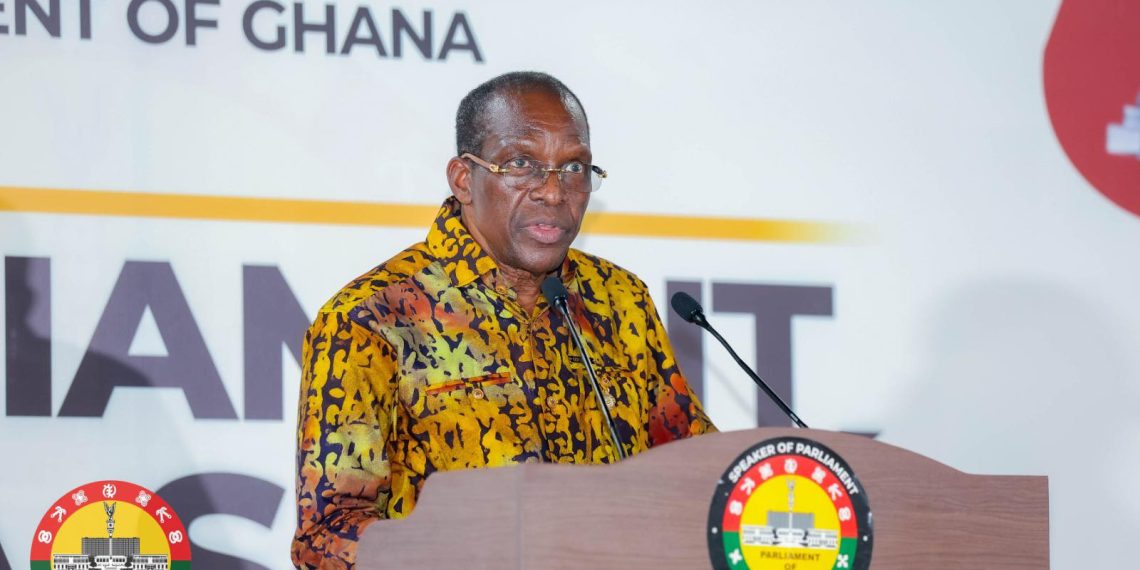
Speaker of Parliament Alban Sumana Kingsford Bagbin is spearheading a continent-wide legislative campaign to pressure international financial institutions and creditor nations into adopting a transformative approach to Africa’s mounting debt crisis, with plans to convene parliamentary leaders from across the continent in Accra this October.
The initiative, coordinated in partnership with the Global Institute for Transnational Intelligence and Finance (GITFiC), will see Bagbin leverage his position as Chairman of the Conference of Speakers and Presidents of African Legislatures (CoSPAL) to rally fellow parliamentary leaders behind a unified advocacy framework. The 10th GITFiC Annual Meeting, scheduled for October 14–15, 2026, will serve as the primary platform for this high-level engagement, according to a statement issued by GITFiC and copied to the Ghana News Agency.
The Debt Crisis in Numbers
Africa’s debt burden has reached alarming proportions. According to the International Monetary Fund (IMF), sub-Saharan Africa’s total public debt stood at over $1.1 trillion at the end of 2025, representing nearly 60 percent of the region’s GDP. Interest payments alone consume an average of 20–25 percent of government revenues in many African nations, crowding out critical spending on health, education, and infrastructure.
Ghana, which exited a sovereign debt restructuring in 2024 after a prolonged default, remains acutely aware of the toll. The country’s total public debt was estimated at over GHS 600 billion (approximately $45 billion) as of mid-2026, with external debt servicing consuming a significant portion of export earnings. Despite the restructuring, Ghana continues to face tight financing conditions and elevated borrowing costs, making the push for systemic reform more urgent than ever.
What the Initiative Envisions
While specific details of the proposed global initiative are still being finalised, sources close to the Speaker’s office indicate that the advocacy will centre on three core pillars:
- A comprehensive debt restructuring mechanism that goes beyond the ad-hoc, case-by-case approach of the G20 Common Framework, offering a predictable and fair process for all middle-income and low-income countries.
- The inclusion of private creditors—who hold a significant portion of African sovereign debt—in any restructuring negotiations, ensuring that all creditors share the burden equitably.
- A new framework for sustainable lending, including clauses that automatically trigger debt service suspensions during economic shocks, natural disasters, or global crises, to prevent countries from being forced into austerity during emergencies.
Bagbin, in an endorsement recording obtained by GITFiC, outlined several strategies and implementation plans intended to advance the advocacy. The statement noted that the Speaker is committed to building a “critical mass of parliamentary voices” that can exert pressure on international financial institutions, bilateral creditors, and private bondholders.
Parliamentary Diplomacy as a Lever
The move represents a significant escalation in parliamentary diplomacy—a field often overshadowed by executive-led negotiations. Bagbin’s role as CoSPAL Chairman gives him a unique mandate to speak on behalf of 54 African parliaments, amplifying the continent’s collective bargaining power.
“Parliaments are not merely ratifying bodies; they are democratic representatives of the people who bear the brunt of debt-induced austerity,” Bagbin is reported to have said in his endorsement remarks. “African legislators must take ownership of this debate, not as passive observers but as active advocates for a fairer international financial architecture.”
The forthcoming Accra meeting is expected to produce a joint declaration—the “Accra Consensus on Debt Sustainability”—which will be submitted to the IMF, World Bank, G20, and African Union. The declaration will seek to institutionalise parliamentary oversight of debt contracting, push for greater transparency in loan terms, and demand that creditor nations respect the sovereignty of debtor states in setting their own development priorities.
GITFiC’s Role and Track Record
The Global Institute for Transnational Intelligence and Finance, a non-governmental research and advocacy organisation based in Accra, has been at the forefront of debt-related discourse in Africa. Over the past decade, GITFiC has convened annual meetings that bring together policymakers, academics, financial institutions, and civil society to deliberate on pressing transnational financial issues.
The Institute’s 10th annual meeting, themed around “Debt, Development, and Democracy,” will provide a formal framework for the parliamentary engagement. Previous GITFiC meetings have produced actionable recommendations on anti-money laundering, illicit financial flows, and climate finance, giving the upcoming event a credible track record of translating dialogue into policy influence.
A Continent in Search of Solutions
Africa’s debt crisis is not a monolithic problem. It stems from a confluence of factors: a history of concessional loans that turned into commercial debt, currency depreciation that inflated dollar-denominated obligations, a global interest rate hiking cycle that raised borrowing costs, and the lingering economic scars of the COVID-19 pandemic and the Russia-Ukraine war.
The G20 Common Framework, launched in 2020 to coordinate debt treatment for low-income countries, has been widely criticised as slow, bureaucratic, and inadequate. Only a handful of countries—including Chad, Zambia, and Ethiopia—have completed restructuring under it, while many others remain in limbo. Meanwhile, private creditors, who hold over $100 billion of African sovereign bonds, have often refused to participate in restructurings, demanding full repayment and triggering costly litigation.
Bagbin’s initiative seeks to address these gaps by placing the debate squarely on the agenda of legislative bodies, which have the constitutional power to approve new loans and audit existing ones. By coordinating across parliaments, the initiative aims to create a common front that can resist the divide-and-rule tactics often employed by creditors.
Regional and Global Reactions
The initiative has already garnered preliminary support from several African parliamentary leaders, including representatives from Kenya, South Africa, Senegal, and Rwanda, who have expressed interest in attending the Accra meeting. The African Union’s Economic, Social and Cultural Council (ECOSOCC) has also signalled its endorsement, viewing the parliamentary push as complementary to the AU’s ongoing advocacy for a new global financial architecture.
International observers are watching closely. “If African parliaments can speak with one voice, it changes the calculus for creditors,” noted Dr. Charles Amoah, a political economist at the University of Ghana. “International institutions are used to negotiating with finance ministers and central bankers. A parliamentary coalition adds a layer of democratic legitimacy and public pressure that cannot be easily dismissed.”
Challenges Ahead
The road to meaningful reform is fraught with obstacles. Creditor nations—particularly those in the G7—have shown little appetite for radical changes to the debt resolution framework. Private creditors, including hedge funds and asset managers, are notoriously resistant to haircuts. And within Africa itself, divergent interests between commodity exporters and importers, and between low-income and middle-income countries, could complicate the formation of a unified stance.
Bagbin’s strategy appears to address this by focusing on procedural reforms—transparency, due process, automatic relief triggers—rather than demanding specific debt write-offs, which may be more palatable to a broad coalition. The Accra meeting will serve as a testing ground for whether consensus can be forged.
A Historic Opportunity
For Bagbin, who has long championed parliamentary autonomy and accountability, this initiative represents a historic opportunity to reposition African legislatures as central actors in shaping economic policy. It also aligns with his broader vision of a “people-centred” approach to governance, where debt decisions are not made behind closed doors but subjected to public scrutiny and democratic oversight.
The October meeting, if successful, could set a precedent for coordinated legislative action on other transnational issues—from climate finance to trade agreements—establishing the African parliamentary voice as a permanent fixture in global economic diplomacy.
Next Steps
In the coming weeks, Bagbin’s office, in collaboration with GITFiC, will circulate a concept note to all African parliaments, outlining the initiative’s objectives and the draft Accra Consensus. Regional preparatory meetings are also being planned in East, West, and Southern Africa to fine-tune the proposals before the main gathering.
The 10th GITFiC Annual Meeting is expected to draw over 500 delegates from across the continent and beyond, including representatives from the IMF, World Bank, European Union, and the United Nations Economic Commission for Africa.
As Africa’s debt clock continues to tick, the Accra gathering may well be remembered as the moment parliamentary leaders decided to stop waiting for a solution—and start building one themselves.


