



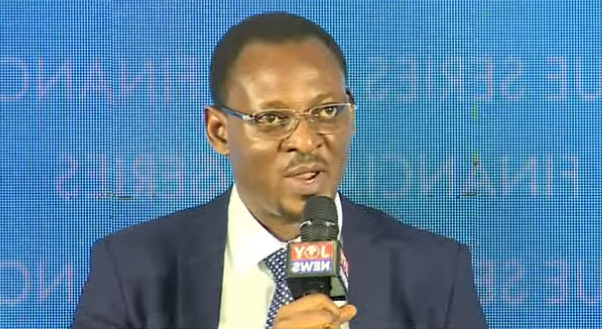
The battle for the future of digital finance has entered a new, high-stakes phase, with Artificial Intelligence (AI) emerging as the sole viable defence against a new generation of intelligent cyber threats. This stark warning was delivered by Dr. Martin Nana Annan, a leading Cybersecurity, AI, and Information Systems expert, during the Ecobank–JoyNews Business Financial Dialogue held on Tuesday.
Speaking at the Ecobank Auditorium, Dr. Annan declared that the traditional approach to cybersecurity—reacting to breaches after they occur—is now obsolete. As cybercriminals increasingly weaponise AI to launch attacks that are too fast and too complex for human analysts to track, defensive systems must evolve to match that sophistication.
“Artificial intelligence fundamentally alters digital finance by shifting from reactive defence to predictive, real-time automation,” Dr. Annan stated. “We are moving from a model of ‘detect and respond’ to a model of ‘anticipate and neutralise’.”
He argued that while information technology has revolutionised modern life, the rise of cybercrime has dangerously eroded public confidence in digitalisation, particularly within the financial sector. “One of the technologies which has moved so fast is information technology. However, when we got to the digitalisation space, the prevalence of cybercrime slowed down the advancement of this technology in enhancing lives,” he explained.
According to Dr. Annan, the threat landscape has fundamentally shifted. Criminals are no longer relying on static code; they are deploying sophisticated algorithms that mutate to evade traditional defences. He pointed to the rise of polymorphic malware as a prime example of this arms race.
“The malware we traditionally send follows a predictable process,” Dr. Annan detailed. “But now, with AI, the malware begins to mutate as it traverses a system, changing its behaviour to render standard antivirus software useless. To counter this, you require an AI tool capable of detecting that mutating nature—something your normal antivirus simply cannot handle.”
He described the current landscape as a technological duel between “defensive AI” and “attacker AI,” noting that both are developed using the same advanced tools, including large language models and machine learning. “The two are working together; they are, in a sense, from the same laboratory,” he said. “So, if I develop a system, another person looks for loopholes and takes advantage. What is making things easy for criminals is AI, so we must leverage that same AI to counter them.”
Dr. Annan further warned that the threat is no longer limited to data breaches. The emergence of hyper-realistic voice and video cloning technologies is opening devastating new avenues for fraud, making it imperative for organisations and regulators to fortify their cybersecurity frameworks.
“Now with voice and video cloning, it is crucial that we ensure we have strong architectural defences,” Dr. Annan cautioned. “The regulatory framework must ensure a level playing field and remove ambiguity when things go wrong.”
His remarks underscore a growing consensus among experts that the future of secure digital finance depends not on human vigilance alone, but on the race to deploy ever-more intelligent machines to protect the systems that power the global economy.
Disclaimer: The views expressed by Dr. Annan do not necessarily reflect the official policy of the Multimedia Group Limited.


