



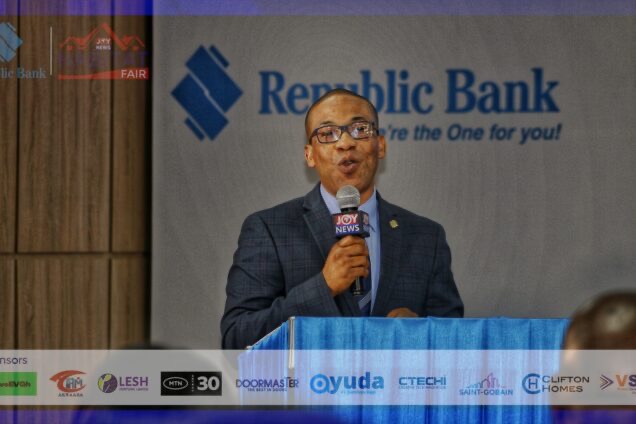
Ghana’s housing deficit may be estimated at 1.8 million units, but the country’s biggest obstacle to home ownership is not a shortage of houses—it is the prohibitive cost of accessing them, according to Dr. Benjamin Dzoboku, Managing Director of Republic Bank Ghana.
Speaking at the official launch of the Republic Bank JoyNews Habitat Fair on August 11, Dr. Dzoboku challenged the prevailing narrative that supply-side constraints alone explain the nation’s housing crisis. “The challenge is not the supply side, but affordability,” he declared, arguing that even if the government and developers were to build a million new units overnight, the majority of Ghanaians would still be locked out due to low incomes, high interest rates, and the structural costs of land acquisition.
A Deficit Widened by Demographics and Dysfunction
The housing deficit, last officially pegged at 1.8 million units in 2015 by the Ministry of Works and Housing, has since widened considerably. Ghana’s population, which stood at roughly 24 million in 2010, has surged past 33 million in 2026, with annual urbanisation rates exceeding 4 per cent—one of the highest in West Africa. This rapid influx into cities like Accra, Kumasi, and Tema has outpaced formal housing delivery, forcing millions into informal settlements and overcrowded shared accommodations.
Yet Dr. Dzoboku stressed that the supply pipeline, though inadequate, is not the binding constraint. Instead, he pointed to three interlocking barriers:
· Low household incomes: The average Ghanaian household earns less than GH¢2,000 per month, while the cheapest newly built two-bedroom apartment in a decent Accra suburb costs upwards of GH¢350,000—more than 14 times the average annual income.
· Prohibitive borrowing costs: Mortgage interest rates in Ghana typically hover between 25 and 30 per cent per annum, reflecting the high cost of funds, inflation, and perceived credit risk. Even with a 10 per cent down payment, monthly repayments consume 80–90 per cent of an average professional’s salary.
· Persistent land litigation: Titles are often contested, with as many as 60 per cent of land transactions in urban areas ending in court disputes. This legal uncertainty drives up developer costs and discourages long-term investment, as banks are reluctant to lend against land that may be encumbered.
“Closing this gap will require a concerted effort, not only from one institution or two institutions, but all stakeholders,” Dr. Dzoboku said, calling on government to streamline land administration, reduce stamp duty and registration fees, and introduce targeted subsidies for first-time buyers.
A Bank with Deep Roots in Mortgage Finance
Dr. Dzoboku’s remarks came as Republic Bank reaffirmed its long-standing commitment to housing finance—a lineage that stretches back to 1990, when the institution began as a home finance company (HFC) focused solely on mortgage lending. Over the years, it evolved into a commercial bank, and in 2015 completed a rebranding and transformation into Republic Bank, but the mortgage DNA remained intact.
“Housing finance is not a peripheral activity for Republic Bank,” he stressed. “It remains central to our identity and history.”
The bank’s partnership with the Multimedia Group’s Habitat Fair dates back more than 15 years, to the HFC era when it served as title sponsor of the Mortgage Habitat Fair. Following the rebrand, the collaboration continued and has since expanded from its original Accra and Kumasi footprint into a nationwide initiative, bringing homeownership solutions to regional capitals and secondary cities.
Products and Impact
Republic Bank has developed a suite of products tailored to different segments of the market:
· Home financing and mortgage loans for purchase of completed properties.
· Home equity facilities allowing existing homeowners to unlock value for renovations or extensions.
· “Buy, Build and Own” financing structured for self-builders, with staged disbursements tied to construction milestones.
· Home completion and improvement loans for those who have already started building but lack finishing funds.
· Pension-backed mortgages, enabling workers to leverage their Tier 2 and Tier 3 contributions as collateral—a scheme that has gained traction among formal-sector employees.
· Support under the National Housing Scheme, a government-backed initiative that offers subsidised interest rates for low-to-middle-income earners.
Dr. Dzoboku noted that the bank has helped thousands of Ghanaians—both resident and diaspora—to buy, build, improve, or complete their homes. Public sector workers, in particular, have been a priority, with thousands of teachers, nurses, and civil servants benefiting from tailored financing packages that factor in government payroll deductions.
He also highlighted the Republic Bank Real Estate Investment Fund, established in 1995, which pools investor capital to finance large-scale residential developments. The fund, he said, demonstrates the bank’s holistic view of housing as an ecosystem—where one can “save, invest, build, buy and create security for your family.”
The Broader Context
Dr. Dzoboku’s intervention comes at a time when Ghana’s housing sector is under intense scrutiny. The government’s own affordable housing projects, including the Saglemi and Kpone schemes, have been plagued by delays, cost overruns, and allegations of corruption. Meanwhile, private developers have focused largely on luxury and middle-income units, leaving the low-income segment underserved.
The affordability crisis is further exacerbated by the cost of building materials—cement, steel, and imported fixtures—which have risen sharply due to currency depreciation and global supply chain pressures. A bag of cement that sold for GH¢80 in 2020 now retails for over GH¢140, making even self-build projects increasingly out of reach.
Analysts have called for a combination of measures: reducing import duties on construction inputs, expanding rent-to-own schemes, and encouraging the use of local alternative materials like compressed earth blocks and bamboo. But as Dr. Dzoboku warned, without addressing the root affordability issue—income growth and interest rates—no amount of housing construction will close the gap.
A Call for Collective Action
The Habitat Fair, which runs alongside the launch, aims to connect prospective homeowners with lenders, developers, and real estate agents under one roof. Republic Bank’s sponsorship of the fair underscores its belief that financial inclusion, not just construction, is the key to unlocking home ownership.
As Dr. Dzoboku concluded, “Home ownership is an ecosystem where you can save, invest, build, buy and create security for your family.” But he cautioned that the ecosystem must become more accessible—through policy reforms, innovative financing, and a shared commitment from government, banks, and developers—if the 1.8 million deficit is ever to become a thing of the past.


