



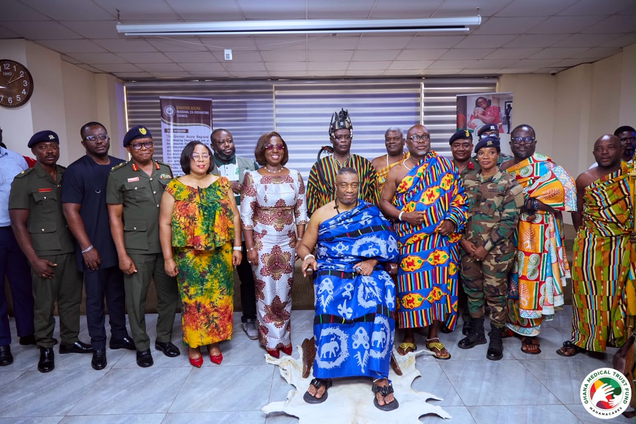
The Ga Mantse, King Nii Teiko Tsuru II, has called for a healthcare system that ensures poverty does not determine who receives life-saving treatment, warning that no Ghanaian should be denied quality care because they cannot afford it.
He made the call during an engagement with a delegation from the Ghana Medical Trust Fund (GMTF), led by its Administrator, Adjoa Obuobia Darko-Opoku, as part of the Fund’s nationwide sensitisation tour. The Ga Mantse described the establishment of the GMTF as a significant intervention for families struggling to afford specialised healthcare and urged stakeholders to make full use of the opportunities provided by the Fund to ensure that vulnerable Ghanaians are not excluded from quality care because of their financial circumstances.
He also encouraged the Fund to explore support for maternal healthcare, saying this would complement its broader efforts to improve healthcare delivery.
A Fund Born Out of National Need
The Ghana Medical Trust Fund, popularly known as “MahamaCares,” was formally established in July 2025 under Act 1144 and launched by President John Dramani Mahama on 29 April 2025 at the University of Ghana Medical Centre. It was created in response to a growing national reality: chronic non-communicable diseases, including cancer, cardiovascular diseases, diabetes, and kidney disease, now account for about 45% of all deaths in Ghana, meaning nearly one in every two lives lost is linked to a condition that often requires long-term, specialised, and costly care.
Positioned at the apex of Ghana’s three-tier health financing system, the GMTF complements Free Primary Health Care and the National Health Insurance Scheme by closing the critical financing gap for high-cost, specialised treatment that often falls beyond routine NHIS coverage. The Fund operates through four strategic pillars: financial support for approved patients accessing specialised care, investment in medical equipment and infrastructure, specialist training, and research and innovation.
Tangible Impact Already Being Felt
Since its establishment, the GMTF has moved beyond legislation to become a life-saving national institution. A pilot programme provided financial assistance to 50 patients requiring complex medical interventions, including heart and brain surgeries, chemotherapy, and radiotherapy treatments, at a reported cost of about GH¢4.8 million. Beneficiaries have included a one-year-old girl with hydrocephalus, a five-month-old baby with severe congenital hydrocephalus, and a 12-year-old boy suffering from a scalp tumour with intracranial extension. In one instance, a cheque of GHS 258,200 was presented to Cape Coast Teaching Hospital as full payment for the treatment of five patients from the Western, Western North, and Central Regions.
The Fund has also commissioned the reconstructed and expanded Cardiac Catheterisation Laboratory at the National Cardiothoracic Centre of Korle Bu Teaching Hospital, where specialist teams began performing complex cardiac procedures within two days of its inauguration, with 30 patients expected to benefit by the end of that week. Two additional Cardiac Catheterisation Laboratories at Komfo Anokye Teaching Hospital and Tamale Teaching Hospital are expected to be commissioned before the end of the year.
Greater Accra’s Hidden Struggles
Speaking at the engagement, Ms Darko-Opoku cautioned that Greater Accra’s reputation as a region of opportunities should not overshadow the difficulties faced by families caring for relatives with non-communicable diseases.
“Even here in Greater Accra, families go through enormous difficulties trying to care for relatives suffering from non-communicable diseases,” she said, underscoring the financial pressure faced by households dealing with chronic illnesses and the need to improve access to healthcare for patients who struggle to afford treatment.
Her remarks are borne out by the data. A 2025 population-based household survey conducted in Ga Mashie, Accra, found that 47.3% of participants aged 25 and above had hypertension, yet only 36.1% received treatment in the previous 12 months and just 16.1% achieved adequate blood pressure control. The study concluded that adults in Ga Mashie run a high risk of hypertension complications such as cardiovascular diseases and stroke, calling for urgent interventions to reduce blood pressure levels and exposure to hypertension risks in the community.
The GMTF Administrator has previously warned that families across Ghana are still selling homes, disposing of property, borrowing heavily, and exhausting their life savings to pay for specialised medical treatment.
Institutional Support and Regional Collaboration
The Greater Accra Regional Director of Health Services, Dr Robert Amesiya, urged Ghanaians to “jealously guard” the GMTF, describing it as an opportunity to strengthen the health system and improve access to critical services. He said collective support was essential to fulfilling the Fund’s mandate, particularly for people who would otherwise be unable to afford specialised treatment.
The Greater Accra Regional Minister, Linda Obenewaa Akweley Ocloo, commended President John Dramani Mahama for establishing the GMTF and welcomed its nationwide sensitisation campaign. She said greater public awareness was essential to ensuring that the Fund’s interventions reached the intended beneficiaries. The minister also called for closer collaboration between the the GMTF and Metropolitan, Municipal and District Assemblies to avoid duplication and maximise the impact of resources, and assured the Fund of the Greater Accra Regional Coordinating Council’s support in strengthening collaboration across the region.
A National Tour to Reach Every Region
The nationwide sensitisation tour, which is conducting engagements across all 16 regions of Ghana, seeks to bring the Fund closer to communities, healthcare professionals, traditional authorities, and other stakeholders while mobilising support for its work. Ahead of the regional rollout, the GMTF engaged Regional Ministers at the Presidency to discuss their critical role in ensuring every Ghanaian understands the Fund’s mandate and how to access its support. The Regional Ministers pledged their commitment to championing the Trust Fund within their regions by engaging traditional leaders, faith-based organisations, healthcare providers, civil society organisations, the media, and local communities.
The Ga Mantse’s engagement forms part of this broader effort. In August 2026, he pledged his full support for the GMTF, describing it as one of the most important healthcare interventions in recent years, and committed to using the influence of the Ga State to champion the Fund’s work. He has also previously stressed the need to improve post-treatment care, noting that many patients experience complications after surgery and calling for greater research to make healthcare services more efficient and ensure continuity of care.
The GMTF Administrator has appealed to individuals, businesses, and corporate organisations in the region to support the Fund in expanding its reach and saving more lives. “The Ghana Medical Trust Fund has been established to ensure that the cost of treating chronic non-communicable diseases will no longer be a barrier,” she has said. “Saving lives is our mission. Making real impact and reducing the financial burden on families is our goal”.


