



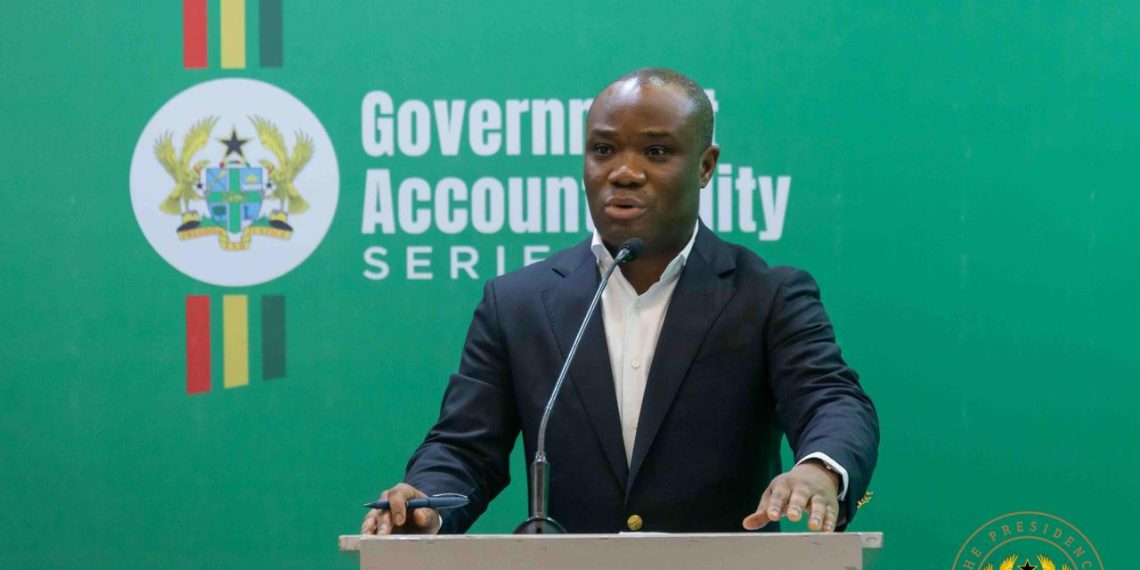
Minister for Government Communications Felix Kwakye Ofosu has rejected claims that the Mahama administration is undermining freedom of expression, insisting there is a clear distinction between criminality and legitimate criticism, as concerns mount over a series of arrests of critics, bloggers, and social media users.
Speaking at the launch of the 30th Ghana Journalists Association (GJA) Media Awards on Wednesday, Kwakye Ofosu said the government had no intention of interfering with legitimate free expression, but argued that law enforcement must act where social media activity crosses into conduct that threatens public peace. “Under no circumstances will the government of President John Dramani Mahama curb free speech,” he said.
Nurse’s Arrest Fuels Debate
His comments come amid growing criticism over the recent arrest of Salomey Baffoe Awiti, a 40-year-old senior nursing officer based in Techiman in the Bono East Region. Awiti was arrested at her residence in Hansua around 11:30 p.m. on September 13, 2026, by three persons who identified themselves as National Security operatives. Her family reportedly struggled to establish her whereabouts after the incident, and both the Bono East Regional Police Command and Regional National Security officials initially indicated they had no record of the operation.
Awiti, a mother of three, was subsequently charged with abetment of crime relating to the publication of false news and appeared before the Adenta Circuit Court on September 17, 2026. She pleaded not guilty. The allegations against her are linked to the controversial “Ghana Jollof” case involving UK-based TikTok personality Barbara Asantewaa Kodua. Police allege Awiti acted as a liaison for Kodua, with investigators citing mobile money payments and chats as evidence of the connection. On October 5, 2026, the Adenta Circuit Court granted her bail of GH¢100,000 with two sureties, both required to be civil servants earning not less than GH¢3,000 per month.
Opposition and Civil Society Raise Alarm
The arrest has become a flashpoint in a broader national debate over free speech under the Mahama administration. The opposition New Patriotic Party (NPP) has petitioned the diplomatic community, accusing the government of using state institutions to target political opponents, journalists, activists, and social media users who criticise the government. The petition, signed by NPP General Secretary Justin Kodua Frimpong and Minority Leader Alexander Afenyo-Markin, warned that Ghana’s democratic image is being threatened and claimed in the country is slowly returning to a “culture of silence”.
The Media Foundation for West Africa (MFWA) has also expressed deep concern over what it describes as the increasing “weaponisation” of laws to criminalise free speech. According to MFWA Executive Director Sulemana Braimah, there is a worrying trend in the use of Section 76 of the Electronic Communications Act, 2008 (Act 775) and Sections 207 and 208 of the Criminal Offences Act, 1960 (Act 29) to arrest and prosecute people for comments made in public and on social media. The organisation notes that within just 16 months of the current administration, more people have been arrested under these laws than during the entire eight-year administration of former President Nana Addo Dankwa Akufo-Addo.
The MFWA recalled that while in opposition in 2022, President Mahama himself criticised the use of state power to criminalise speech, warning against what he called the “growing criminalisation of speech and journalism in Ghana”. The organisation has documented 14 arrests linked to false news and offensive speech since January 2025, including journalists, bloggers, political activists, TikTok creators, and ordinary citizens.
Private legal practitioner Martin Kpebu has also weighed, saying: “For one and a half years, this current government has arrested more people on matters of free speech than Akufo-Addo’s eight years. It is a bad record for John Mahama; they should be careful”.
Government Defends Law Enforcement Actions
Kwakye Ofosu, however, defended the government’s position, saying that some individuals had used social media to spread hate speech and commentary capable of worsening conflicts in parts of the country. “Sometime last year, we began to notice the activities of individuals who were using hate speech to foment trouble in areas of conflict. These are people who took to social media to run commentary that had the potential to deepen conflicts that were raging in certain parts of the country, so law enforcement used technology available to them to clamp down on such activities,” he said.
He referenced historical examples of how harmful speech led to genocide and conflict across Africa, arguing it would be irresponsible for law enforcement to ignore those who misuse social media for such purposes. “Africa is littered with examples of how speech like that led to serious genocide and conflict. And it will be derelict on the part of law enforcement to sit and not do anything about people who abuse the space of social media to engage in these sorts of activities,” he said.
“A clear distinction must be struck between free speech and criminal conduct,” Kwakye Ofosu added, stressing that the government remains committed to protecting legitimate expression while ensuring public safety.
A Tense Political Backdrop
The minister’s remarks come at a politically charged moment. In August 2026, the NPP organised a “Democracy Under Attack” demonstration to raise concerns over what it described as threats to the rule of law and democratic accountability. The government has rejected those allegations. In May 2026, the NPP also petitioned the diplomatic community, warning that state security agencies including the Bureau of National Investigations (BNI), Economic and Organised Crime Office (EOCO), and the Ghana Police Service were carrying out politically motivated arrests and intimidation.
Ahead of his address to the 81st United Nations General Assembly, President Mahama himself cautioned against disproportionate arrests in response to criticism, warning that such actions could create “undeserving martyrs” and erode public trust in state institutions. He argued that criticism, satire, and dissent should not be criminalised. That principle is now being tested against his government’s own record.
30th GJA Media Awards
The launch event also marked a significant milestone for Ghanaian journalism. The GJA has received 327 entries from 206 journalists for this year’s awards, which will be held on November 7, 2026, in Accra. The 30th edition introduces two new categories: the Bank of Ghana Governor’s Economic and Financial Story of the Year and the Best Digital and New Media Platform. The Female Journalist of the Year category has been removed following recommendations from members.
Chief of Staff Julius Debrah, who launched the awards committee alongside Kwakye Ofosu, reiterated the government’s “unwavering and non-negotiable commitment to entrenching press freedom, safeguarding media independence”.
The 30th GJA Media Awards ceremony is scheduled for Saturday, November 7, 2026, and is expected to attract leading figures from government, business, diplomacy, traditional authorities, and civil society.


