



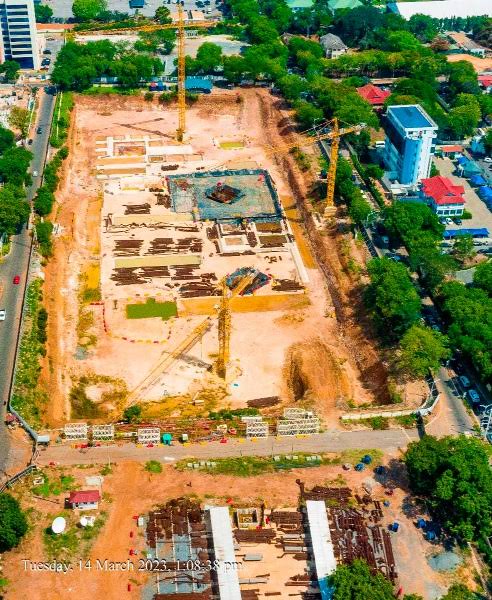
The government will not spend “one single cedi” on the National Cathedral, the Minister of Local Government, Chieftaincy and Religious Affairs, Mahama Ayariga, has said, bringing an end to years of state funding for a project that has become one of Ghana’s most controversial and costly national undertakings.
Speaking at a press briefing at the Jubilee House in Accra on Monday, October 5, 2026, Mr Ayariga said the decision reflects President John Dramani Mahama’s position that the state could no longer finance the project, which had been abandoned before this government took over office in January 2025.
“Government is not going to put one single cedi in any further construction work at the National Cathedral site, so no government money is going into the construction of a National Cathedral,” he said.
A Personal Pledge That Became a National Burden
The National Cathedral project was announced in March 2018 by former President Nana Addo Dankwa Akufo-Addo as a personal promise to God following his 2016 election victory. The proposed cathedral, designed by renowned British-Ghanaian architect Sir David Adjaye, was envisioned as a major national religious infrastructure project and a symbol of Ghana’s Christian heritage.
What began as a personal pledge, however, quickly evolved into a state-backed undertaking with significant public funding. The project’s financing, expenditure and progress have since drawn intense public debate, particularly amid Ghana’s broader economic difficulties and competing demands for investment in healthcare, education and essential infrastructure.
Nearly a decade after its announcement, Ghanaians have nothing to show for an expenditure of approximately US$97 million beyond a massive hole in the ground in central Accra — a site that has been described as a prime breeding ground for mosquitoes.
Board Dissolved, Site Reverts to State
Mr Ayariga said members of the Board of Trustees, set up to oversee construction, had been formally notified of its dissolution. With no public funds going into the project, he explained, the board was no longer relevant as an agency of government.
The dissolution was communicated in a letter dated September 18, 2026, signed by Mr Ayariga and addressed to the Chairman and members of the Board, chaired by Apostle Professor Opoku Onyinah. The trustees were directed to liaise with the project consultant and formally hand over the National Cathedral project site to the Ministry by October 31, 2026.
“Given that the National Cathedral is a property of the Government of Ghana, I’ve also directed the contractor to hand over the site to the Minister of Local Government and Chieftaincy and Religious Affairs,” Mr Ayariga said. The ministry will retain control until a decision is made on the project’s future.
The dissolution followed months of uncertainty. In July 2025, government announced plans to dissolve the National Cathedral Secretariat and begin the process of disbanding the Board following an audit into the project. However, some members of the Board remained in office, saying they had not received formal written instructions asking them to leave.
Forensic Audit with Attorney-General
Mr Ayariga said what happens next depends on the Attorney-General’s review of a forensic audit into spending on the project under the past administration.
“After the Attorney General has reviewed the audit, and based on the Attorney General’s advice, we would know what the next steps are,” he said.
The forensic audit was conducted after an earlier audit by Deloitte and Touche uncovered financial irregularities but did not establish the full extent of the issues or identify those responsible. The PwC-prepared forensic audit report was presented to Attorney-General and Minister for Justice Dr Dominic Ayine on Friday, August 7, 2026.
President Mahama has disclosed that almost US$90 million had been spent on the National Cathedral. He said the forensic audit into the expenditure had been completed and was currently with the Attorney-General, and that he intended to share a copy with the Christian Council of Ghana for review.
The review, he said, would allow the Christian Council to examine the processes through which the money was spent and determine whether any corrective action was required.
Attorney-General Ayine has criticised the expenditure, arguing that funds committed to the project could instead have been used to complete some of the stalled hospitals under the former government’s Agenda 111 programme.
“The PwC report on the National Cathedral was presented to me last Friday. The monies spent on the National Cathedral from that report could have been used to complete some Agenda 111 Hospitals,” Dr Ayine said during the district launch of the Free Primary Health Care programme in the Bolga East Constituency of the Upper East Region on August 13, 2026. “You don’t build a house of God in the manner in which they went about it.”
President Mahama: Let the Church Fund It
President Mahama has consistently maintained that construction should not depend on public funds. Speaking during a citizens’ engagement in Wa on September 12, 2026, the President said he had no objection to the construction of a national cathedral because he was a practising Christian, but insisted the project should be treated differently from other policies inherited from the previous administration.
“My second problem was that we shouldn’t use taxpayers’ money,” President Mahama said. “If we all pay a thousand cedis each, we should be able to construct a national cathedral.”
He compared the National Cathedral project with the National Mosque, which he said was constructed without government funding through support from a Turkish Muslim non-governmental organisation.
The President also questioned the location chosen for the cathedral in central Accra, saying the area already housed several major public institutions and facilities, including Parliament, the International Conference Centre, the Greater Accra Regional Hospital and the National Theatre. He cited the demolition of 10 judges’ residences, the residence of the Malian ambassador — which he said had yet to be replaced — the old passport office and other properties.
Opposition Pushback
The dissolution of the Board and the government’s decision not to fund the project have drawn criticism from the opposition. Minority Leader Alexander Afenyo-Markin has defended the National Cathedral project, arguing that it was a national undertaking rather than a personal promise by former President Akufo-Addo.
Critics have also pointed to the broader implications of the expenditure. The Attorney-General’s remarks have reignited debate over whether the scale of public resources committed to the project was justified when essential healthcare infrastructure across the country remained unfinished.
What Happens Next
With the Board of Trustees dissolved and the site reverting to the Ministry of Local Government, Chieftaincy and Religious Affairs, the immediate future of the National Cathedral rests on the Attorney-General’s review of the forensic audit. The findings will determine whether any legal action follows and what becomes of the site that has consumed nearly a decade of public debate and millions of dollars in state funds.
For now, the government’s position is unequivocal: no more public money will go into the construction of a National Cathedral.


