



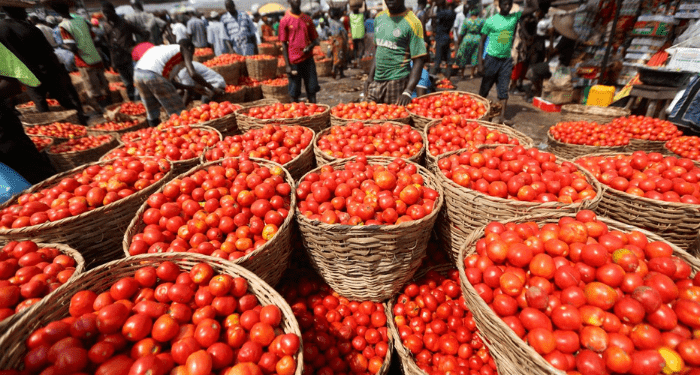
Fresh tomatoes, rent payments and ginger were the biggest contributors to Ghana’s 5.2% inflation rate in September 2026, highlighting the uneven price pressures facing households despite the sharp decline in inflation over the past year.
According to data from the Ghana Statistical Service, fresh tomatoes alone accounted for 20.3% of the September inflation rate, followed by rent payments at 13.9% and ginger at 9.9%. Cooked rice contributed 7%, while bus and trotro fares and yam each contributed 5.4%.
Presenting the detailed inflation figures in Accra, the Government Statistician, Dr. Alhassan Iddrisu, said the headline rate masks significant differences in price movements across individual items.
“We are talking about one national rate of 5.2% at the end of September 2026, which contains very different experiences in the market,” he said.
The September rate represents a marginal increase from 5.0% in August, marking the second consecutive monthly rise after inflation fell to 3.2% in March — its lowest level since 1999. On a year-on-year basis, however, the rate remains 4.2 percentage points lower than the 9.4% recorded in September 2025.
Tomato Prices More Than Double
Fresh tomatoes recorded the highest inflation rate among the items tracked in September, with prices rising by 153.4% compared with September 2025. The Government Statistician explained that this means tomatoes cost roughly two and a half times what they did a year earlier.
Ginger followed with inflation of 100.4%, meaning its price approximately doubled over the same period.
Other items recording some of the highest inflation rates were shrimps at 62.8%, mangoes at 46.6%, and packing space and related services at 40%.
The figures have raised concerns about the impact of fresh food supply on overall inflation, with tomatoes and ginger alone accounting for about 30% of the national inflation rate.
“Also, pay attention to fresh food supply, since tomatoes and ginger alone contribute about 30% of inflation,” Dr. Iddrisu said.
The sharp rise in tomato prices is not new. In August, fresh tomatoes had already recorded a 158.3% year-on-year increase, contributing 21.4% to the overall inflation rate at the time. The persistent price pressures reflect structural challenges in Ghana’s fresh produce supply chain, including post-harvest losses estimated at $2 billion annually — equivalent to 30% of all agricultural produce. The government’s Feed Ghana Programme, launched in 2025, has sought to address these challenges through increased domestic production, with 500 hectares at the Kono Irrigation Site earmarked for tomato cultivation and a special tomato production programme being implemented in 130 communities across 35 districts.
Food Inflation Rises but Remains Below Year-Ago Levels
Food inflation increased from 3% in August to 4% in September, although it remained well below the 11% recorded a year earlier. Food prices rose by 1.5% during the month, after falling by 2.6% in August.
Dr. Iddrisu noted that food accounted for about 37% of the overall inflation rate, while non-food items remained the bigger contributor at 63%. Non-food inflation, however, eased from 6.8% in August to 6.2% in September.
Some Food Items Become Cheaper
While some food items recorded sharp price increases, others became significantly cheaper compared with a year ago.
Lime recorded the largest price decline, falling by 29.9%, followed by maize at 26.4%, foreign apples at 24.1%, bambaran beans at 21.7% and carrots at 21.5%.
The contrasting movements underscore the wide differences in price experiences across Ghana’s markets. In February 2026, fresh produce including garden eggs, tomatoes and maize had recorded sharp declines that helped ease overall food inflation to 3.3% — the lowest level in nearly three decades.
Services Remain a Key Pressure Point
The Government Statistician also identified services as a major area of concern, with services inflation standing at 8.3% in September. This compares with goods inflation of 4.2%, meaning prices for services are rising at nearly twice the pace of goods.
“Services inflation is at 8.3 percent at the end of September 2026, and they are the last hurdle for us to deal with, rising twice as fast as goods, which recorded inflation of 4.2 percent,” Dr. Iddrisu said.
Housing, water, electricity, gas and other fuels recorded the highest inflation rate among major spending categories at 10.3%, down from 11.6% in August. Restaurants and hotels recorded inflation of 9.2%, while transport stood at 7%.
The persistent services inflation reflects a pattern that has frustrated households throughout 2026. A “Cost of Living Outlook Report” published in April found that 58% of respondents said electricity costs were high, 53% cited public transport as expensive, and 47.7% described food costs as high.
Inflation Is ‘Homegrown’
The presentation further showed that Ghana’s inflation is largely being driven by domestically produced items. Local items accounted for about 86% of inflation in September, while imported items contributed the remaining share.
“Inflation is homegrown, with local items driving about 86% of inflation in September 2026,” the Government Statistician said.
The dominance of domestic drivers marks a significant shift from previous years when exchange-rate depreciation amplified the cost of imported goods. The cedi, which traded at about GH¢14.71 to the US dollar at the end of 2024, appreciated significantly in 2025 and has since stabilised around GH¢11.02 to the dollar. The relative strength of the cedi has prevented global commodity price increases from being compounded by currency depreciation, with imported inflation standing at just 2.2% in August compared with 6.1% for locally produced items.
Regional Differences Remain Significant
The national inflation rate also masks substantial differences across regions. Dr. Iddrisu noted that inflation ranged from 9.8% in the Ashanti Region to negative 0.5% in the Western Region.
Four regions recorded rates above the national average. The Eastern Region recorded 7.8%, while the Greater Accra Region stood at 3.4%. The Western Region’s negative inflation rate means prices there were slightly lower overall than they were in September 2025.
“But not least, where you live matters, from 9.8% in the Ashanti Region to negative 0.5% inflation in the Western Region,” he said.
He said the figures should therefore be used by policymakers, businesses and households to better understand where cost-of-living pressures are strongest.
Path to Macroeconomic Stability
The September figures cap a remarkable disinflation journey for Ghana. Headline inflation fell from 23.8% in December 2024 to 9.4% in September 2025 — a sustained shift that signalled the country was firmly on the path to macroeconomic stability. By February 2026, inflation had dropped to 3.3%, its lowest level since August 1999.
The decline was driven in part by the government’s Feed Ghana Programme, which the Agric Minister credited with reducing food inflation from 28.3% in January 2025 to 2.2% in April 2026 — the lowest food inflation rate in the country’s recorded history.
The Bank of Ghana responded with an aggressive easing cycle, cutting its policy rate by 250 basis points in January 2026 to 15.50% before reducing it further to 14% in March. The central bank maintained the rate at 14% at its September 2026 meeting, the third consecutive hold, as the Monetary Policy Committee assessed risks to inflation and growth as “broadly balanced.”
However, the recent uptick in inflation — from a low of 3.2% in March to 5.2% in September — has raised questions about whether the disinflation trend has run its course. Databank Research had projected a further 150-basis-point cut to 12.5% at the September meeting, but the central bank opted to hold steady, citing rising global prices, transport costs and renewed conflict in the Middle East as upside risks.
The transport sector added to cost pressures in late September when public transport fares increased by 8%, the first official upward adjustment since a 15% decrease in May 2025. A standard intra-city fare of GH¢5 rose to GH¢5.50, while passengers paying GH¢10 now pay GH¢11.
What the Data Means for Different Ghanaians
For government, the Ghana Statistical Service recommended using the official Consumer Price Index to guide budgets, subsidies and targeted support.
Businesses were also encouraged to use official inflation data when setting prices and negotiating contracts rather than relying on market rumours.
For households, Dr. Iddrisu pointed to the moderation in food inflation, which fell to 4% in September from 11% a year earlier, as providing some room for planning and saving.
“With inflation easing, families can plan their budgets with greater confidence. This is the time to track spending on food, rent, and school fees, avoid non-essential expenses, and set aside small savings whenever possible to strengthen household finances,” he said in a previous briefing.
Yet the gap between the headline rate and lived experience remains wide for many. With rent alone contributing nearly 14% to inflation and services prices rising at twice the pace of goods, households with significant spending on housing, education and daily commuting are likely experiencing inflation well above the national figure.
The Bank of Ghana targets an inflation rate of 8% with a tolerance band of 2 percentage points on either side. With headline inflation now at 5.2% — below the lower bound of that band — the question for policymakers is whether the recent uptick is a temporary blip or a signal that the disinflation gains of the past two years are under threat. The October inflation reading, due in early November, will offer the first indication of whether September’s rise marks the beginning of a new trend or a fleeting interruption in Ghana’s economic recovery.


