



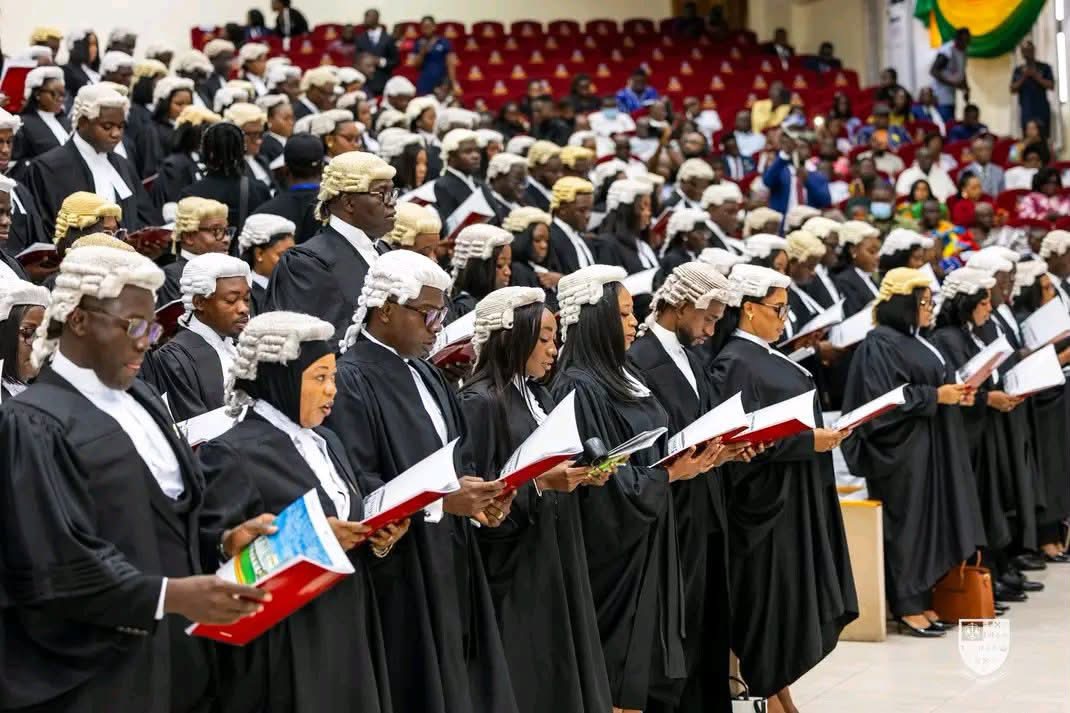
In Ghana today, everybody is becoming a lawyer. Actors, journalists, chiefs, public servants, lecturers, engineers, bankers, doctors, and more. The reason, according to commentator Albert Nat Hyde, is simple: law has become one of the easiest and fastest routes into politics and Parliament.
His comments come as 1,568 newly qualified lawyers were called to the Ghana Bar on Friday, October 9, 2026, at the Ghana School of Law’s 63rd Call to the Bar ceremony held at the ICGC Christ Temple in Teshie, Accra. Among them were four Members of Parliament — Samuel Nartey George (Ningo-Prampram, Minister of Communication, Digital Technology and Innovations), Emmanuel Armah-Kofi Buah (Ellembelle, Minister of Lands and Natural Resources), Davis Ansah Opoku (Mpraeso), and Phyllis Naa Koryoo Okunor (Awutu Senya East) — and three media practitioners: Umaru Sanda Amadu of Channel One TV and Citi FM, Naa Ashorkor Duodu of TV3, and Ayisha Ibrahim.
“A country approaching 70 has over-glorified the legal profession, turning it into a status symbol, while we continue to grapple with basic systemic problems such as water, sanitation, poor roads, and children studying under trees,” Hyde wrote.
From 11 Lawyers to 12,000 — and Counting
Ghana’s legal profession has undergone a dramatic transformation since independence. In 1957, the year Ghana became the first sub-Saharan African nation to gain independence from colonial rule, the country had just 11 lawyers. Today, that number has surpassed 12,000, according to Ghana Bar Association President Efua Ghartey, who disclosed the figure at the Association’s 2026/2027 Annual Conference in Ada.
The growth has accelerated sharply in recent years. In 2022, an unprecedented 1,075 lawyers were called to the Bar. That number rose to 1,092 in 2023, before dipping to 959 in 2024 and 945 in 2025. In 2026, the figure climbed again to 1,568 — the largest single cohort in recent memory.
Between 2020 and 2026, more than 7,000 lawyers have been called to the Bar.
But the surge in numbers has not been matched by a surge in impact, according to Hyde. “After all, we are yet to see enough lawyers championing causes such as ensuring that teachers and nurses are paid on time without having to take to the streets to demand their salaries, or pushing for systemic reforms that guarantee jobs for graduates after their National Service.”
The Prestige Paradox: A Nation of Arguers, Not Builders
Hyde’s critique echoes a growing chorus of concern about Ghana’s career priorities. In October 2025, a viral social media post asked: “So You’re Telling Me We Have More Lawyers Than Functional Drainage Systems?” The satire, though humorous, exposed what many see as a structural imbalance in Ghana’s education and employment landscape — a nation producing lawyers faster than it produces engineers, scientists, or innovators.
Sir Sam Jonah, Chancellor of the University of Cape Coast and one of Africa’s most respected businessmen, put it bluntly: “You cannot litigate yourself into development.” Speaking in an interview with Starr FM in October 2025, he warned that Ghana has lost its sense of priority. “You can produce all the lawyers, but a country that is producing more lawyers than engineers, scientists, and physicists means there’s something wrong. It’s the government that fixes it.”
The data supports the concern. Ghana produces over 4,000 LLB graduates each year, yet physics departments graduate fewer than ten students annually. In 2025 alone, of the over 4,036 LLB graduates who sat the entrance examination for the Professional Law Course at Makola, only 2,042 were admitted, alongside 390 repeat students. Only about 28 to 29 percent of LLB graduates gain admission to the Ghana School of Law annually, leaving thousands of qualified candidates frustrated and an estimated backlog of 5,000 to 8,000 graduates unable to practise despite holding law degrees.
Why Everyone Wants to Be a Lawyer
The reasons are both cultural and pragmatic. Ghanaian society has long glamorised titles — Lawyer, Doctor, Manager — while undervaluing technical and craft-based work. Engineering students are often treated as “mechanics with degrees,” while artisans are dismissed as “uneducated.” Yet, as Hyde notes, “the ultimate flex after being called to the Bar is taking fancy pictures to make others feel they chose the wrong profession.”
For many, law also offers a pathway to political relevance. Parliament has long been populated by lawyers, and the profession is seen as a credential that confers authority in public life. The 2026 Call to the Bar ceremony underscored this: four sitting MPs, including two ministers of state, were among the inductees.
The crossover is not limited to politicians. In October 2025, celebrated media personality Serwaa Amihere of GHOne TV was called to the Bar, alongside several other journalists. Asempa FM’s Philip Osei Bonsu, host of the popular Ekosiisen show, was called to the Bar in 2024. Obrempon Hima Dekyi XIV, the Western Region’s first paramount chief, was also among those inducted in 2025. Gifty Afenyi-Dadzie, former President of the Ghana Journalists Association and a member of the Council of State, was called to the Bar in May 2024 at the age of 66.
“Imagine Bernard Avle quitting journalism to become a lawyer. Who would be asking the hard questions?” Hyde asked.
Legal Education Reform: Opening the Floodgates
The surge in lawyer numbers is partly a consequence of deliberate policy reform. In May 2026, President John Dramani Mahama signed the Legal Education Act, 2026 (Act 1170) into law, ending the Ghana School of Law’s 66-year monopoly on professional legal training. The new law allows multiple accredited institutions to offer the professional law course under the supervision of a new Council for Legal Education and Training.
The reform was designed to address a longstanding bottleneck that had left thousands of qualified LLB graduates stranded. But it has also raised questions about whether Ghana is expanding the right profession. As Hyde puts it: “If we study the development stories of Singapore, Malaysia, and China, we will see that nations are not built on arguments alone. They need thinkers, builders, engineers, innovators, and visionary leaders.”
The Politicisation of the Bar
The growing political influence within the legal profession has not gone unnoticed. In May 2026, private legal practitioner Maurice Ampaw criticised the Legal Education Bill, warning of “the growing politicisation of the legal profession,” which he said “will produce incompetent lawyers — lawyers who don’t have the moral character and proven integrity.”
Tensions between the Ghana Bar Association and political actors have flared repeatedly. In September 2026, the GBA faced accusations of partisanship after issuing a statement that critics said suggested lawyers were above arrest. Former Supreme Court judge Justice William Atubiga accused the GBA of finding its voice only when the National Democratic Congress is in power, while NDC MP Rockson-Nelson Dafeamekpor described the Association as the New Patriotic Party’s “ventilating association.”
Attorney-General and Minister for Justice Dr Dominic Akuritinga Ayine has urged the GBA to strengthen its independence from political parties and remain focused on defending the public interest.
A Slippery Slope
Hyde warns that Ghana is heading down a dangerous path. “If we want real development, we must allow journalists to be journalists, engineers to be engineers, and lawyers to be lawyers, rather than treating the legal profession as the ultimate destination for everyone seeking influence.”
He acknowledges that lawyers are indispensable in any modern economy. “Lawyers are, at their core, trained to argue, debate, and litigate.” But he argues that a country cannot build roads, bridges, drainage systems, or power plants through litigation alone.
“Ghana needs builders, not just talkers,” he concludes.
The question, as the 1,568 newest members of the Bar begin their careers, is whether the profession will produce the champions of systemic reform that Hyde and many Ghanaians are waiting for — or simply more of the same.


