



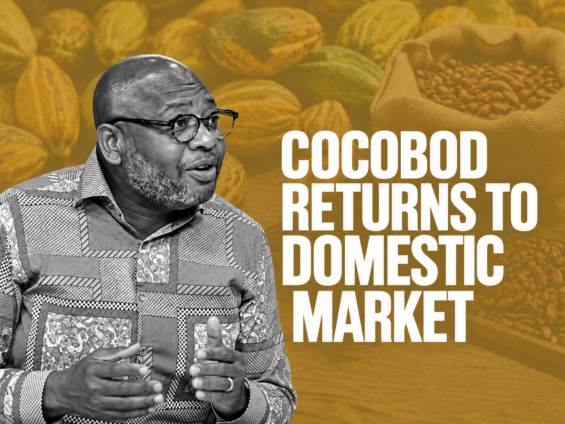
The Ghana Cocoa Board (COCOBOD) has raised approximately GH¢3.39 billion (US$288.02 million) through its first commercial paper issuance under a landmark domestic financing programme, falling about GH¢610 million short of the GH¢4 billion indicative target presented to investors.
The funds were raised through Cocoa Capital PLC, the wholly owned special-purpose vehicle established by COCOBOD in August 2026 to borrow from investors under its new domestic financing model. According to published results, GH¢3.39 billion was allotted at a yield of 11%. The notes were issued on October 5, 2026, and will mature on June 28, 2027.
The amount represents approximately 85% of the initial GH¢4 billion financing plan for the first tranche. However, the GH¢4 billion was an indicative figure in the investor presentation. That distinction matters because the amount accepted is not necessarily the total amount investors offered. The published results do not state how much COCOBOD received in bids or whether some were rejected. It is therefore unclear whether investors offered less than expected, demanded rates COCOBOD was unwilling to pay, or whether the company decided to raise a smaller amount.
The issuance also took place later than initially planned. Cocoa Capital’s September 25 announcement set out an indicative timetable for bidding to close on September 30, followed by settlement and issuance on October 1. The notes were eventually issued on October 5, four calendar days later. Their duration was also reduced from 270 to 266 days. The final yield of 11% was at the upper end of the initial guidance of 10.5% to 11%.
These developments raise questions about how readily COCOBOD was able to secure the funds on its preferred terms. But without the full bidding results, they do not explain why it raised less than initially envisaged.
A Historic Shift Away From Syndicated Loans
The first issuance forms part of a programme allowing up to GH¢16.3 billion in notes to be outstanding at any time. Approximately GH¢14 billion is intended to finance cocoa purchases through commercial paper, while GH¢2.3 billion in longer-term bonds is intended to refinance existing COCOBOD debt.
The programme represents a historic shift in how Ghana finances its cocoa sector. For more than three decades, COCOBOD relied on annual syndicated loans from international banks to pre-finance cocoa purchases, using expected export revenues as collateral. That arrangement, in place since the 1992/93 season, collapsed during the 2023/24 cocoa season after Ghana failed to honour contractual obligations, including the supply of 800,000 tonnes of cocoa sold under forward contracts. The failure destroyed COCOBOD’s credibility with international lenders, leading to a total lack of seed funding for the 2024/25 season.
A subsequent arrangement under which international cocoa traders financed purchases through an “80/20” model also broke down. As global cocoa prices plummeted from $6,400 to approximately $4,200 per tonne, traders became reluctant to pay the high upfront sums sought by Ghana, contributing to delays in payments to farmers during the previous season.
COCOBOD’s Deputy Chief Executive in charge of Finance and Administration, Ato Boateng, has insisted the shift to domestic financing was a deliberate strategic choice, not a forced retreat. “Since I took this position over 18 months ago, I’ve had a lot of international banks coming to Cocoa Board to talk about Cocoa Board re-entering the market at the international level. It is not that we are forced out of the market,” he said on Channel One TV’s The Point of View in September 2026. “I don’t like fair-weather friends. You don’t run away from Cocoa Board when we have difficulties, and then when we have weathered those difficulties, then you show up.”
Mr Boateng also cited the relative stability of the cedi as a key factor. “This change is as a result of the currency stability that we want in the country. Historically, the syndication brought in a lot of money and given the new macro environment, the cedi-dollar exchange rate would want to stabilise it,” he said.
A Balance Sheet Under Pressure
The new financing model comes as COCOBOD grapples with a deeply strained balance sheet. The Board entered 2025 owing approximately GH¢32.9 billion, with roughly GH¢11.9 billion due for repayment that year alone. Licensed Buying Companies were owed about GH¢10.1 billion, contributing to payment delays to farmers and operational disruptions across the value chain.
COCOBOD failed to deliver more than 330,000 tonnes of cocoa sold under forward contracts before global prices surged in 2023/2024, resulting in losses estimated at over US$1 billion and further damaging its credibility with both domestic and international lenders. By the end of 2024, COCOBOD recorded a negative equity position of about GH¢3.8 billion, meaning its liabilities exceeded its assets for the first time in its 79-year history.
The Board’s financial performance has been volatile. Its half-year profit fell 67% to GH¢2.1 billion for the six months to March 2026, even as export prices jumped 46%. Nine-month profit collapsed 87% to GH¢1.08 billion, with cash and cash equivalents falling 63.3% to just over GH¢1 billion. Total liabilities rose 28.6% to GH¢34.7 billion.
However, operating revenue rose to GH¢48.6 billion in 2025 from GH¢15.8 billion in 2024, while net profit margin improved to 10.4% from a negative 35.1%, suggesting early signs of stabilisation.
COCOBOD has taken steps to normalise its financial position. In September 2026, it settled GH¢2.31 billion to complete its mandatory Domestic Debt Exchange Programme bond obligations for the year, bringing total payments to DDEP bondholders in 2026 to GH¢2.68 billion. The government is also converting COCOBOD’s legacy debt owed to the Ministry of Finance and Bank of Ghana into equity, while cocoa road contracts are being transferred to the Ministry of Finance to enable COCOBOD to focus on its core mandate. Remaining liabilities mainly consist of cocoa bonds, bills, and a US$70 million bridge facility.
Regulatory Reforms and Producer Price Increase
The domestic financing programme is part of a broader cocoa sector reset agenda underpinned by the new Ghana Cocoa Board Act, 2026. The legislation provides for an automatic producer price adjustment mechanism linked to international market prices, exchange rates, and other relevant variables, while guaranteeing farmers at least 70% of the gross FOB price.
Ahead of the 2026/27 season, COCOBOD increased the producer price of cocoa from GH¢41,392 per tonne to GH¢42,400 per tonne, effective September 25, 2026. The new price translates into GH¢2,650 per 64-kilogramme bag. The government is also targeting at least 50% of Ghana’s cocoa beans to be processed locally from the 2026/27 crop season, a significant increase from current levels.
How the Funds Will Be Secured and Used
Repayment obligations under the programme are supported by receivables from selected executed cocoa forward sales contracts assigned to Cocoa Capital PLC. Proceeds from these contracts flow through designated ring-fenced accounts held with appointed account banks and are applied in accordance with the programme’s payment waterfall. About 14% of the funds raised will be used to finance COCOBOD’s legacy debts.
The bookrunners for the programme are Absa Bank Ghana Ltd, CalBank PLC, Fincap Securities Ltd, GCB Bank PLC, One Africa Securities Ltd, and Stanbic Bank Ghana Ltd.
Cocoa Capital PLC was incorporated on August 7, 2026, under the Companies Act, 2019, with an initial paid-up capital of GH¢5 million. Its principal purpose is to raise funds and apply the proceeds to approved cocoa-sector financing and refinancing activities.
Unresolved Questions
There is an unresolved question over how the first GH¢3.39 billion will be used. The investor presentation assigned commercial paper to cocoa purchases. The issuance announcement, however, also listed repayment of a bridge loan obtained to refinance COCOBOD’s legacy debt. The latest notice does not disclose how much will be used to purchase cocoa and how much, if any, will repay that loan. The prospectus says details of bridge funding should be disclosed in the relevant pricing supplement, the document setting out the terms of each issuance. As of October 8, that document was not available on Cocoa Capital’s website.
COCOBOD to Return to Market Shortly
COCOBOD has indicated it could return to the market shortly. Mr Boateng indicated in his September 28 interview that COCOBOD could return to the market about two weeks after the first issuance. “Maybe two weeks later… we’ll come in and then do another tranche, and then we’ll finally look at the GH¢2.3 billion, which is the longer term,” he said.
The first offer gives COCOBOD a basis for deciding how much to seek next and at what price. Whether investors will provide more money on similar terms remains to be seen.
The Road Ahead
The transition to domestic financing transfers more of the financing risk to the domestic market and to COCOBOD’s balance sheet. The 11% interest rate and the June 2027 maturity mean the regulator must generate sufficient cash flow to repay the borrowing while continuing to finance cocoa purchases and meet existing obligations.
Analysts have cautioned that large-scale domestic issuance could crowd out private sector credit or push domestic yields higher if investor demand proves insufficient to absorb the volume. Governance consultant Dr. Richmond Akwasi Atuahene has warned that the post-DDEP trust deficit among investors remains a central obstacle and that the bonds may need to be priced 200 to 400 basis points above government securities to attract institutional investors.
What will make this season different will not be the announcement of the financing programme alone. It will depend on whether the remaining tranches are raised on schedule, whether the proceeds are ring-fenced and disbursed promptly, and whether Licensed Buying Companies receive enough liquidity to pay farmers without relying on their own limited resources.
For now, the amount raised is known. How much investors offered, why COCOBOD accepted less than its initial financing plan, and how the money will be divided between cocoa purchases and debt repayment remain unclear.


