



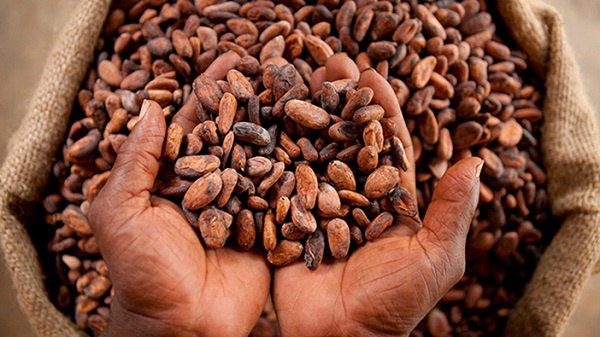
Cocoa prices have risen by 95.1% since the beginning of March 2026, driven by mounting fears of reduced crop yields in the 2026/27 season as El Niño weather conditions take hold in West Africa, according to a new report from Fitch Solutions.
The UK-based research firm said higher cocoa prices will partly offset lower production volumes in nominal export terms, but the benefit to Ghana — the world’s second-largest cocoa producer — could be significantly muted by government-controlled pricing mechanisms and a widening gap between global and farmgate prices.
A Dramatic Price Rebound
The price surge marks a sharp reversal from the market’s collapse earlier in the year. Global cocoa prices had plunged from a historic peak of nearly $13,000 per tonne in 2024 — the highest level since the 1970s — to approximately $3,000 per tonne in early April 2026, a decline of more than 75% in just over a year. The unprecedented 2024 rally, which saw prices breach $10,000 for the first time on March 26, 2024, and touch $12,646 by December, was driven by three consecutive years of global cocoa deficits caused by climate-related supply disruptions in West Africa, ageing trees, and the spread of swollen shoot virus and black pod disease.
Fitch Solutions now forecasts cocoa prices to average US5,670 per tonne in 2027 — which, while below the levels seen in 2024 and 2025, remain well above the 2014–2023 average of US$2,642 per tonne. BMI, a Fitch Solutions company, had raised its 2026 forecast from a prior projection of $4,000 per tonne, citing a significant repricing through the second half of 2026, with prices averaging $5,870 per tonne in Q3 and $6,175 per tonne in Q4.
El Niño Threatens Production
El Niño’s adverse weather conditions are expected to place downward pressure on the 2026/27 cocoa output, with Fitch Solutions forecasting cocoa production of 1.7 million tonnes in Côte d’Ivoire and 670,000 tonnes in Ghana. This implies greater near-term supply pressure in Côte d’Ivoire, where output is forecast to decline by 17.5% year-on-year, while Ghana’s production is expected to remain flat.
Other forecasts paint a similar picture. Commodities broker StoneX said the global cocoa surplus could shrink to 25,000 metric tons in 2026/27 from a projected 422,000 tons in the current season, with Côte d’Ivoire’s output expected to fall 11% to 1.7 million tons and Ghana’s harvest forecast to contract 10% to 585,000 tons. BMI expects the global surplus to fall from 442,000 tonnes in 2025/26 to just 82,000 tonnes in 2026/27. Ghana’s Cocoa Board itself warned in July that 2026/27 production could fall to between 450,000 and 550,000 tonnes, citing swollen shoot disease, aging cocoa farms and adverse weather.
Ghana’s production had shown signs of recovery in 2025/26, reaching approximately 771,000 tonnes — about 18.6% above COCOBOD’s initial forecast of 650,000 tonnes. But that increase was partly driven by smuggled beans from neighbouring countries. Overall, national output for 2025/26 remained far below the 1,047,385 tonnes recorded in 2021.
The Price Gap: Why Ghana May Not Cash In
According to Fitch Solutions, the benefit of higher global prices will be most pronounced in Nigeria and Cameroon, where liberalised pricing mechanisms allow domestic prices to move more closely with global cocoa prices. By contrast, gains will be more muted in Côte d’Ivoire and Ghana, where government-operated pricing mechanisms determine domestic cocoa prices. Both countries also forward-sell their cocoa crop, usually three-to-six months ahead, which means there will be a lag before higher prices are reflected.
Under a new law, Ghana’s price will no longer be fixed for the full season; the Ghana Cocoa Board will instead review it periodically, a shift from Côte d’Ivoire’s fixed seasonal pricing model. COCOBOD raised the producer price for the 2026/27 season to GH¢42,400 per tonne, a 2.4% increase from GH¢41,392. The new price represents 71.18% of the realised Free-On-Board (FOB) value of US$2,650 per tonne, reflecting the government’s commitment to ensuring farmers receive a significant share of the value generated from their produce. The Ghana Cocoa Board Act, 2026, provides for an automatic adjustment mechanism linked to international cocoa prices and guarantees farmers at least 70% of the gross FOB price.
Yet, structurally higher cocoa prices are unlikely to deliver a major windfall for African producers. The feedthrough of higher international prices to local farmers remains limited by the fiscal and operational constraints of national marketing boards, which limit the extent to which governments can pass on global price gains to farmers.
Smuggling Threat Intensifies
Fitch Solutions warned that higher cocoa prices will increase the incentive for farmers in Ghana and Côte d’Ivoire to sell outside official channels, amplifying export losses in both markets.
“When global prices rise well above domestic farmgate prices, farmers have a stronger incentive to move cocoa into neighbouring countries where they can capture higher returns,” the report stated. “In both 2024 and 2025, when global cocoa prices reached record highs, neighbouring economies such as Guinea and Togo saw steep increases in cocoa exports despite not possessing large domestic cocoa industries. A renewed rise in smuggling would therefore further reduce officially recorded cocoa exports from Ghana and Côte d’Ivoire”.
The smuggling problem is already acute. Cocoa smuggling to neighbouring Togo and Côte d’Ivoire between 2022 and 2025 cost Ghana a total of US$1.1 billion, according to official estimates. In early 2024, COCOBOD estimated that roughly 160,000 tonnes — about one-third of Ghana’s total crop — had left the country through informal channels. Missed deliveries reached 330,000 tonnes, while smuggling displaced an estimated 29,600 tonnes, with approximately 50,000 tonnes stranded at ports.
The smuggling routes have expanded across the Volta, Western, Western North and Bono regions, capturing volumes that would otherwise enter the formal export pipeline. In April 2026, COCOBOD’s anti-smuggling unit arrested four suspects and impounded over 100 bags of Ivorian cocoa in Nkrankwanta in the Dormaa West District, while the Bono Regional Minister warned smuggling syndicates to “prepare to face the full rigours of the law.”
The price gap has also fuelled reverse smuggling. Ghana’s farmgate price of GH¢2,650 per 64-kilogramme bag is significantly higher than Côte d’Ivoire’s 1,200 CFA francs per kilogramme, prompting Ivorian beans to flow into Ghana. Ghana’s cocoa regulator has accused some officials at licensed buying companies of diverting government funds meant to pay local farmers to purchase cheap smuggled beans from Côte d’Ivoire.
Ghana’s Cocoa Sector Under Financial Strain
The price volatility has compounded deep structural challenges in Ghana’s cocoa sector. COCOBOD entered 2025 with a cumulative debt of approximately GH¢32.9 billion, alongside declining production, eroded equity and loss-making financial statements. The sector required GH¢30.7 billion in working capital per annum to sustain operations, based on a projected output of 650,000 tonnes.
The government has initiated a comprehensive reset aimed at restoring financial viability and repositioning COCOBOD as a disciplined commercial institution. Under the new Ghana Cocoa Board Act, 2026, the government has also launched a GH¢16.3 billion Domestic Cocoa Notes Programme through Cocoa Capital PLC — a wholly owned subsidiary of COCOBOD — to finance the 2026/27 crop season. Of this, GH¢14 billion will be issued via commercial paper to fund short-term liquidity requirements for cocoa purchases, while GH¢2.3 billion will be raised through medium-to-long-term bond issuances to refinance existing COCOBOD legacy debt.
Ghana has also deployed a digital cocoa traceability system, tagging farm-sorted bags with barcodes scanned at district and port levels, feeding real-time data to a central dashboard. The system is designed to ensure compliance with the upcoming EU Deforestation Regulation, effective December 30, 2026. On June 3, 2026, COCOBOD proposed legislation imposing up to 10-year prison sentences and fines reaching five times the value of seized cocoa to deter smuggling.
A Structural Dilemma
The Fitch Solutions assessment underscores a fundamental paradox in West Africa’s cocoa economy: even as global prices remain historically elevated, the structural features of government-controlled pricing, forward-selling and cross-border arbitrage mean that the world’s largest cocoa producers may capture only a fraction of the benefit.
While Ghanaian cocoa farmers will see improved incomes relative to historical levels, they are unlikely to capture the full upside of high market prices, limiting the broader impact on household consumption and domestic demand. Meanwhile, the persistent price gap between farmgate and international prices will continue to fuel smuggling, depriving Ghana of a key source of foreign exchange and weakening its ability to absorb future external shocks.
For Ghana, the challenge is not merely whether prices will remain high, but whether the country can reform its cocoa sector’s pricing, financing and traceability systems quickly enough to ensure that the next price rally benefits farmers, the exchequer and the economy alike.


